Obsessive design disorder became a career
Issue 79: July/Aug 2011
Who can say when the first hint of the madness appeared? Was it on my first sail on a Lightning at age 12? I hadn’t been aboard for more than 15 minutes when I was working out how to make a camp cruiser out of her. Perhaps it was when I was reading Jack London’s The Sea Wolf? Pacing back and forth between chapters, I meticulously calculated how to re-rig Ghost so she could be easily singlehanded. Or maybe it was triggered by Jules Verne’s Twenty Thousand Leagues under the Sea? If ever there was a vessel in need of redesign, it was certainly the Nautilus. I bet I could still dig up some of my sketches.
You get the idea. I can’t see a boat — any boat — without feeling the urge to know how she works, how she was built, how she behaves, and then, naturally, to improve her. Hours, days, weeks of study, sketches, calculations, more sketches — if I reshaped the entry, adjusted the rudder form and location, and switched to a ketch rig . . .
This is boat noodling. A compulsion and obsession, it borders on madness. It’s a happy and benign madness, to be sure, but try to explain that to someone not so afflicted.
Since you’re reading Good Old Boat, the chances are you, too, are a compulsive boat noodler. How many boats have you looked at, dreamed of owning, schemed to improve, labored to repair? How many articles, boat books, and plans have you pored over? How many sheets of checklists and sketches are lying about your house, on the seats of your car, or on your office computer?
The fact is, I get as much satisfaction out of noodling boats as I do sailing them. Indeed, the noodling may be more than half the fun — if “fun” be the word. There are very few things that equal the deep gratification of the hours, weeks, months, even years of noodling, followed by putting your plans into effect and then seeing them come successfully to life. And that’s not even taking into account the rewards of enlightening less well-versed friends on the pros and cons of such things as high-aspect keels, cored-composite construction, proper roll period for comfort, and so on. There’s that further satisfaction in simply understanding and then discussing all these wonderful things about boats.
Most people noodle boats for a pastime. Some few of us — the most misguided — noodle boats for a living. We call ourselves naval architects or boat designers. My college friends (who call themselves doctors or lawyers or financial managers) make, oh, a fair bundle more than I’m likely to as a boat designer, but I wouldn’t trade with them for a minute. (I told you it was a madness.) Heck, I get paid to noodle boats, and it’s pretty much all I do.
Noodles begin with doodles
Professional designer or weekend sailor, it all starts with ideas. There’s a beautiful boat . . . one you’d love to own. You’d need to make her a bit longer (or shorter), maybe modify the keel design, then balance that with a modification to the rig, and — of course — the arrangement needs some adjustment. Two weeks and three pads of paper later you have a new design. Truly the one . . . until the next time — or in my case the next client.
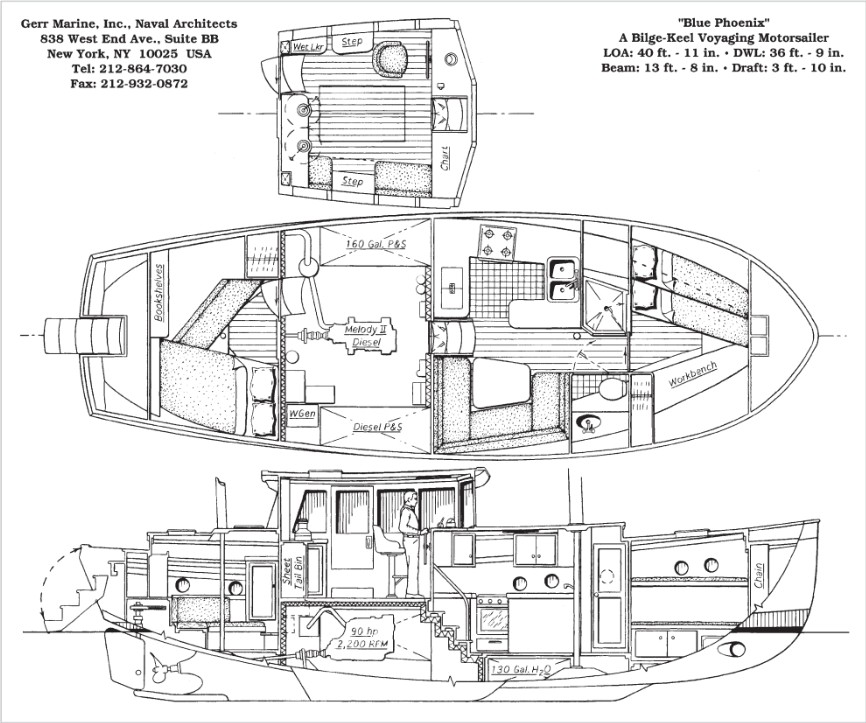
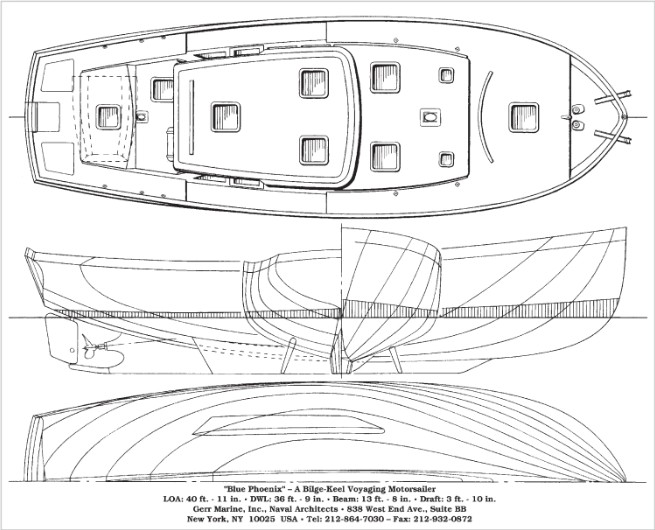
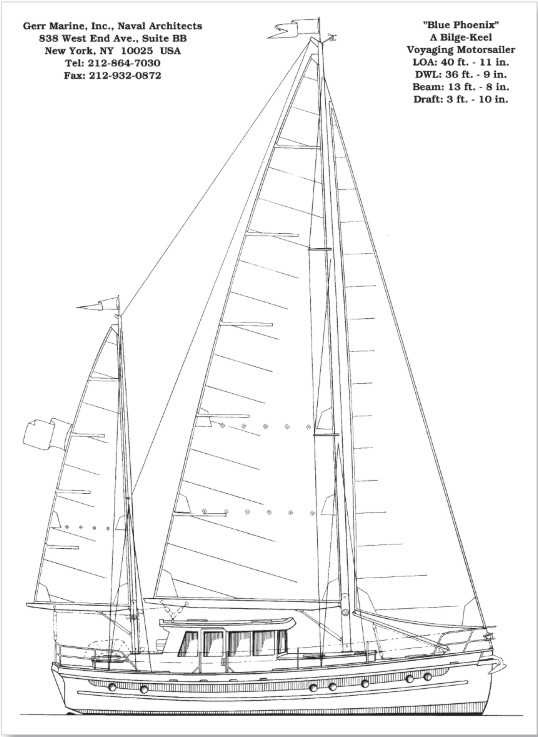
A good example is Blue Phoenix (Gerr Marine design no. 106). I started with sketches of the arrangement plan and profile, then estimated displacement and went on to preliminary calculations of the hydrostatics and sail area. From there, it was off to a more detailed preliminary lines drawing, then still more detailed arrangement sketches checked against the joiner sections. (You simply must check everything in all three views: plan, profile, and joiner sections to be sure it will really fi t into the odd shape of a boat.) Next came sketching and re-sketching the sail plan. It’s not easy getting the right amount of sail area (plenty, for Blue Phoenix) to match the righting moment of the hull and place it in the fore-and-aft location where it will give the proper balance to the helm.
Next up for consideration is the machinery: engine, tanks, exhaust run, and more — back to the sketches again. There has to be room for a properly sized propeller and access to the engine. The tank capacities need to be worked out and the tanks located so they won’t negatively affect boat trim from full to empty — back to adjust details of the arrangement and the pilothouse.
Blue Phoenix is to have less than 4-foot draft with bilge keels to take the ground upright and level anytime and in safety. Those bilge keels have to be located correctly for helm balance.
One of Blue Phoenix’s intended cruising grounds is the Baltic. It can get cold and nasty, hence the motorsailer with enclosed wheelhouse. Hmm, have to work out a way to trim the sheets from inside the wheelhouse.
What about access to the water from on deck? Can I fi t a folding transom ladder? A few sketches later and Blue Phoenix can have better than that: true fold-down transom steps integrated into the stern in the lazarette. When they’re folded up, you’ll never know they’re there. Add a counterbalance weight and the operation is effortless, one handed.
At last, it’s time to redraw everything in final form. It’s been weeks of noodling, but Blue Phoenix’s drawings have come to life.
Dave Gerr is Director of the Westlawn Institute of Marine Technology and chief designer of Gerr Marine, Inc. He’s the author of Propeller Handbook, The Elements of Boat Strength, The Nature of Boats, and Boat Mechanical Systems Handbook, all published by International Marine/McGraw-Hill.
Thank you to Sailrite Enterprises, Inc., for providing free access to back issues of Good Old Boat through intellectual property rights. Sailrite.com