An old-world technique avoided a budget-busting haulout
Issue 81 : Nov/Dec 2011
Throwing money at a problem may bring the quickest and easiest resolution, but the less expensive alternatives often provide better rewards — not only more money kept in the sailing kitty, but also improved seamanship, a real sense of accomplishment, and greater resilience for the next challenge.
When my 32-foot steel ketch, Kuan Yin, needed a new Cutless bearing in the middle of a 2,000-mile voyage from the Great Lakes to the Atlantic Ocean, the unexpected expense of a haulout was simply not in my budget. I decided instead — on the suggestion of the mechanic who would be doing the work — to take advantage of the large tides on the St. Lawrence River in Quebec.
I was on my way from Toronto to Newfoundland, singlehanded, on a shakedown cruise for the boat and for me. It was the first leg of a challenging venture: I planned to retrace an extraordinary voyage made in 1811 by an Inuit sea captain and his family who risked their lives to take two missionaries 1,400 miles north along the remote coast of Labrador into Ungava Bay (the “teacup” just east of Hudson Bay).
A solid, well-found boat
Kuan Yin is a Tahitiana 32, Weston Farmer’s adaptation for homebuilders of John Hanna’s Tahiti Ketch, which itself was adapted from Colin Archer’s famous 19th-century lifeboat for the Norwegian fishing fleet. The Tahitiana is the antithesis of modern raceboat-influenced cruising boats, but she’s perfect for a trip in the rough North Atlantic. She handles bigger seas and remains comfortable, holds a course well, and was designed, above all, to be seaworthy and seakindly. She’s a double-ender, with an exterior-hung rudder, a full keel, and sidedecks wide enough to sleep on comfortably. Down below, the main cabin seems narrower than in modern sailboats with a comparable 10-foot beam. However, this does keep all handholds within easy reach, a clear advantage for heavy-weather sailing.
Kuan Yin had new electronics, a new charging system, and modified running rigging. I’d recently completed an intense training course, but I still felt green and lacking depth of practical experience. The damaged Cutless bearing represented more than a blow to the pocketbook. It brought home the inevitable truth that things can unexpectedly go terribly wrong. Also, given the short sailing season in northern latitudes, any delay threatened my entire Labrador project.
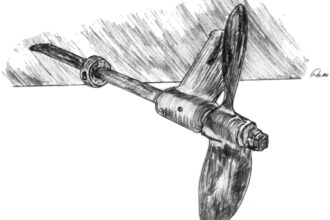
The problems started somewhere on the St. Lawrence Seaway between Toronto and Montreal, when three engine mounts cracked and the engine shifted. This caused serious wear on the Cutless bearing before the propeller shaft finally fell off the back of the gearbox! I was oblivious to the problem at the time and it came as a shock to discover, just as I was re-entering the busy shipping channel, that Kuan Yin had no engine propulsion.
I sailed a few hours downstream to Quebec City with fi ngers crossed, dodging ships and praying I wouldn’t be becalmed in the narrow shipping channel. To my great relief, and with help from the Coast Guard, I made it through the entrance into the Parc Nautique de Lévy, across the river from Quebec City.
With that challenge behind me, I turned my attention to the damage. Engine mounts, gearbox, and prop shaft were all repaired within 24 hours, but the cost of hauling out the boat to repair the Cutless bearing threatened to bring to a premature end the passage toward my intended winter destination.
A time-honored solution
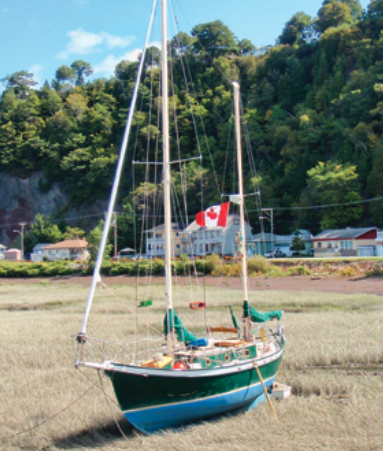
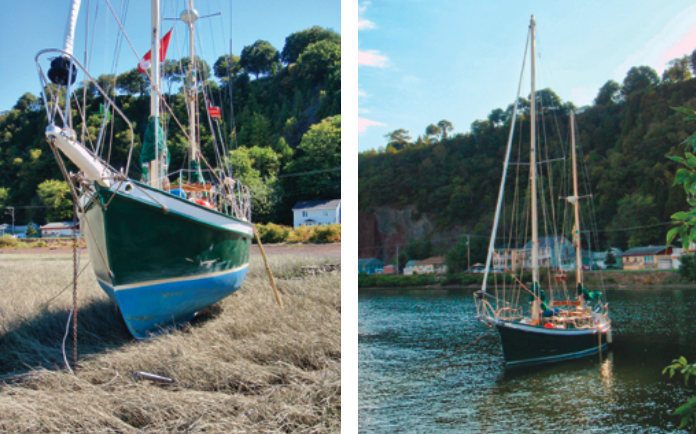
Kuan Yin draws only 4 feet 5 inches. Her keel is up to 10 inches wide and she carries her own support legs that can be bolted to the bulwarks amidships. Built of 3⁄16-inch steel plates, she’s extraordinarily strong, but weighs about 11 tons with water, fuel, and supplies.
Monsieur Bertrand, the local mechanic, suggested I take advantage of the 15-foot spring tide and 10-foot drying height in the bay next to the marina to beach Kuan Yin to do the repair. To me, the prospect of balancing 11 tons of sailboat on the mud at low tide was daunting. The risks seemed formidable. The mud and grass might be too soft to support the boat’s legs under such a weight, or the boat might come to rest unevenly on the bottom and topple over. I could visualize damaged masts and the cabin flooding when the tide returned.
I’d never done anything like this before. My stomach tied in knots of apprehension as I tried to imagine how the maneuver would even be accomplished. I felt relatively inexperienced handling the boat at sea, never mind this.
However, I also knew that if I flunked this test, there would be no way to fulfill my dream of sailing to northern Labrador. If I didn’t have the courage even to attempt a technique that had been common practice before the convenience of travel lifts, I’d never have the guts to sail the remote and hazardous coast of Labrador, nor the tenacity to tackle whatever challenges that voyage would undoubtedly present.
So I took a deep breath and committed myself. I made a rough chart of the bay at low tide, marked the rocks, and plotted a route using bearing lines from conspicuous trees and buildings on shore. There would not be much clearance under the keel inside the bay and it was essential that Kuan Yin come to rest on firm and level ground.
Taking the ground
The 15-foot high tide coincided with sunset, so daylight was already fading as I brought Kuan Yin very slowly into the bay along my pre-planned route. The top sections of the support legs were already bolted to the bulwarks. The bottom sections lay ready on the decks. I was apprehensive but determined.
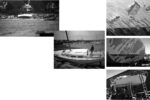
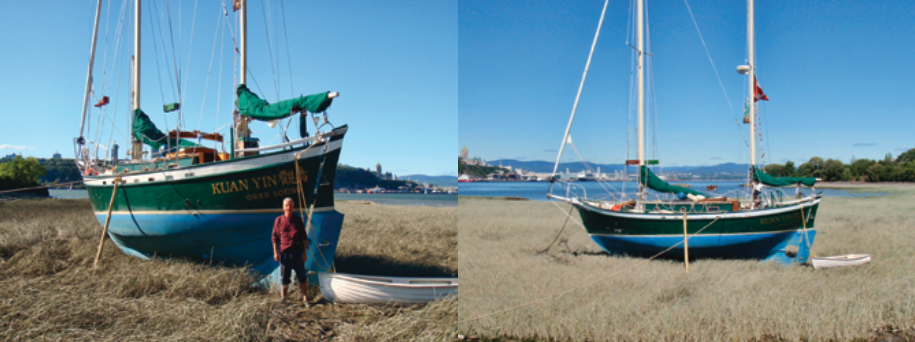
As I drew closer to the shore, people began shouting warnings and conflicting advice about where to anchor, and I could feel my anxiety rising toward panicked inaction. I decided to ignore everyone and to trust my own hand-drawn chart and gut instincts. I dropped the hook near the rocky shore, then quickly assembled the bottom sections of the support legs and lowered them into the black water until the struts hit the bottom. As the tide receded, I held my breath and prayed that Kuan Yin would take the bottom on an even keel and that the wooden plates I’d bolted to the bottoms of the support legs would not slip in the mud and allow the boat to fall over.
After two hours, she seemed to be safely aground. After four hours, the beam of my flashlight cut through the overcast and starless night and showed the struts standing firmly in the grasses surrounding the boat and not sinking into the mud. Knowing there was nothing more I could do to support the boat, I tried to relax, but sleep was difficult.
Low tide came in the early hours of the morning, so Kuan Yin had to refloat through another high tide and await the next low tide before the mechanic could come out in daylight to replace the Cutless bearing. Foolishly, I had not put out a kedge anchor to hold the boat in position. Fortunately, the light wind did not shift overnight, and at dawn Kuan Yin took the bottom again in almost the same location.
At 10 a.m., M. Bertrand and his assistant trudged in rubber boots across the muddy flats, bringing tools and the new Cutless bearing. It was not the same size as the old bearing but we were able to drive the new bearing inside the old sleeve. One hour later the work was done. Then there was nothing more to do before high tide at sunset except to relax and enjoy an invitation to the fall corn roast at the local yacht club. The next morning, Kuan Yin could continue eastward.
What I learned from the experience was to be more open to trying less orthodox methods rather than automatically accepting the most convenient (and usually the most expensive) procedure. By attempting a traditional boating technique that was beyond my experience and comfort level, I not only saved a bundle and avoided a long delay, but this small success boosted my confidence and skills. Above all, it helped prepare Kuan Yin and me to face greater challenges on our voyage toward the Atlantic Ocean, Labrador and, ultimately, Ungava Bay.
Dennison Berwick took up sailing after much earlier adventures walking across India and traveling solo in a canoe on the Amazon. In the summer of 2011, he was sailing in Newfoundland and Labrador, attempting to retrace the 1811 voyage of an Inuit captain and Moravian missionaries around northern Labrador into Ungava Bay. Follow his weblog at www.dennisonberwick.info.
Thank you to Sailrite Enterprises, Inc., for providing free access to back issues of Good Old Boat through intellectual property rights. Sailrite.com