A life’s love of sailboats summed up in Finesse
Issue 84 : May/Jun 2012
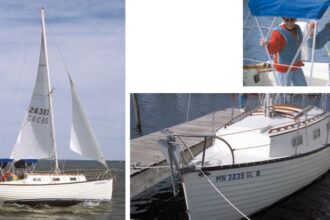
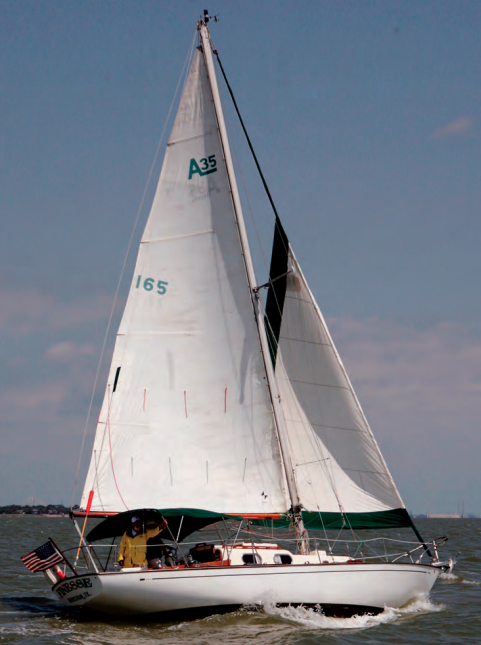
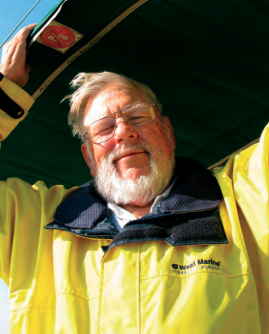
Over the years, Texan Richard Beard has owned nearly two dozen boats, but his heart has always gone out to Alberg designs. It’s not surprising, therefore, that for the last 17 years he’s been true to just one boat. Finesse, his Alberg 35, is the one that captured his heart and soul.
Richard grew up in Texas ranch country and was comfortable roping cattle and engaging in other daredevil activities from the backs of fast horses. But his education at the University of Houston and his degree in drafting technology led him to a career near the shores of Galveston Bay. Blame it on his supervisor in a chemical-manufacturing plant, a fellow who was obsessed with sailing . . . as a concept.
“He talked about sailing all the time,” Richard recalls. “He researched boat design and made drawings for a hull design. He later made two or three scale models and we did some crude research on towing them to see which was the best. This got me all fired up. But while he talked about boats constantly, I wanted action.”
Richard took matters into his own hands. A newspaper classified ad led him to a neglected Sailfish for just $50. Richard says, “All I knew about sailing was what I had read in a small booklet. The sail was in tatters, but the guy told me I could sew a new one from a WWII surplus parachute. So I bought it — story and all — and went to Sears to buy a car-top carrier to get it home.”
It should be noted that during his career as a boat owner, although he bought and sold many boats, Richard says he lost money on only one of them. The Sailfish was the first of a couple of dozen boats he purchased, fixed up, and sold for more than he’d paid for them. His learning curve at this point was steep, but Richard is technically inclined and was not afraid of a little bit of hard work. Over the summer, he painted the hull and fixed up the rudder, tiller, and centerboard. Soon after buying the boat, Richard and his wife spent one long night sewing a sail from a parachute, as the previous owner suggested, and he headed off for a test sail first thing the next morning.
Sailing made not so easy
Once the boat floated, Richard began work on a sailing diploma from the School of Hard Knocks. “Lesson number one,” he says, “is do not stand up on a plywood Sailfish when you don’t know what you’re doing!” Each time he stepped on the boat to raise the sail, he wound up swimming. Richard finally figured out a better plan, the wind caught the sail, someone gave the boat a shove, and, as he puts it, “I was on my way to being a sailor.”
His first lesson in tacking occurred when the centerboard grounded on an oyster reef. Once the boat was stopped, Richard climbed off, turned the boat around, and headed back to the launching ramp. But by the end of the day, he’d learned a few subtler skills and was grinning from ear to ear. “The way I was beaming when it was time to go home,” Richard says, “you would think I could cross an ocean.”
The euphoria with the Sailfish lasted all summer. Once it cooled off outside, a wet boat became less appealing and Richard began drooling over a Chinese junk in a nearby boat dealership. That boat lured him through the door, but a 17-foot Thistle hooked him.
“The dealer was a representative for W. D. Schock sailboats,” Richard says, “and several Schock boats were on display, but I liked the look of the Thistle. I had no idea what I was doing, I just wanted one of those boats.”
The salesman, knowing Richard couldn’t afford the boat, set the hook anyway. He suggested a demo sail with a friend who had a Thistle in the racing fleet at the Houston Yacht Club on Galveston Bay.
After the day’s race, this sailor and his son took Richard out for a joy ride. The Thistle was designed for lake sailing in light wind, but it was blowing 20 knots out of the north with gusts to 25. “When we cleared the harbor, we got the full force of the wind and the boat jumped up on a plane. I think we were going about 15 knots, but it felt like 50. It was the most exciting thing I had ever imagined. I was hooked but good,” Richard says, grinning as though it had happened the day before.
Since money was an issue, Richard was pointed toward Thistle kit boats and, although he’d had just one shop class in his life, he built a Thistle in his living room that winter with plenty of help and advice from others. He launched the boat in March and began racing it in May. He admits to being slow in the first race. “By the time I came dragging in, the other sailors had loaded their boats on trailers, washed them down, and were in the clubhouse drinking beer. I was one whipped dog. I had been working awfully hard at doing something I didn’t know how to do.”
To learn more about this thing called sailboat racing, Richard crewed for others in the Seabrook Sailing Club races and sailed his own boat as often as he could. “By the end of the season, I was finishing the races in the top half and occasionally in the top five out of 15 boats,” he says. “I was determined. I learned more that first racing season than most people learn in their first five years spent daysailing. It was very intense.”
An Alberg infatuation
During this time, Richard also crewed on 22-foot Ensigns racing out of the Houston Yacht Club. This was his introduction to Carl Alberg designs. So when his wife and three growing children pointed out that the Thistle was a wet and uncomfortable boat for family sailing, Richard found a fairly new Ensign and moved into that racing fleet. Her name was Stormy.
“This boat had a petrel-green hull, white deck, lots of varnished wood, and I thought she was the most beautiful thing I had ever seen,” Richard recalls. His love affair with Carl Alberg designs blossomed on the spot.
“Carl Alberg once said that he drew the lines on a balloon and when someone wanted a bigger boat he just blew the balloon up a little bigger,” Richard says with a laugh. There may be something to this, since Alberg designs generally have a full keel with an attached rudder and cutaway forefoot and other distinctive design elements like wooden cockpit coamings with pedestal winch mounts. Among the 20-something boats Richard has owned were three Ensigns, a Bristol 27, a Pearson Commander, and the current Alberg 35 . . . all Alberg designs.
Richard spent as much of his time as he could sailing. His frustrated wife, claiming he spent more time sailing than with her, left him at some point and he poured himself into sailing, buying, fixing, and sailing. He crewed for lots of other sailors on larger boats and had many chances to sail offshore in big-boat races.
“I was hooked harder,” he says. “I bought a home three blocks from the Houston Yacht Club and sailed constantly.”
In addition to all the rest of his sailing and racing activities, Richard also earned his USCG 50-ton Master’s license.
Scuba diving captured his imagination in a big way for a few years, but sailing won in the end. The boat that lured him back to sailing was Finesse. Richard had seen this beautiful Alberg 35 when — as a brand-new boat — she was delivered to a member of the Houston Yacht Club in 1965. So, while their paths had crossed, Richard had to wait until Finesse was nearly 30 years old and in need of a dedicated fixer-upper-type owner before this boat fit his budget.
The year was 1994, and Richard noticed an Alberg 35 advertised in the local paper.
“I remembered the boat as soon as I saw her,” Richard says. “She’s an Alberg design and looked a lot like my old Ensigns, except she was in terrible condition. I felt so sorry for her I just had to buy and restore her.”
A litany of liabilities
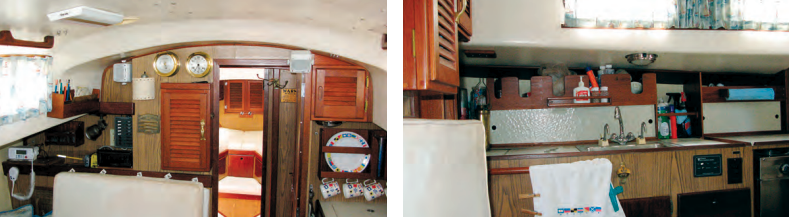
Her Atomic 4 engine was the most glaring problem in the beginning, but there were other cosmetic and safety issues as well. The teak on Finesse had never been varnished; the previous owners had used a pressure washer on the fragile grain until the handrails — originally 1 1⁄2 inches in diameter — were just 7⁄8-inch thick. They were so thin they flexed, he notes. The running rigging was old and frayed. Down in the cabin, the cushions were gone and the plastic overhead liner was yellowed and peeling.
The engine’s problems were evident on the trial sail. “It barely ran, with the emphasis on barely,” Richard says. I took $3,000 off my earlier offer because of the engine and other complaints. In the end, I paid $15,000 and put another $15,000 into it.”
On Richard’s first sail on Finesse, the engine quit and he had to call for a tow.
“This was just unacceptable,” he says. First things first. Richard pulled the engine out and took it home. “I stripped the engine to a bare block, ordered parts from Moyer Marine, and rebuilt it from scratch. I had steel seats installed in the block for the exhaust valves, had other work done by the machine shop, and soon I had a good engine again. The rebuilt engine has 17 years on it now. I’m happy with it.” The prop and shaft were very loose, so he also replaced the Cutless bearing. Once the drive train was functional, it was time to address safety issues such as handholds, electrical wiring, and rigging. Richard built new handrails. These had to be custom-fitted, of course, as they had to match the spacing of counterpart rails inside in the cabin.
Over the years, the previous owner had added more electrical complexity to what had started out in 1965 as a very simple boat with not much more than the minimum requirement for running lights and a few cabin lights running off 12 volts. The add-ons had been wired using basic lamp cord. Richard was also faced with a 110-volt system that had been added to the boat.
“The only things that worked were the water heater and one cabin outlet,” he says. “The previous owner had bought a battery charger and run lamp cord to it. The farther I went, the more lamp cord I found. I stripped a piece at a time and added breaker boxes. I should have added larger boxes.” But nearly 20 years ago he could not foresee the increasing number of electrical gizmos that would be available to sailors today.
Richard replaced the running rigging right away, then turned his attention to the purchase of a new mainsail and eventually to the addition of roller furling for the jib. The previous owner had purchased 150 and 180 percent jibs to be used only for racing while wearing out the original jibs on daysails. As a result, Richard was able to have both racing jibs, which were still in pretty good condition, re-cut so he could use them on the roller furler.
Endless upgrades
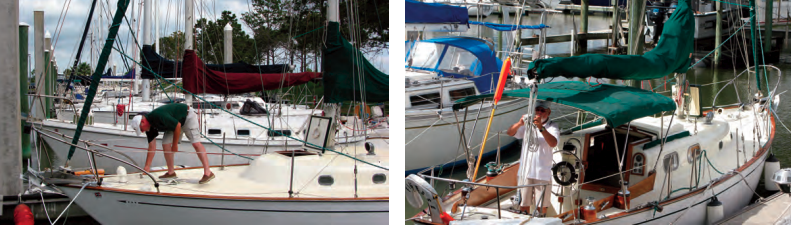
When the mast had to be pulled, Richard replaced the standing rigging and rewired the mast, adding new lights. He also varnished all the exterior woodwork, repainted the deck, added new non-skid, and re-sealed the hull-to-deck joint. He stripped the hardware (primarily the winches and portlight trim pieces) and had it re-chromed. Much later, he replaced the original South Coast winches with Harken 2-speed self-tailing winches. “I had to do that in self-defense when I started singlehanding,” he says.
Over the years, he revised the controls on the steering pedestal, had cockpit cushions made, redid the non-skid once again, and had the hull Awlgripped.
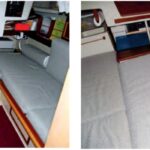
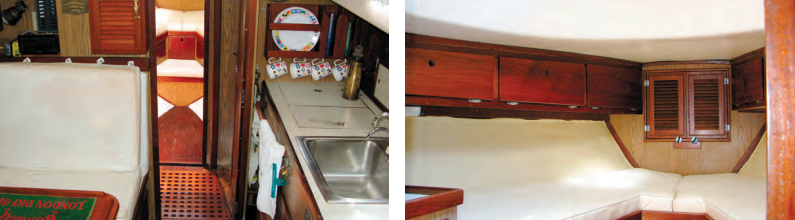
Inside, he replaced all the cushions with new foam and covers, replaced the tattered curtains, redid the overhead, added ceiling strips in the aft bunks, and built very useful storage compartments in the V-berth where most boats, including the Alberg 35, have nothing more than small fiddled trays. He replaced the alcohol stove with a three-burner propane unit, added refrigeration, and replaced corroded overhead lights.
Next, Richard removed the Formica tops. He started with the table and built a new one of teak. “That worked so well,” he says, “I asked myself, what else can I do?” That little question led to a rash of new additions: a medicine cabinet, a teak pencil/navigation-tool holder, a spice rack, a magazine rack, an instrument panel, a dish rack . . .
“I have modified, replaced, or repaired virtually every part on this boat,” Richard says with pride. While all these lists of modifications and additions are easy enough to read, all good old boaters know the truth: each job breaks down into many individual tasks and each takes a lot of time . . . always about twice as much time as we think it will.
As he looks around his boat, Richard says, “Lots of agony, work, and money made her what you see today. There were lots of funny stories of lessons learned along the way, but it was well worth it. People walking the docks stop and talk to me about her and admire her. The classic design and lots of varnish really get their attention. That makes me feel good and makes all the hard work worthwhile.
“This boat fits me. I can singlehand and dock it. One person can make everything work. The Alberg 35 is easily sailed. One person can move it and push it around at the dock.”
Richard gives a lot of credit regarding who he is to his great-grandfather back on that ranch in Texas. “I think the underlying theme through all this,” Richard says, “is that I always had a lot of curiosity and no fear. If you’ve got the courage to try it, you can make it work. I learned that from my great-grandfather.”
Karen Larsen co-founded Good Old Boat with her husband, Jerry Powlas, and is the magazine’s editor. When she has time out of the office, she enjoys meeting fellow good old boaters and reporting on their accomplishments.
Thank you to Sailrite Enterprises, Inc., for providing free access to back issues of Good Old Boat through intellectual property rights. Sailrite.com