A perky pocket cruiser built in great numbers
Issue 83: March/April 2012
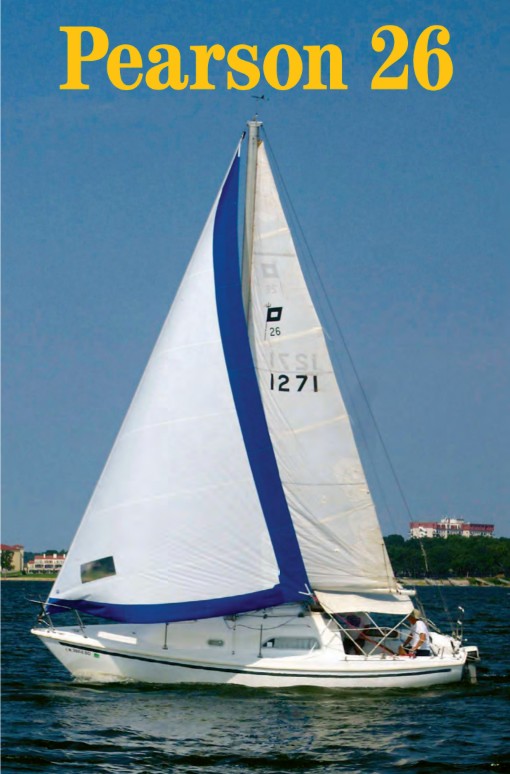
It’s often said that numbers don’t lie. Using that adage as a benchmark, the Pearson 26, with more than 700 hulls produced, qualifies as a very successful design. It was therefore no surprise to find three Pearson 26s at the Grand Lake Sailing Club in Oklahoma as Commodore Tom White welcomed us to the club’s facilities on the beautiful Grand Lake O’ the Cherokees. The lake offers 18 miles of good sailing between the club’s marina and the Pensacola Dam at its western end and even more sailing to the east.
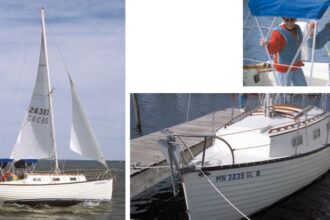
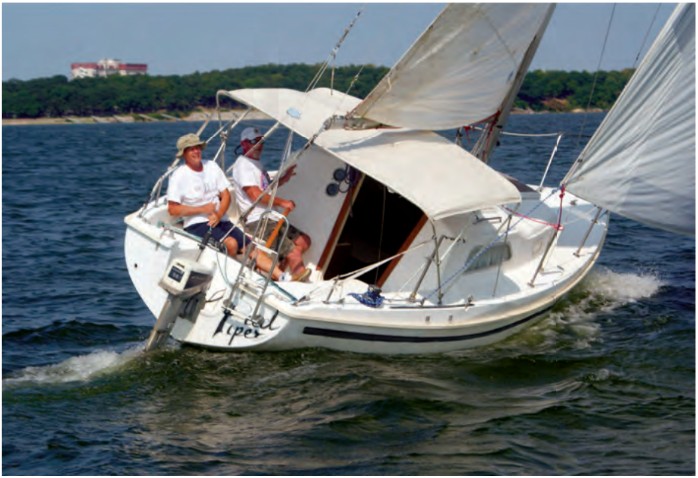
Bill Snow, Marshall Orcutt, and Mike McCall own the three Pearson 26s at the club. Unfortunately, none of the owners could be present when the stars and the weather aligned during our visit to provide suitable conditions for the test sail. This was not a problem, however, because GLSC member Roy Goding stepped in to sail Bill Snow’s Pearson 26, Pied Piper, with the able assistance of club caretaker Tim Chambers. Marshall Orcutt’s Alice O was made available for interior photography. The club also provided its race committee boat for our use during the photography session.
Design and history
Cousins Clint and Everett Pearson began their business in a small way, at first building dinghies in a garage and eventually forming Pearson Yachts in 1956. They continued building smaller boats, but in 1959 they joined the first wave of fiberglass cruising-boat production when they introduced the 28-foot 6-inch Triton, a Carl Alberg design. Several production cruising boats followed the Triton.
Change came quickly to Pearson Yachts during the 1960s when it was sold to Grumman Allied Aircraft Corporation. In 1964, Bill Shaw, a designer with several years of experience at Sparkman & Stephens, joined the company. In the same year, Clint Pearson left to form Bristol Yachts and when Everett Pearson also parted ways with Grumman two years later, Bill took over the management reins as well.
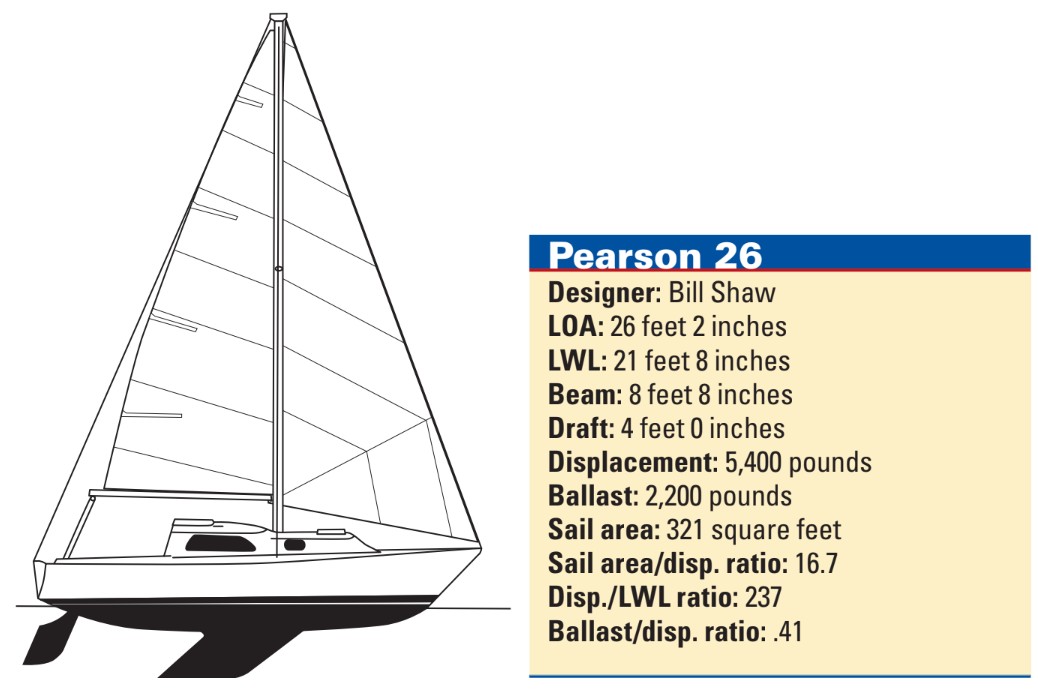
In 1970, Pearson Yachts introduced Bill’s Pearson 26. Between 1970 and 1982, 1,774 hulls were sold, making it Pearson’s most-built model, eclipsing even the popular Pearson 30.
In 1975, Pearson also introduced the Weekender, later called the One Design. It was based on the Pearson 26 but with a longer cockpit and a straight profile in the shortened cabin trunk. More than 300 of these boats were built between 1975 and 1983.
Bill continued designing the bulk of the Pearson offerings through the 1980s and in 1986 he and other investors bought the company from Grumman. The company went into bankruptcy in the early 1990s. Bill Shaw died in 2006.
Construction details
The Pearson 26 hull is a sturdy layup of solid fiberglass. The sweptback cast-iron fin keel is joined to the hull with eight bolts and the draft is a modest 4 feet.
The rudder tube is located at the rear of the cockpit sole, just forward of the outboard-motor well. Some boats have had leaks here and their owners have had to repair saturated balsa core. The deep scimitar-shaped rudder provides ample clearance to allow a center-mounted outboard, rather than the offset outboard configuration found on many other small cruisers. Owners have reported rudder-stock problems, and here the Pearson 26 is a bit unusual. Pearson built a solid fiberglass rudder over an aluminum stock riding in a plastic bushing, and wear on the stock is common.
This could be dangerous in a seaway if a worn stock allowed enough movement to fatigue the metal and cause failure and loss of the rudder. Anyone considering a Pearson 26 should be sure to check the rudder stock for wear and also to check the cockpit sole for water intrusion near the rudder tube.
The deck is balsa-cored fiberglass with plywood core in load areas. The hull and deck were joined by through-bolting outward turning flanges on both parts. The joint was finished by covering the flanges and bolts with a sturdy vinyl rubrail and by applying fiberglass mat and resin over the inside of the joint. This produced a relatively trouble-free joint. The outer edge of the deck has a small raised toerail with a short, through-bolted aluminum genoa track.
The interior incorporates a fiberglass hull liner, a fiberglass deck liner, and plywood bulkheads. The liner is cored in areas of the sole where heavy loads are expected. The liner was tabbed to the hull and the bulkheads bolted to the hull liner. After the hull and deck were joined, the bulkheads were fastened to the deck liner. The inboard end of the port bulkhead attaches to a compression post that transmits loads from the deck-stepped mast.
The rig
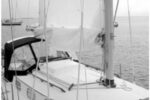
The mast is an aluminum extrusion supported by a single-spreader rig. The original halyards were external and no mast-mounted halyard winches were fitted as standard equipment. Many owners have run the halyards to the cockpit where they use a coachroof winch for halyard tensioning.
The upper shrouds and single lower shrouds attach to chainplates mounted inboard of the toerail. The rig has a split backstay to clear the centered outboard motor and this allows the easy use of a backstay tension adjuster.
The traveler spans the forward end of the outboard motor well and the mainsheet runs to the aft end of the aluminum boom.
Deck details
For the Pearson 26, Bill Shaw retained the characteristic stepped cabin-trunk profile of the earlier Alberg-designed Pearson models. The mast step is located at the step in the deck, so crew working at the mast need to be mindful of their footing. There are short grabrails on the raised after section of the coachroof. The forward hatch, positioned over the V-berth, is made of fiberglass with the gelcoat omitted from the center portion to let light into the cabin.
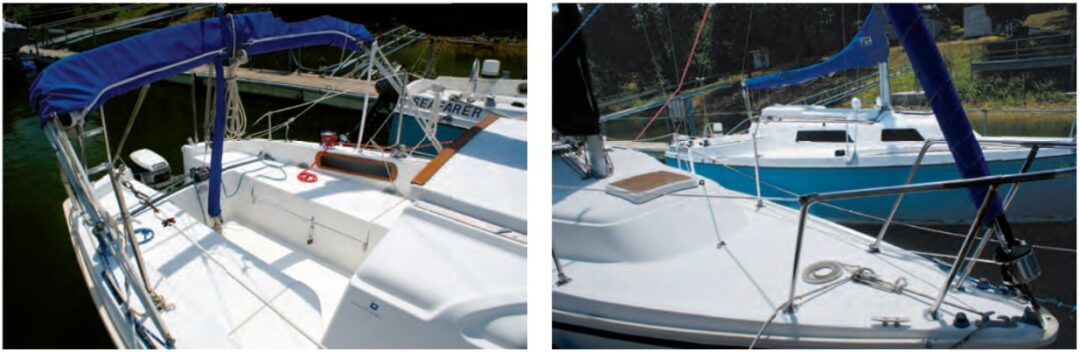
Crew must work around the shrouds when going forward because the chainplates are in the center of the narrow sidedecks. Even so, access is still better than on some boats of comparable size.
The foredeck is fairly clean. With no hawsepipe or other means to stow an anchor rode belowdecks, an owner wanting to carry and mount a bow anchor must coil and secure the rode on deck. The only items of hardware on the foredeck are chocks to port and starboard, cleats to port and starboard, and a center cleat for belaying the rode.
A stainless-steel bow pulpit and single lifelines, which drop to coaming level at the stern, provide some security. A stern pulpit was optional, but most boats were not equipped with one.
The cockpit seats are 6 feet 6 inches long, providing enough space for crew to stretch out. Sail-locker hatches in both of the seats provide access to a large space below. In early boats, the fuel tank was stored in the sail locker area and both hatches were identical in length. In 1973, Pearson modified the cockpit design to add a dedicated fuel-tank cubby beneath the aft end of the starboard seat. When this was done, the starboard sail-locker hatch was shortened slightly. At the same time, the motor well was enlarged to accommodate larger outboards.
The cockpit well averages approximately 30 inches in width and the tiller extends for most of its length. Crew positioning is important to avoid interference with the helmsman.
Coaming cubbies on both sides provide stowage for winch handles and other items. Lewmar #8 sheet winches mounted on the coamings were standard equipment, though many owners have upgraded to self-tailing winches.
The companionway is offset to starboard because the aisle below is off-center to accommodate the port-side dinette. A low sill at the companionway is not high enough to qualify as a bridge deck. When the boat is in any kind of sea, the lower washboard should be left in place. A track-mounted sliding hatch over the companionway provides access below. There is no sea hood protecting the forward edge of the hatch.
Accommodations
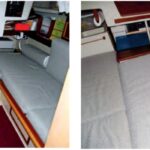
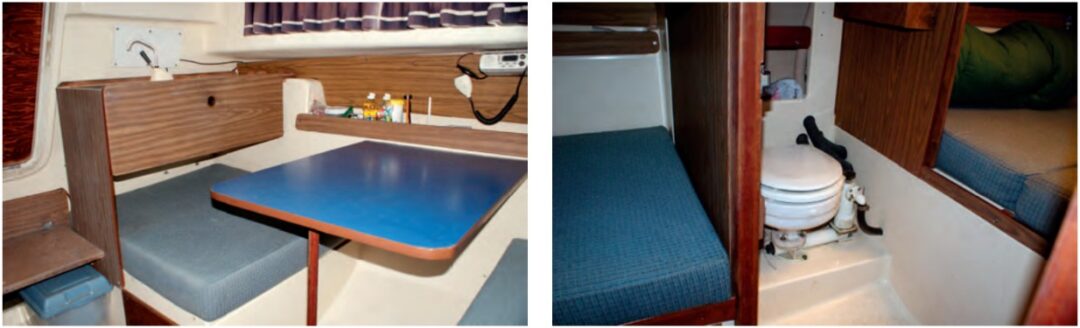
Although the Pearson 26 does not provide standing headroom for the average sailor, the raised aft portion of the cabin trunk does have more than five feet of clearance. The dinette offers fore-and-aft seating for a couple or four very close friends as long as two of them are seated on the starboard settee. The table can be lowered to form a tight double berth. The settee to starboard also serves as a single berth.
Removable lids under the cushions provide access to stowage space beneath the port seats and the starboard settee. Shelves with fiddles are above the seats port and starboard. Near the end of the production run, acrylic sliding doors were added on some boats.
There is a small sink on a counter platform behind the aft table seat, with more stowage available in the counter. Some flat surface space is available on the counter between the sink and the port side of the cabin trunk, but it is not as convenient as normal counter space. On the two boats at GLSC, a hand pump delivers water to the sink, but some owners have installed pressurized systems. A 22-gallon water tank beneath the V-berth provides adequate capacity for weekend cruises. A small two-burner alcohol stove can be set on the small navigation table to starboard of the offset companionway.
The cored-fiberglass liner surface and the bilge boards over the access openings form the cabin sole. Many owners have cut and installed all-weather carpeting to dress up the interior.
Large fixed portlights admit ample light but the only source of ventilation is the open companionway hatch. There are no deck vents.
The head is to port between the saloon and V-berth bulkheads. A door at the saloon and a sliding panel at the V-berth can be closed for privacy. A marine toilet and 12-gallon holding tank were standard, but some boats were sold without these features and use a portable toilet instead. There is no vanity sink. Opposite the head is an ample hanging locker.
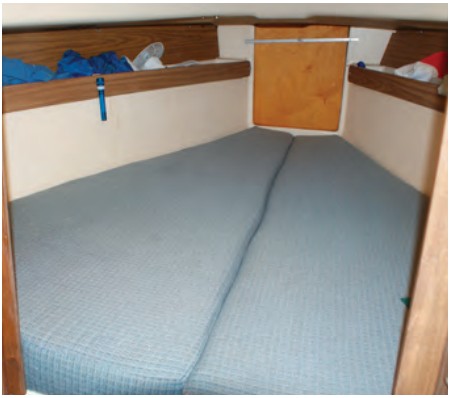
The V-berth is 6-feet 3-inches long but it narrows to around 18 inches at the forward end. It’s adequate for two, provided one person is quite short. Fiddled shelves along both sides provide stowage for personal items. There is a small forepeak for stowage but no easy way to use it for the anchor rode.
The fiberglass hatch over the V-berth can be opened for ventilation and access. Replacing this hatch with a modern one with a Lexan lens might be a desirable upgrade.
Under power
Handling the boat under power is different from steering a boat with an inboard engine. The motor can be pivoted as needed in close quarters, but generally it can be left locked in the fore-and-aft position and the rudder used for steering. The small outboard induces little prop walk in reverse and once the boat has steerageway it can be tiller-steered as needed. A small outboard is quite suitable on an inland lake. A larger outboard would be desirable in coastal areas, but some larger outboard engines, like the 4-stroke 9.9-hp models, might not fit the smaller motor well in pre-1973 boats.
The motor can be tilted to raise the lower unit out of the water to reduce drag, but many owners don’t bother unless they are racing.
Under sail
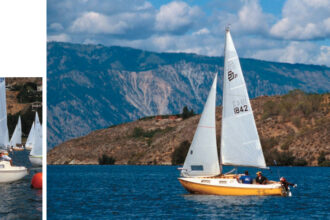
We set out for our test sail on a clear summer morning with winds around 10 knots and the temperature already in the high 80s. As the forecast was for 106 degrees that afternoon, a morning sail seemed to be the best course of action. We left the dock, raised sail, and Roy Goding gave me the helm.
Sailing the Pearson 26 is easy and instinctive. If you’ve grown accustomed to wheel steering, the first impression is that the tiller takes up a lot of cockpit space, but the solid feel and rudder feedback quickly bring back the joys of sailing a responsive smaller boat. With end-boom sheeting, the mainsheet and jibsheet can be easily trimmed from the helm position. This would be a relatively easy boat to sail singlehanded, provided self-tailing primary winches are installed.
We sailed in 10 to 12 knots of breeze under full genoa and main, and the boat never felt overpowered. As we were going to windward, minor adjustments to the mainsheet and traveler balanced the helm nicely with just a few degrees of weather helm, as is desirable. Tacking was a snap, as the boat pivots quickly on her shallow keel and doesn’t lose much in the turn. The boat will sail between 35 and 40 degrees to the apparent wind without losing drive. Above that point she felt a bit pinched, but we were able to regain speed by footing off a bit. Newer sails and some sheeting-angle adjustments might allow the boat to point slightly higher. Some amount of leeway can be expected because of the fairly shallow keel, but it isn’t too noticeable on a beat.
Sailing on a beam reach provided good speed and, with the sails properly trimmed, a fingertip on the tiller kept the boat on course. There was just a little chop on the lake, but the occasional big wake from a passing power cruiser provided the opportunity to estimate the motion in a seaway. The boat took these wakes cleanly without pounding or much loss of drive.
The crisp tiller steering, aft-mounted traveler, and easy access to all sail controls make the Pearson 26 a joy to sail.
Owners still race these boats in many areas, and PHRF ratings nationwide are between 210 and 222. The boat rates about the same as the C&C 25 (213) and the older Hunter 25 (235) outboard models, and is still competitive in local fleet racing.
Conclusion
The Pearson 26 is a good value as a pocket cruiser, and its accommodations and seaworthiness make it suitable for weekends and short coastal cruising. It’s a solid, durable design, and most of the hulls produced are still sailing. In the fall of 2011, at least nine were on the market in the U.S. and Canada. Asking prices ranged from $8,575 to $2,690 with an average price of approximately $5,700, making it a very affordable entry-level small cruiser. Anyone buying a lower-priced boat should anticipate doing some work to address deferred maintenance issues such as saturated deck core and uncorrected rudder problems, but the work may be well worth the effort.
Tom Wells is a contributing editor with Good Old Boat. He and his wife, Sandy, own and sail a 1979 Tartan 37, Higher Porpoise. They have been sailing together since the 1970s and look forward to cruising upon retirement.
Thank you to Sailrite Enterprises, Inc., for providing free access to back issues of Good Old Boat through intellectual property rights. Sailrite.com