A lot of boat in a small, stout package
Issue 84 : May/Jun 2012
Starting a business venture requires nerve and dedication, and the first product must be good if the company is to succeed. George and Michael McCreary proved this when they introduced their first production sailboat, the Caliber 28.
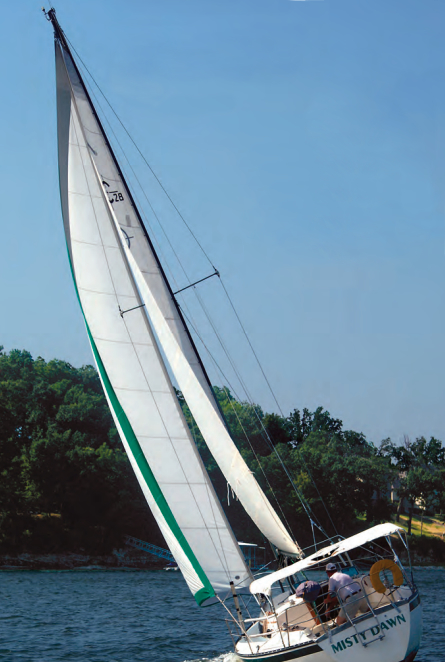
In July 2011 my wife, Sandy, and I traveled to Oklahoma’s Grand Lake O’ the Cherokees to sail and photograph Gary and Cathy Gray’s Caliber 28, Misty Dawn. They found Misty Dawn in 2009 and brought her to the Grand Lake Sailing Club’s marina near the city of Grove. Gary and Cathy live across the border in Arkansas, but after sailing on Grand Lake with friends in 2006 they knew it was where they’d like to keep their own boat.
We met Gary and Commodore Tom White at the GLSC clubhouse and, following a marvelous breakfast courtesy of the commodore, we began our review activities. The GLSC made its race-committee boat available for the photo session.
History
The McCreary brothers founded Caliber Yachts in 1980. Michael — Westlawn trained and with an engineering degree from the University of Michigan — assumed design responsibilities and George used his business degree and skills in marketing to successfully promote the new company. They built their first boat, a Caliber 28, in their garage, but they soon moved into their own manufacturing facility in Clearwater, Florida.
In 1985, the company began producing the Caliber 33. The boat was a success, even in the midst of an economic downturn. The Caliber 38 followed in 1987, and was modified in 1989 by extending the stern to become the Caliber 40. The company introduced its respected LRC (Long Range Cruising) series in 1993 with the 35LRC. This was followed by the 40LRC in 1995 and the substantial 47LRC in 1999. These models are builtas passagemakers and are renowned for their solid construction and good sea manners.
As the larger models became more prevalent, Caliber 28 production ended after approximately 48 hulls had been built. The company continues to build the three LRC models.
Construction
In the Caliber 28, the company introduced many of the strong construction methods and techniques it would use in its later models. The hull is a very solid fiberglass hand layup and the deck is cored with plywood, rather than the end-grain balsa used by many other builders. Deck penetrations are all in solid fiberglass. The shallow fin keel is bolted to the hull, but this is the only Caliber model with that type of keel construction. In newer Caliber models, the ballast is encapsulated in an integral keel. The rudder, which is rectangular in shape, is of fiberglass laid up over a stainless-steel armature and shaft. It has a small skeg at its leading edge.
Unlike most builders, Caliber chose not to use interior liners or pans for economy or as a way to stiffen the hull. Instead, it uses its “Multi-Bulkhead Bonding System,” in which all bulkheads are taped and tabbed securely to the hull and deck.
To form the “Quad-Seal” hull-to-deck joint, an overlapping deck flange is mated to an inward-turning hull flange with a copolymer tape between them. The system is secured by through-bolting a substantial aluminum toerail, bedded on 3M 5200, to backing plates on 6-inch centers. The joint is then finished on the exterior with a full-length rubrail, also bedded on 3M 5200, that completely covers the joint, and more 3M 5200 is applied on the inside of the joint. Owners have not reported issues with this joint.
Chainplates are solidly connected with through-bolts to a very substantial bulkhead and also to the deck. Shroud forces are transmitted to the deck, bulkhead, and hull as a unit.
Misty Dawn was extremely solid with no sign of movement or deterioration in the tabbing or around the hull-to-deck joint. The overall feel of the boat is very substantial, especially for a 28-footer.
Rig
The Caliber 28 was offered with a masthead rig, and a fractional rig was reportedly available as an option. The aluminum mast and boom are beefy extrusions with a linear-polyurethane paint finish.
The upper and lower shrouds supporting the single-spreader mast attach to the chainplates in the middle of a fairly wide sidedeck, but they don’t impede passage forward for crew. The split backstay frees center space at the helm and allows for easy installation of a tensioner. For additional support and finer tuning, a baby stay is set up between the mast at the spreaders and the forward end of the cabin trunk.
Mainsail control is achieved with mid-boom sheeting and a traveler that is only the width of the companionway sea hood. That may be too short for some conditions. However, the boom is nicely set up for slab reefing with reefing hooks at the gooseneck. Reefing lines and the outhaul line are run inside the boom.
Standard Barient #12 primary winches were provided for trimming the genoa sheets. A Barient #10 winch is mounted to port on the aft end of the cabin to handle the halyards.
Deck
The deck layout is quite accommodating, with the wide sidedecks and straight cabin trunk allowing crew free movement forward and aft. The full-length aluminum toerails and the heavy grabrails along the cabin-trunk sides provide good security, and the grabrails double as slip protection for anyone working at the mast.
The cabin-trunk sides have a teak eyebrow above the ports. Misty Dawn has two opening ports on each side, one forward and one aft, with a large trapezoidal smoked-Lexan port between them to provide light for the saloon. On later models, the trapezoidal fixed ports were eliminated and four opening ports were fitted on each side. Deck hatches provide good light and ventilation. A small hatch is located over the starboard aft end of the cabin and a larger hatch is on centerline just behind the mast. A smoked-Lexan companionway hatch slides into a sea hood.
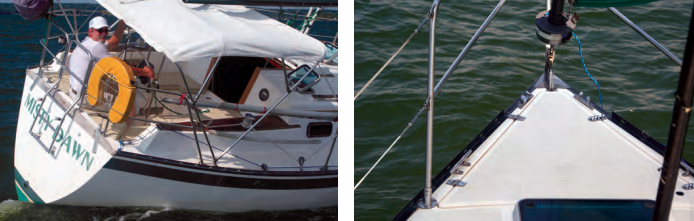
The foredeck is spacious and uncluttered. The 19-inch-square hatch over the V-berth lies just forward of the cabin trunk. At the bow, there is a substantial anchor locker with integral drain. Its cover is secured with a stainless-steel barrel bolt. The bow has aluminum chocks mounted just beyond the forward ends of the toerails, and reasonably sized cleats on each side provide solid attachment for docklines and anchor rodes. Misty Dawn did not have an anchor roller fitted. Later models were equipped with an anchor roller platform.
The stainless-steel bow and stern pulpits and stanchions support double lifelines for security. There are no lifeline gates; aft sections secure with pelican hooks and can be dropped for boarding. The stern pulpit incorporates a hinged swim ladder that raises and secures to become a part of the rail.
The cockpit is surrounded by generous molded coamings with attractive teak caps. Two storage lockers
and a small cockpit icebox are accessible from the cockpit. The Edson pedestal and its 28-inch wheel are mounted well aft but there is ample space at the helm and the wheel does not hinder side access. The bridge deck is a rare feature in a boat of this size and it shows design consideration for rough conditions. The side seats allow a person of average size to stretch out for a nap, but someone taller may find them a bit short.
Belowdecks
When you step down into the cabin, you immediately notice the high steps. These are necessary to accommodate the bridge deck, but they’re well designed and built for ease of use. You also notice the 6-foot 1-inch standing headroom and the expansive use of rich teak throughout.
The Caliber 28 was available with two interior layouts. The two-cabin layout reserves all space beneath the cockpit seats for storage. The galley in this version is to port of the companionway. A large U-shaped counter houses a sink forward, a two-burner stove along the port side, and the icebox and a storage compartment beneath the aft countertop. The electrical panel is located along the aft bulkhead above the galley counter.
A hanging locker and a large head compartment are located to starboard of the companionway. The head has a marine toilet, a vanity, and an integral shower pan and sump. Pressurized water serves the galley and head from a 25-gallon storage tank.
The saloon has long settees along both sides and a centered table with fold-down leaves. The compression post beneath the mast is at the forward end of the table. The starboard settee converts into a double berth and generous shelves and storage space are outboard above both settees.
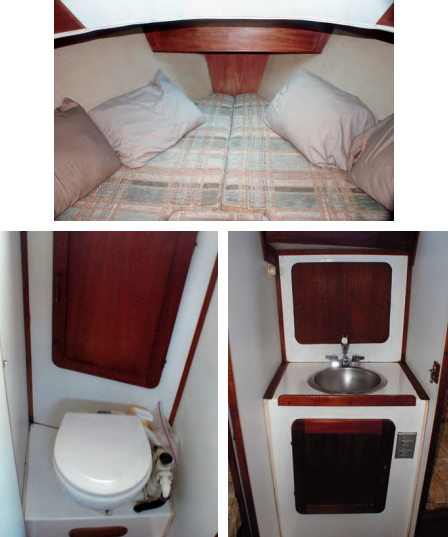
The V-berth serves as the second cabin and has a solid teak door for privacy. The berth is 6 feet 6 inches long and more than 6 feet wide at the aft end. With the filler panel in place, it can serve as a fairly comfortable double.
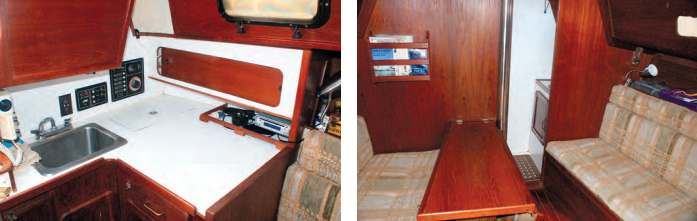
A three-cabin option also was offered, and that is how Misty Dawn is configured. The galley is still to port but it’s reduced in size with an L-shaped counter and the sink is moved aft. There is still space for a two-burner stove and a large icebox compartment with countertop access. The electrical panel is still mounted on the bulkhead aft of the galley.
The real differences begin to starboard of the companionway. An angled partition and door provide privacy for an aft quarter berth that extends beneath the cockpit seats. A seat behind the door provides dressing space. Caliber literature touted the berth as a double, but it would be cramped for two.
The saloon retains settees along both sides, but they are moved aft, filling the space made by the smaller galley and elimination of the aft head compartment. The starboard settee will convert to a double berth, as in the two-cabin model. The table is no longer mounted on centerline but is hinged off the main bulkhead.
The head is forward of the saloon in the space created by moving the settees aft. There’s a marine toilet to port, a vanity sink to starboard, and a shower pan and sump amidships. The door to the head is offset to clear the mast compression post, and a door in the bulkhead forward provides privacy for the V-berth, which is basically the same as in the two-cabin model.
The engine is an 18-hp Yanmar 2GM 20F, and the 22-gallon fuel tank gives the boat a fair range under power. Engine access is fair and most service points can be reached from the front when the companionway stairs are removed.
Under way
Gary welcomed us aboard Misty Dawn for our test sail on a clear Oklahoma summer morning. The temperature was already in the mid-80s and forecast to rise well above 100, so we were glad to sail while conditions were more tolerable. The 10-knot breeze made it quite comfortable, and off we went to put Misty Dawn through her paces.
The boat tracks well and handles easily under power alone, with just a slight amount of helm correction required to hold a straight course. The engine and standard two-blade prop drive the boat easily to near hull speed.
Some prop walk to port is evident when backing under power, which is not unusual. However, with judicious use of the throttle, it’s possible to achieve good control in reverse once the boat has gathered enough sternway to make the fairly large rudder effective. It’s important not to release the wheel while backing as that could cause the rudder to slam over against the quadrant stops.
The first thing I noticed when under sail is that the Caliber 28 doesn’t feel like a 28-foot boat. It has the solid feel and firm tracking of a much larger craft. This may be partly due to the solid construction and fairly long fin keel.
Feedback through the wheel steering was a bit muted, as expected, but after a bit of time at the helm, it was easy to feel the boat respond to changes in the wind. We started off on a reach and she accelerated nicely to around 5 knots. We made some minor trim adjustments and gained speed. The genoa tracks could be somewhat longer, but for most sailing conditions they’ll be fine.
The nice breeze gave us a chance to test windward performance. This is not a particularly weatherly boat but it does well enough, pointing up to around 40 degrees apparent wind. Trying to point any higher than that resulted in loss of speed and the need to foot off.
The boat tracks very nicely with the keel and rudder configuration and showed no tendency to round up even in occasional puffs. There was just a bit of vibration in the helm at times, and Gary told us he’d lost the fiberglass fairing strip that mounts at the leading edge of the small skeg.
We encountered some large powerboat wakes that simulated higher sea conditions. The boat took them in stride and it appeared that she would not pound much if sailed in a seaway.
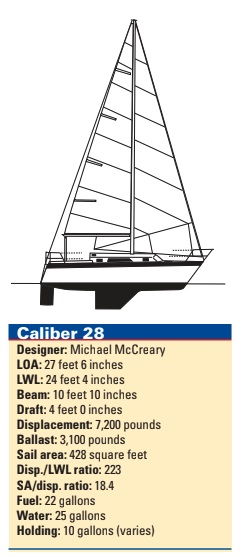
While the Caliber 28 is not a racing boat, some owners have apparently competed in local fleets. PHRF New England shows a rating of 186 for this boat, and in the same fleet the Catalina 28 and Hunter 28.5 both carry a 183 rating. Comfort and solid construction don’t usually translate into great success around the marks, but the Caliber 28 can be competitive and look good doing it.
Conclusions
The Caliber 28 offers solid construction, good seakeeping qualities, and comfort in a fairly small package. You may not win many races with this boat, but you’re going to arrive in comfort and have fun on the way.
Although the production numbers for this boat are fairly low, two were on the market in Florida late in 2011. Both were listed at asking prices of $19,500 and, given the quality and seaworthiness of the Caliber 28, this is likely a reasonable figure.
Tom Wells is a contributing editor with Good Old Boat (and his musical contributions have also earned him the title of Troubadour). He and his wife, Sandy, own and sail a 1979 Tartan 37, Higher Porpoise. They have been sailing together since the 1970s and look forward to cruising upon retirement.
Thank you to Sailrite Enterprises, Inc., for providing free access to back issues of Good Old Boat through intellectual property rights. Sailrite.com