Drawn to the irresistible rhythm of Polynesia
Issue 85 : Jul/Aug 2012
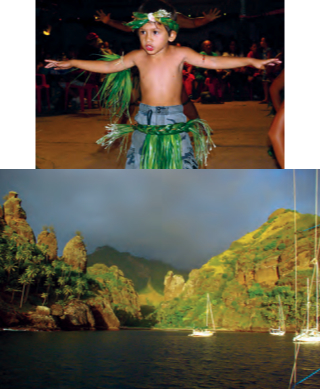
We pull into Hanavave Bay on Fatu Hiva after a long afternoon of sailing. The jagged mountains and deep valleys of the Marquesas Islands have made for gusty, shifty winds and trying sailing conditions. We long ago stopped depending on the engine to get us to our destination. Repeated engine problems throughout Central America have caused us to think of our engine as advertised: auxiliary power to get us in and out of harbors and off anchor. So we have spent the afternoon tacking into the winds funneling out of the bay.
We cautiously approach the anchorage, since our depth sounder — newly installed in Panama City — is again on the fritz. It seems like we may never exterminate the electronics gremlins on board. The anchorage is fairly busy and, as we pass by, the skipper of a German-flagged boat advises us to head in as far as possible as the whole bay is very deep. He says he’s anchored in 30 to 35 meters. We find a spot close to the sheer cliff on the left-hand side of the bay. The water is clear and I can make out shapes on the sea floor. At Steve’s signal, I pay out the chain. I am not too worried about the lack of a depth sounder. I became pretty good at seeing the slight hesitation in the chain when the anchor hits the bottom while in Mexico, when our original depth sounder stopped working. But, this afternoon, perhaps it’s too deep, or I’m paying out the chain too fast, or I’m not paying attention; the chain screams endlessly off the windlass. I lock off the gypsy at 60 meters and we wait. It seems like we’re dug in but, without a true depth reading, I’m hesitant.
I head to the cockpit to grab the back-up depth sounder: a lead weight on the end of a marked line. Back on the bow, I toss it over and all 18 meters wind off without a pause. We are deep. I attach the lead line to a hand fishing line and toss it over again. The line slackens at 25 meters! We’ll have to start getting used to these deep South Pacific anchorages. I pay out all 80 meters of chain and we hang sharply into the wind. After sitting in the cockpit a few hours and watching the boat ride safely in 25-knot gusts, we decide we are firmly anchored and feel confident enough to go below and start dinner.
What’s that sound?
The next morning we’re back to boat business as usual: troubleshooting the depth sounder and routine cleaning and maintenance. All morning I can’t help but hear the rhythmic thumping coming from shore. It’s vibrating though the hull and ricocheting off the surrounding hills. It buzzes in my ears. I can feel it in my chest. Drums. When Steve suggests that we head to shore to find the source, I have one foot in the dinghy before he finishes his sentence.
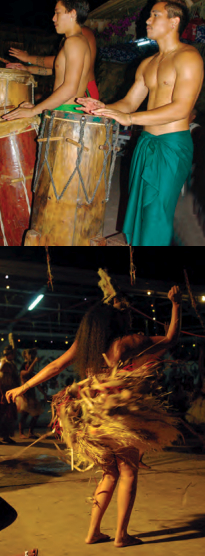
As we motor the dinghy around the breakwater that has been obscuring our view of the town, we are greeted by what seems like the whole community — at least 100 people — gathered on a stagelike concrete pier. The local dance troupe and band are here to practice as their big mid-July celebration will soon be upon them. The Heiva will culminate in days upon days of dance competitions. The concrete pier is the perfect setting, flat and unencumbered. The sheer 50-meter rock wall behind it creates a natural amphitheatre, sending their music and voices out into the valley and surrounding harbor.
As we pull the dinghy up the concrete ramp, I twist and strain to watch the performance: row upon row of men and women weaving in and out, hips twisting, arms flowing, voices raised. We walk out onto the rocky point and take a seat. With the warm clear water sloshing around our feet, we watch the performance and the village children frolicking in the water and leaping off the pier into the ocean. The activity is as elegant as a ballet and as visceral as a war dance. The dancers move back and forth in a well-practiced choreography, taunting, teasing, and challenging one another as the various guitars strum a melodic song and the drums keep a primal rhythm. A director of sorts with a clipboard shouts directions and cues the dancers in their vocal responses. I can’t take my eyes off them, not even to dig out a camera and snap a few pictures. The dances seem at once completely foreign and inherently familiar to me. We are mesmerized.
The beat goes on
A few days later, while returning from shore on a brief water-and-provisions run, we stop to say hello to friends on a neighboring boat. As it is a hot late afternoon, they invite us aboard for a cool refreshing drink and we end up passing the afternoon exchanging stories. As the sun dips low on the horizon, the anchorage is once again filled with the distant sounds of drums. Try as we might to ignore them, the drums call to us and soon we pile into our dinghy in search of the sound.
As soon as we land, someone stops to tell us to follow the shoreline to a soccer field, where the dancing is being held. We hobble barefoot down the rocky beach and across a stream to the soccer field full of people assembled into lines and groups, once again rehearsing their dance.
We shyly join the onlookers, trying to get good seats without infiltrating the local crowd too much. In the last of the day’s dusky light we sit transfixed and watch another stunning, yet totally different, performance. I smile at the 4-year-old girl on the sidelines as she mimics the dance group, sashaying and turning at all the right cues, singing, and chanting in time. It seems that everyone is imbued with rhythm here; everyone knows how to dance. But my attention is primarily drawn to the musicians. Young and old, they sit at the head of the field, their guitars, ukuleles, and drums giving voice and rhythm to the dancers. I am transfixed by their fast staccato beats and, without a word, get up and start toward them, their songs vibrating inside my chest. My feet carry me toward this ancient sound as if they have known it all along.
Slowly, I walk a little closer, then closer still until I am standing beside a young man beating a 4-foot high drum. I can’t help but stare. He is almost dwarfed by his instrument, but at the same time he is strong, concentrated, and handsome. Suddenly he notices me, turns, and smiles without ever falling out of time. Encouraged, I move a little closer.
Who, me?
He motions to me with a tilt of his head and a nod, a slight raise of his eyebrows, and flicker of his eyes. Do I want to try? For some reason, I don’t hesitate (perhaps it was that last rum sundowner). I step in front of his drum. He pauses as he moves to make room for me beside him. Then he picks up the beat again, showing me how to play this incredible drum before he steps back and pulls a pack of tobacco out of his pocket to roll a cigarette. Brazenly, I bring my hands down on the taut goatskin and try to keep up with the band. I catch the rhythm for a few bars then drop it, the tempo and cadence quite unlike anything I have played before.
With a tight cigarette balanced on his lips, the young man steps beside me and demonstrates his skill again, then recedes, takes a haul on his smoke, and motions me to try again. I catch the tune for another few bars before losing myself in the music. Somewhat determined, I let the band play on and jump in again when I feel the timing is right . . . only to falter after a few bars. I look up into the crowd of dancers and catch a woman in the front row giving me the hairy eyeball; I am obviously not helping the band. Regardless, I give it one more try before the man stamps out his cigarette and returns to his instrument. I step aside but barely out of the way, thrilled that he gave me the opportunity to try my hand on his beautiful drum.
The sun has long gone and, as there is no electric lighting to illuminate the field, the performance is soon over. As the band begins to pack things away I meander back over to help my drummer carry his drum inside the nearby shed, trying to make conversation in broken French while admiring all the instruments. When I return to Steve and our friends waiting on the dewy grass beside the now empty field, they are as speechless as I am elated. It is not like me to act so spontaneously, to get up and play a drum in front of a hundred strangers. I can’t explain it. Words can’t convey this incredible feeling in my chest. As we walk back to the dinghy, I feel like I’m on air. I am beaming with a wide smile and can’t stop talking about playing that drum.
In the days and weeks to come, we have many more chances to see dance performances and other bands play in the Marquesas. All of them are fantastic, memorable performances. But they pale in comparison to the night when I stood barefoot in the wet grass and lent my sound to the symphony that filled the valley in Hanavave Bay.
That night, for a short while, I was part of the community. I was just one of the band.
I am not sure that I dance to the beat of a different drum, but I certainly recommend going in search of the sound of one echoing through a distant valley. You never know what great spectacle you might find or what opportunity awaits.
Heather Francis and Steven Hertik have been sailing Kate, their 1973 Newport 41, throughout the Pacific for the past three years. Originally from Canada and Australia, respectively, they’ve been traveling and working on the water together for the last decade and consider it home. Follow their travels at www.yachtkate.com.
Thank you to Sailrite Enterprises, Inc., for providing free access to back issues of Good Old Boat through intellectual property rights. Sailrite.com