A sturdy club racer and coastal cruiser
Issue 86: Sept/Oct 2012
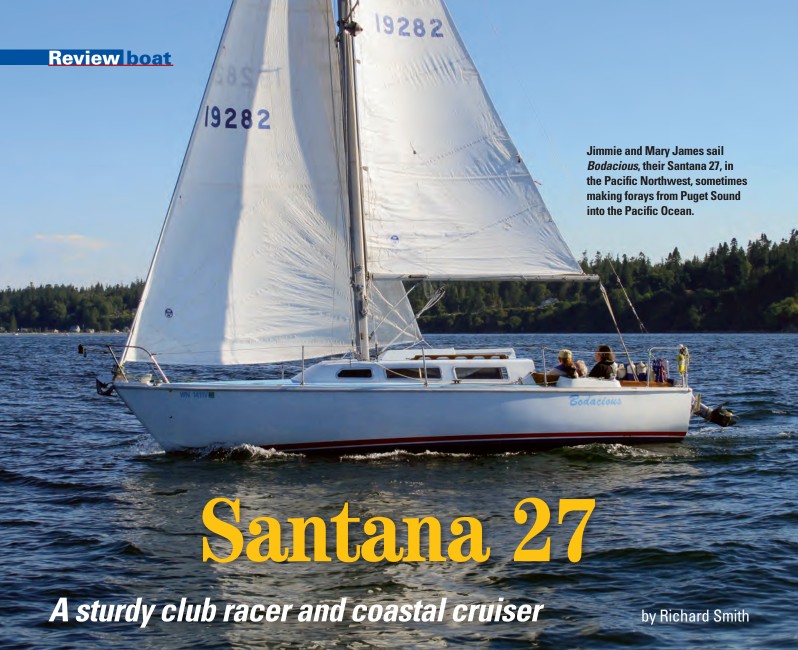
Humphrey Bogart’s sleek and much-loved yacht, Santana — a contraction of “Santa Ana” — was named for the katabatic winds that blow through the valleys of Southern California. W.D. “Bill” Schock, one of the leading lights of the fledgling West Coast fiberglass boatbuilding industry in the years immediately following World War II, thought it a good name as well, attaching it to no fewer than 16 models his company built: the Santana 21, 22, 23D, 23K, 25, 26, 28, 525, 228, 30, 30/30 PC, 30/30 GP, 30/30 RC, 35, 37, 39, and our review boat, the Santana 27.
Bill Schock grew up in Hollywood and played an important role in making sailing available to the growing middle class. He built a cold-molded International 14 for himself, but before it was finished he sold it and thus launched the W.D. Schock Boat Building business. The year was 1946. He went on to produce the fiberglass Lehman 10, which was followed by the one-designs Snowbird, Sabot, and Schock 22. But it was the Lido 14, introduced in 1958, that secured the reputation of the company.
Bill met naval architect Gary Mull in 1965 and together they developed the popular Santana 22. Many of the 747 22s built still sail the windy waters of San Francisco Bay. Gary went on to design the Schock 37 and the Santana 27. The latter boat was in production from 1967 to 1974.
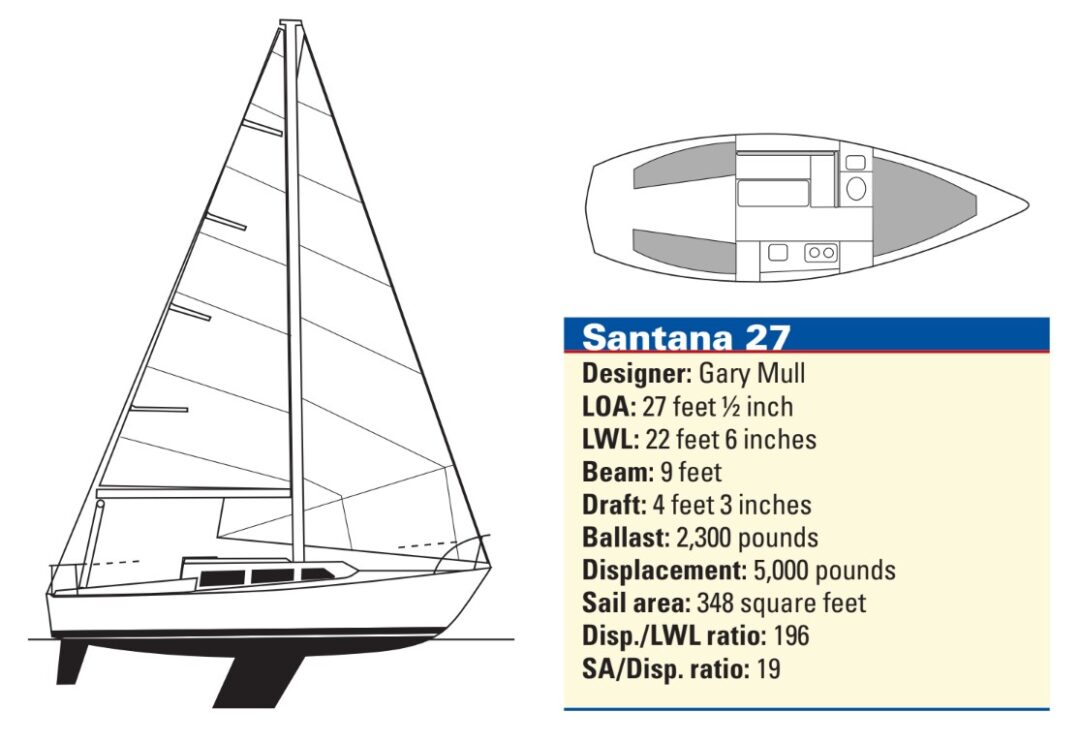
Design
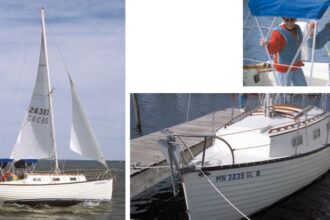
Our review boat, Bodacious, was built in 1969 and has been owned by Jimmie James of Kingston, Washington, since 1985. Gary Mull’s design for the Santana 27 brought together many of the features that marked his work during the later 1960s and early ’70s. The design shows none of the characteristics often associated with the Cruising Club of America (CCA) rule, which was on the wane at the time, and predates the International Offshore Rule (IOR). All in all, the 27 is a wholesome design free of the sometimes unfortunate quirks of boats designed to take advantage of a rating rule.
The sheer has an easy spring in it from the transom to the nicely drawn spoon bow. The boat has a lively, almost sleek, appearance when viewed from the port side. From starboard, however, the offset companionway hatch and sea hood abaft the mast look ungainly.
A club racer/cruiser, it has a fin keel and spade rudder. The displacement/LWL ratio is a moderate 196. A generous sail plan gives a sail area/displacement ratio of 19, suggesting that the boat performs well.
Inboard and outboard models rate around 198 seconds per mile under PHRF. For comparison, the largest fleets of Catalina 27s, inboard and outboard models, rate 204. A Cal 27-2 inboard rates 198 and the C&C 27 rates between 198 and 210.
Construction
The Santana 27’s construction is typical for its class of boat and the time it was built. The standard provisos apply. The hull is laid up of solid fiberglass and the deck consists of laminations of fiberglass separated by a plywood core. It’s good, stiff, and solid construction but, when water penetrates the fiberglass, laminated decks are subject to rot, especially near fittings like cleats and chocks. The prudent owner will keep a close watch below the chainplates, a favorite hiding place for rot. Ditto for the bottoms of bulkheads and low cabinetry.
Not long ago, Jimmie noticed softness underfoot in the deck area above the forward cabin. Following an established procedure, he drilled closely spaced, small-diameter holes into the top skin of the deck and injected Git-Rot epoxy into the affected area. It’s not an easy fix but, if the damage isn’t extensive, decks can be economically restored to previous stiffness in this manner.
The deck-to-hull joint is formed by the deck edge resting upon the outward-turning flange of the hull. The two moldings are bonded chemically and fastened mechanically with bolts and the inside of the joint is taped with fiberglass. A vinyl rubrail conceals and, to a certain extent, protects the joint. There has been no separation or water leakage at the joint on Bodacious.
Owners are advised to check that through-bolted deck hardware is backed up satisfactorily. In spite of the use of fender washers in lieu of backing plates, there have been no failures in many years of hard use, with one exception: during a day of heavy sailing, the traveler extrusion tore away from the cockpit molding. Jimmie replaced it with a heavier piece of hardware bolted through the reinforced fiberglass molding with heavy backing plates.
By 2001, Bodacious was showing blistering on the bottom and a lot of stress cracks. Jimmie decided to grind the gelcoat off the hull, cockpit, topsides, and bottom and recoat everything. It looks fine and there has been no further blistering. He replaced the standing rigging at the same time.
The Santana 27 has three fixed portlights on each side. Leaks are not uncommon but the glass and frame can be readily removed. Jimmie replaced the tempered glass of one of his ports and re-bedded it with little fuss.
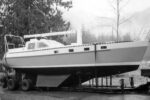
The keel is made of cast iron and must be protected against corrosion with quality coatings, preferably epoxy and bottom paint.
On deck
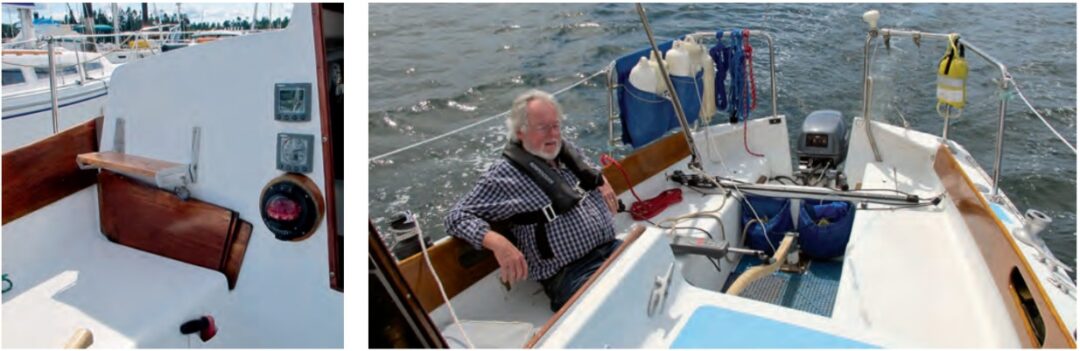
The deck on Bodacious is clean and unencumbered by superfluous gear, as befits a small yacht given to leaving the inland sea of Puget Sound to face the strong winds and currents of the Pacific Ocean while circumnavigating Vancouver Island. Jimmie and his wife, Mary, sail their boat hard and, for them, simplicity in all things is a guiding force.
A 22-pound Bruce anchor is kept in a husky bow roller with anchor tackle (15 feet of 1/4-inch chain and 200 feet of 3⁄8-inch nylon) led through the deck and stored in an improvised box above the foot of the V-berth below. A 14-pound Danforth carried on the stern pulpit serves as a stern anchor.
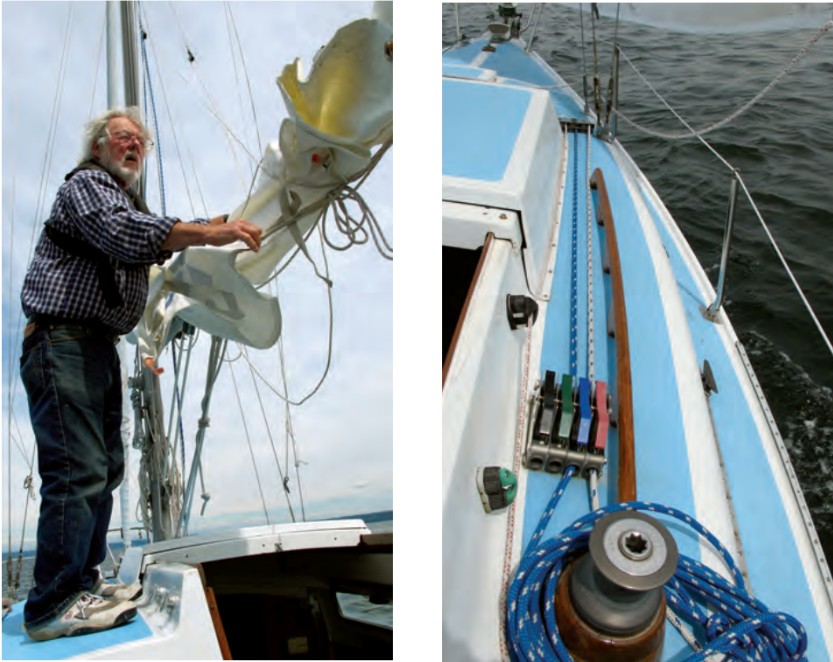
Main, headsail, and spinnaker halyards, as well as first and second reefing lines, are led aft to clutches mounted on the starboard cabintop and tended by a Barient #10 winch. Sheets are handled by Harken #32 self-tailing two-speed winches. Jimmie added Schaefer headsail-furling gear in 1998.
The foredeck and sidedecks are markedly cambered and — though providing a little more headroom below and good footing on deck to windward when heeled — they can be hazardous when working on deck at dockside. Chainplates mounted on the cabin trunk ease the situation somewhat and provide for better sheeting angles for windward work.
Gary Mull resolved the conflict between the asymmetrical accommodation plan in the cabin and the topside area by offsetting the companionway. This makes for a rather crowded space to the starboard side of the hatch and sea hood.
Cockpit
The cockpit is spacious and provides ample lounging and sleeping space while at anchor. The seats offer good back support with a convenient leg-bracing distance between them. Cockpit stowage is minimal, restricted to the lazarette that contains a couple of 6-gallon cans of gasoline in addition to everything else.
Over the years, Santana 27s were equipped with a variety of inboard engines, including the venerable Atomic 4 and Yanmar 1GM 10, but Jimmie proclaims the Yamaha 9.9 four-stroke outboard motor a perfect match for the boat. It’s clean and quiet and has proven sufficiently reliable for his considerable cruising needs. Cruising speed is about 5 knots and tops out at about 6 in quiet water. A deep notch in the transom gets the prop low enough to get a good bite on the water. Cavitation has not been a serious problem. The 10-amp alternator provides enough battery-charging power for lights and judicious use of the Webasto heater over two or three nights at anchor.
The Yamaha is larger and heavier than the old Evinrude two-stroke it replaced and this required strengthening the transom below the cutout. While he was at it, Jimmie also added two corner braces to the transom at deck level.
On one occasion Jimmie took green water into the cockpit — about 6 inches — and found the two drains to be wholly inadequate, a common fault of many boats. Santana 27s were built with fiberglass tube “through-hulls” extending between the scuppers and hull. A hose for draining the sink was tied into one of these tubes. Jimmie replaced the tubes with bronze seacocks.
Rig
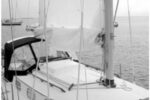
The Santana 27 is a masthead sloop with a deck-stepped mast. The mainsail is on the small side and carries a very high boom. The idea was that a working jib would provide for leisurely cruising and a large foretriangle would accommodate big genoas and spinnakers for racing. But that was in the days before jib furlers. Today, Jimmie carries a 135 percent genoa. He tucks the first reef in the mainsail in about 18 knots of wind and adds the second when it steadies above 20, still flying the full genoa. On occasion, he reefs the genoa to settle her down.
Standing rigging consists of a forestay, single backstay, upper and lower shrouds attached to chainplates on the main bulkhead, and forward lower shrouds on separate chainplates.
Belowdecks
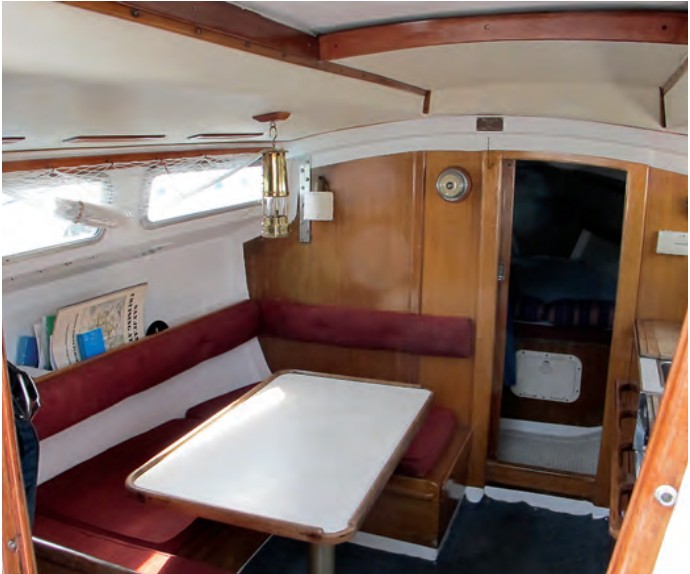
Owing to the boat’s lower freeboard, and the cabin designed in proportion, headroom below is just 5 feet 9 inches, with a bit more under the companionway slide. At 6 feet, however, I found little difficulty moving about the Santana; just a slight nodding attitude seemed to do the trick.
The forward cabin has a wide — if a tad short for me — double berth. Beneath it to port is a 10-gallon holding tank for the marine toilet and to starboard a 15-gallon freshwater tank. A small hanging locker just aft of the berth on the starboard side is now outfitted with shelves for folded clothes. A sliding door separates the forward cabin from the main cabin.
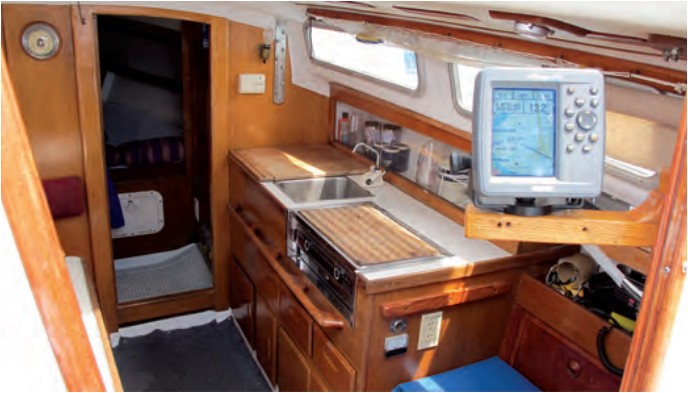
The saloon layout is in the California tradition with a galley to starboard opposite an upholstered dinette with a fold-down table that converts into a double berth. Just abaft the galley is a seat with an electrical distribution panel below. Good use is made of teak cabinetry and bulkheads and the atmosphere is light and cheerful. Jimmie installed a new overhead lining in 2001.
When they provision carefully, Mary and Jimmie James can cruise Bodacious independently for about a week without needing to obtain further supplies of food or water. In keeping with their general goal of simplicity, they cruise without ice, preferring to carry extra food in the icebox rather than blocks of ice. While we talked about the boat, Jimmie and I enjoyed two plenty-cold-enough beers cooled by the near-freezing waters of Puget Sound.
There are two quarter berths — a fairly normal one to starboard and a secondary cubbyhole to port with a tortured entry that only a curious child could discover. This storage area might be more useful if it were accessible through a cockpit seat hatch.
Under way
The Yamaha started on the first pull. Compared with an inboard of similar horsepower, the engine was smooth and quiet without a hint of vibration or scent of fuel. Backing was certain leaving the slip and we made for deep water. Jimmie set the Autohelm tiller pilot and hoisted the main, complaining a little about the friction, as the halyards are led aft to the cockpit through turning blocks. I gathered in the fenders and tidied up stray halyards and sheet ends before taking the helm. Jimmie cranked in the sheet to unfurl the genoa and we leaned into a nice 10-knot breeze, quickly making 3.5 knots over the ground.
My first impression was how well the Santana stood up to the occasional gust, accelerating smoothly and shrugging off the wakes of ferries and passing powerboats with the assurance of a larger and heavier boat. A second impression was how close-winded the boat is. The Santana consistently went beyond the point that I thought would cause her to luff up. The boat is finely balanced with just the slightest weather helm in the gusts.
Bodacious is well laid out for singlehanded sailing, most of which can be done from the cockpit. But when coming into the dock, I found the narrow, heavily cambered sidedecks to be particularly hazardous.
Conclusion
The Santana handles as well as any 27-footer can be expected to under sail and when using the outboard engine in a variety of conditions. Well sailed and with a good suit of sails, it’s very close-winded and generally well-behaved. Jimmie has found that, when handled conservatively, the Santana 27 can stand up to the rigors of occasional offshore cruises.
Prospective owners would do well to try moving forward and aft on the sidedecks a few times. The cambered decks, the contorted access to the port quarter berth, and the shortage of cockpit-accessible stowage are peculiar to the Santana 27 and should be evaluated carefully.
Richard Smith , a contributing editor with Good Old Boat, is an architect. He specializes in designing and building very small houses and has built, restored, and maintained a wide variety of boats. He and his wife, Beth, sail their Ericson Cruising 31, Kuma, on the reaches of Puget Sound.
Thank you to Sailrite Enterprises, Inc., for providing free access to back issues of Good Old Boat through intellectual property rights. Sailrite.com