Artful modifications relieve trailersailor angst
Issue 87 : Nov/Dec 2012
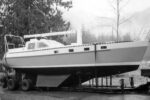
Several years before retirement, my wife, Johanna, and I purchased Someday Lady, a trailerable 1995 Catalina 25. It’s the water-ballasted centerboard model, hull #151. As a way to transition into retirement, Johanna and I lived aboard for an entire year while cruising and trailering our boat around the continent from Vancouver via San Diego to Florida, north to Ontario, and then through Ontario’s Trent-Severn Waterway from Lake Ontario west once again to Lake Huron’s Georgian Bay. We spent approximately half the time on water and half on the road. Someday Lady was our home for that year as we followed the sun, covering more than 16,800 miles. So that she could accommodate us comfortably, we invented, made, and added a variety of modifications.
Have you ever traveled to and launched your boat at an unfamiliar rough, old, and dilapidated ramp and noticed that your trailer-jack wheel was stuck, bent, or being destroyed by the ramp’s grooves, cracks, or potholes? Perhaps you concluded that the ramp was too shallow to provide clearance for your keel and you needed a hitch extension to avoid backing the tow vehicle into the water.
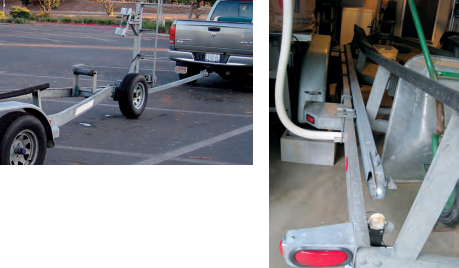
Our desire to be prepared after witnessing or hearing of problems such as these gave us the incentive to fabricate a simple 9-foot-long sleeve hitch extension. Reversing the mounting arrangement of the trailer’s spare wheel gave us a substantial hitch jack and eliminated all our ramp worries, regardless of the ramp’s condition.
Simple fabrications
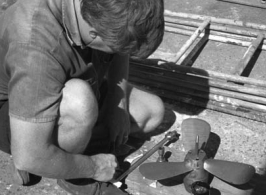
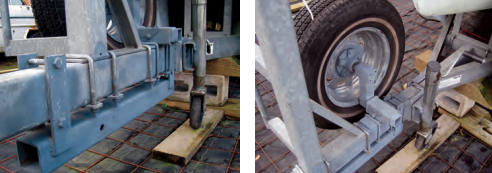
We took a 2-foot length of 3-inch outside-diameter, 1⁄4-inch wall, square steel tubing and welded brackets to it so we could bolt it to the underside of the trailer’s hitch beam. Into this sleeve we can fit a standard 10-foot-long, 2 1⁄2-inch outside-diameter, 1⁄8-inch wall, square-tubing hitch extension. We secure it with a regular trailer pin inserted through the sleeve.
We also fabricated a Z-shaped mounting arm for the spare wheel that allows the spare wheel to double as the trailer’s hitch jack. The arm is made of 2 1⁄2-inch outside-diameter square tubing and fits into a sleeve made of a short length of the 3-inch tubing fitted across the hitch beam. We welded a bracket to the sleeve so we could attach it to the hitch beam with U-bolts. We used bolts rather than welding on the trailer itself to avoid problems with rust. After degreasing all the fabricated steel parts, we sprayed them with several coats of 95-percent-zinc liquid cold galvanizing.
The Z arm is secured in the sleeve with a pin. When we want to use the hitch extension, we remove the pin, pull the wheel from the sleeve, and re-insert it in the down position. The wheel will then carry the weight of the trailer and boat while we use the hitch extension, which is approximately 9 feet long and equipped with its own hitch/ ball arrangement.
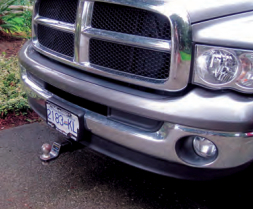
As the saying goes, “We would not leave home without it.” The process of launching and retrieving a boat always creates a little apprehension. Using our spare wheel and extension takes away the worry when we come to unfamiliar launching ramps, whether natural or manmade, especially if the ramps are remote or in disrepair.
Henk Grasmeyer , a native of Holland, learned to sail at the age of six in a rowboat with an oar and a bedsheet. Later, when living in British Columbia, he owned a Hobie Cat for years. Now retired, he and his wife, Johanna, sail and trail their Catalina 25 all over North America.
Thank you to Sailrite Enterprises, Inc., for providing free access to back issues of Good Old Boat through intellectual property rights. Sailrite.com