A good old springline suffices on a good old boat
Issue 87 : Nov/Dec 2012
I recently came across a new Jeanneau with the 360 Docking system. A drive leg that rotates through 360 degrees, coupled with a bow thruster, allows the operator to maneuver the boat in virtually any direction, including to parallel park, simply by moving a joystick. That will come in handy when you take your boat to the nearest Target store. It also might improve your video-game scores as well as save your topsides.
I doubt that many good old boats will be retrofitted with such a handy system. However, owners of good old boats need not worry. We can accomplish almost the same thing by the tried and traditional use of springlines, wind, and current — albeit with a little more difficulty and no improvement in our video-game dexterity.
Singlehanded reverse
For me, leaving the dock is more difficult and stressful than other docking maneuvers. My boat refuses to back in an orderly manner. It crabs hard to port. In fact, with a decent wind on the stern, it will go sideways as much as it will go backward. In the right conditions, it has been known to do an uncontrolled right angle turn in reverse. Unless there is virtually no wind, if the fairway exit is to my port, I have to back all the way down the fairway.
Many good old boats, especially those with full keels, behave in a similar way in reverse gear. The problem, however, is easily solved with the use of a springline.
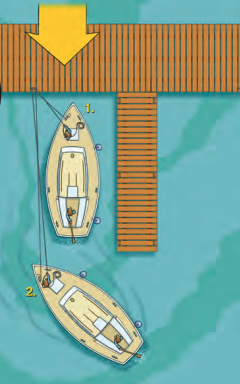
Before backing out of a slip, I attach the springline to the starboard stern cleat on the boat. I lay the line over the horn of the last cleat on the dock and double it back to the boat, making sure that it will run free. At this point, I often receive questioning stares from dock lurkers. I ignore their smirks.
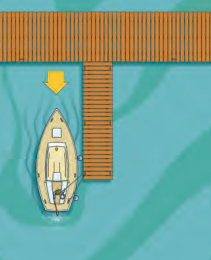
If I’m alone, I hold the springline in one hand and operate the boat with the other hand. I start backing the boat. When it begins to get out of line, I restrain the springline with my hand. That brings the stern back in line to allow the boat to back straight. When I am far enough out of the slip for the bow to clear, I hold the line tight. The boat pivots in an arc and the bow rotates until the boat is parallel to the fairway. I then nod to the lurkers, put the transmission in forward, and drive the boat straight out of the fairway. It may sound a bit complicated but it’s really easy.
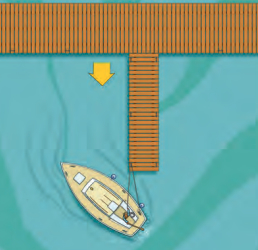
To perform this maneuver, I use 80 feet of 5⁄16-inch polypropylene line. It’s long enough to allow me to completely clear the slip if need be. The line is slick, so it slides easily through the cleat on the dock. It also floats, so it won’t be caught in a propeller, mine or anybody else’s. I imagine that fouling someone else’s prop could cause some on-the-water discord. Before I start, I fake the line on the boat to ensure that it will run free. Once I start forward, it’s easy to pull the line in. With a little imagination, this technique can be used in many tight situations with crosswinds and crosscurrents, and it’s cheaper than a joystick.
Strong wind on the bow
Backing out of a slip isn’t much fun with a strong wind on the bow. The bow will tend to blow off before the boat can be brought under control in reverse. This often is cause for inappropriate language.
A person on the bow can double the same polypropylene line back from a cleat on the dock. With one end of the line cleated to the boat and the other in hand, the bow person can let the line out slowly to allow the boat to clear the slip. When the boat is clear of the slip, the engine can take over and the line is hauled in. All this can be accomplished with hardly a word spoken, let alone an inappropriate one.
Gone with the wind
When I first learned to sail, some decades ago, I was on a linear dock with boats rafted two deep ahead of my boat and astern of it. I was by myself and wanted to leave, but felt stuck. I asked a fellow on board one of the other boats if he would help me leave. He said, “If you knew how to use springlines, you wouldn’t have a problem.” He then walked away.
I was deflated, but he was right. If I had known how to use springlines, I would have had my own 360-degree system. I could have left very easily.
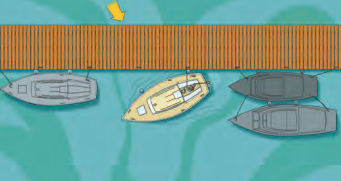
With the boat on a starboard tie and with the wind on starboard, leaving the dock is a simple matter. If the wind is not too far aft, simply releasing the bow line and holding in the stern line will allow the bow to blow out and clear the boat ahead. Make sure the dock cleat is even with or somewhat forward of your boat’s stern cleat. It’s a good idea to place a fender at the stern to prevent contact with the dock.
The easiest way to perform this maneuver is to double the stern line back to the boat, hold it from on board, and release it when the bow is clear. That way you don’t have to clamber aboard after releasing the line from the dock cleat and risk falling in the water as the boat goes off by itself.
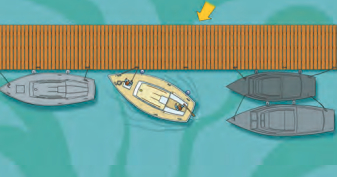
If the wind is too far aft for the bow to blow clear of obstacles after the bow line is released, simply reverse the maneuver. Double the bow line back to the boat, then release the stern line. The wind will blow the stern out, allowing the boat to back out and clear the obstacles after you release the bow line. Again, the bow line should
be even or abaft of the bow cleat (or chock) and, unless you want to learn about gelcoat repair, place a fender at the bow.
One or the other of these maneuvers can be performed with the wind on the bow or on the stern. If the wind is on the stern, release the stern line first and hold the bow line tight until the stern swings out. If the wind is on the bow, release the bow springline first and hold the stern springline tight until the bow swings out.
Going against the wind
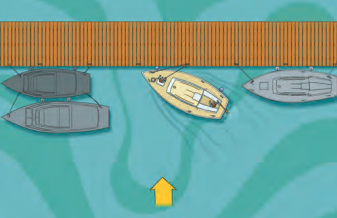
A more difficult maneuver is required when the wind is on the port side pushing the boat onto the dock. The first thing I usually do is curse. Once that is out of the way, I lead a springline from the bow to a point on the dock near midships and double it back to the bow. Then I either pull on the bow line or put the transmission in forward and apply some power. The shape of the boat will cause the bow to go in and the stern to go out. If you are lucky, the stern will swing out far enough that the wind will catch it and push it out farther. On my boat, when it really crabs hard to port, I can usually force the stern into or past the eye of the wind after I start backing out. This is a bit more complicated maneuver, but once you are used to using springlines it won’t present any difficulties.
Arrival complications
Entering a slip or maneuvering to a side tie generally seems a bit easier to me. Some friends of mine have a slip across from the guest dock at Shilshole Marina in Seattle. It’s great fun to spend cocktail hour observing the docking maneuvers in the guest slips.
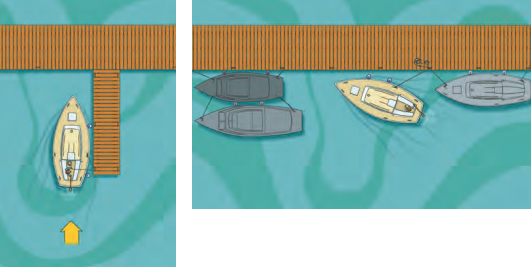
Very often, the first person off the boat (or someone on the dock) grabs the bow line first. If that person attempts to stop the moving boat with the bow line, the bow might stop but the rest of the boat will use its momentum to swing the bow toward the dock and the stern away from the dock, and the person poised to step decorously from boat to dock now has to make an Olympic leap over a widening gap of water. Usually, the Olympic leap is done successfully.
Because my stern kicks hard to port in reverse, I’ve made this heart-stopping leap a number of times when bringing my boat starboard-side-to into a slip or a dock.
About the only time to grab the bow line first is when the wind is on the bow. The wind then helps to stop the boat and the bow line can be secured first to keep the boat from being blown out of the slip.
One useful technique when docking downwind is to use a springline abaft the center of lateral resistance. I place the line on the first dock cleat as I enter a slip or side tie. It will stop the boat and pull it into the dock at the same time, which is very useful for those of us who think we’re too old to attempt heroic leaps.
I also use this technique when the wind is such that it wants to push the boat away from the dock. As soon as the springline is secured on the dock cleat, I put the boat in forward with appropriate throttle to hold the boat on the dock until other lines can be secured.
Parallel parking
This same technique can be used to parallel park, even without backing up. However, someone has to be on the dock to handle the springline. Putting someone on the dock may be a minor problem but after that, the rest is easy. The springline needs to be attached abaft the center of lateral resistance on the boat and to a cleat on the dock even with or behind the stern. If the person on the dock holds the line tight on a cleat, when the engine is put in forward the boat will move to the dock. If the boat needs to come in directly sideways, the person on the dock can pull the line in as the boat moves toward the dock. The helmsman must decrease power to allow the dock person to do this.
Honor our fathers
I admit that parallel parking with the new Jeanneau system is easier, but it’s not as interesting. Also, using springlines attaches us to the long history of sailing, much like using a sextant. On the other hand, just as GPS has displaced the sextant, I expect that the new Jeanneau system will be standard on boats of the future. However, until that day, we can reach back to the techniques used by our forebears to perform those functions and honor them when we do it.
Carl Hunt is a semi-retired economist. He lives in Colorado and has sailed for 30 years and cruised his boats from British Columbia to Mexico. He has chartered and cruised other people’s boats throughout the eastern United States and the Gulf of Mexico, the Caribbean, the Mediterranean, and other parts of the world.
Thank you to Sailrite Enterprises, Inc., for providing free access to back issues of Good Old Boat through intellectual property rights. Sailrite.com