Many things — coastal enforcer to racing machine
Issue 87 : Nov/Dec 2012
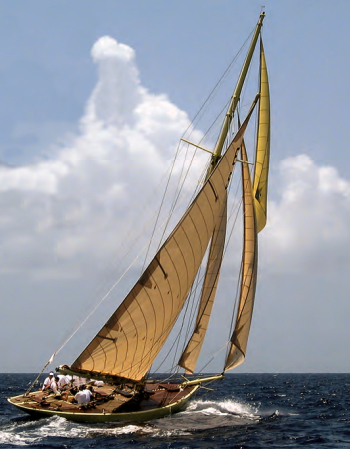
The term “cutter” has a long history in the sport of yachting. In the 1870s and ’80s it figured in a hotly debated controversy regarding the merits of the American sloop against those of the English cutter. This came in sharp focus in the early America’s Cup racing after 1881, when the challenge by the Canadian sloop, Atalanta, saw the end of schooners in this contest. This cutter/sloop controversy wasn’t completely resolved until the introduction of the Universal Rule in 1903, and America’s Cup defenses in this period were to a large extent predicated on the desire to prove the superiority of the American sloop over the English cutter. That is not to say that all cutters were English, as the famous Jolie Brise, winner of the Fastnet Race an unprecedented three times in the 1920s and ’30s, was in fact a French pilot cutter built in 1913.
However, the term cutter at this time referred not to the rig but to the service in which the vessels, such as the pilot cutter and the well-known revenue cutter, were engaged. The type of boat we know as a cutter evolved as the vessel best suited to those roles in and around the English Channel. However, when vessels were engaged to perform those same duties around the coasts of the United States, the American schooner rig was used. That did not stop these craft from being referred to as revenue cutters, even though they were schooner rigged. Indeed, after the Revenue Service became the United States Coast Guard, and sail gave way to power, USCG vessels of a certain size were, and still are, referred to as cutters.
Cutter yachts
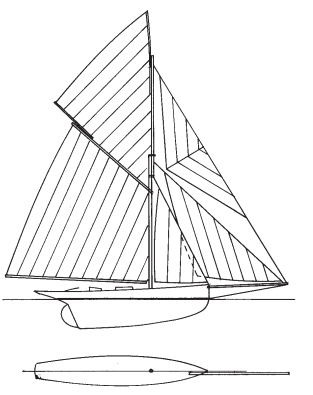
In the 1880s, a cutter was a keelboat of moderate beam, deep draft, heavy displacement, and a high ballast/displacement ratio with a high percentage of external ballast. It had a plumb stem, a long bowsprit, and a counter stern extending well aft of the rudder post, which was located at the aft end of the LWL. The boats were rigged with a single mast with a retractable topmast and a long retractable bowsprit mounted off-center. The only fixed forward rigging was the forestay, which went from the hounds at the top of the lower mast to the stemhead. The fore staysail was flown from this forestay, the jib was hoisted from above the hounds and set flying from a traveler on the bowsprit, and the jib topsail was set flying between the top of the fully extended topmast and the end of the bowsprit. The mast was usually set well back in the hull, as would befit the primary foresail being affixed to the stemhead. Retracting the topmast and bowsprit would dramatically reduce the pitching in a seaway and eliminate or greatly reduce the need for anyone to go out on the bowsprit to hoist or reduce sail. The gaff mainsail on the traditional cutter rig was loose-footed so it could be easily “brailed up” to the mast to quickly and effectively reduce sail.
So, the cutter rig was defined as having a retractable bowsprit and topmast and three headsails, one fixed and two usually set flying. Since the mast was stepped fairly far aft, the mainsail was smallish but could be augmented with a topsail set between the topmast and the gaff or on jackyards.
At this same time period, the American sloop had a light-displacement hull with wide beam, a smaller amount of primarily internal ballast, and a centerboard, not a keel. Both the bowsprit and the topmast were fixed in place, assuming there was a topmast at all. The early sloops, as exemplified by the famous (or infamous) sandbaggers, carried only one large headsail hanked onto a forestay that extended from the end of the bowsprit to the top of the mast. This jib was often clubfooted, and thus self-tacking. The mainsail was always lashed to the boom. Often there was no topmast or gaff topsail, nor a flying jib, nor a jib topsail.
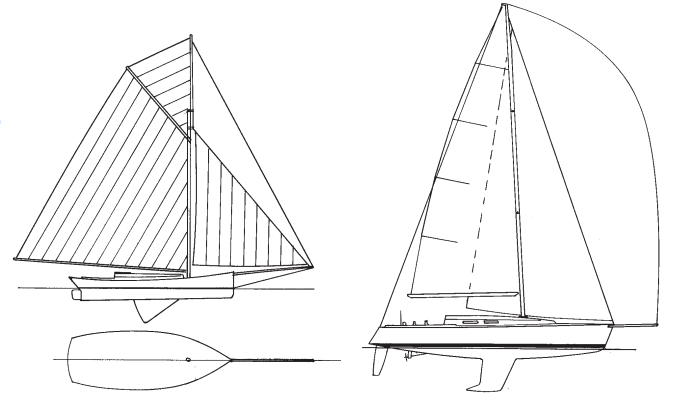
In the 1880s, these two distinct design philosophies were emerging on opposite sides of the Atlantic. While the British relied primarily on heavy displacement and ballast to achieve stability on hulls of moderate to narrow beam, the Americans relied almost entirely on form stability achieved with ever-increasing beam. These design trends were encouraged by the rating rules in use on each continent, and both reached their extremes with spectacular disasters that eventually forced yacht clubs to rethink rating rules and their detrimental influence of on the boats they encouraged. First came the Seawanhaka rule in North America, then the International Rule in Europe and the Universal Rule in North America. (Note: Both Ted Brewer and Bob Perry wrote about how rating rules influenced yacht design. You can read Ted’s article, “Rating Rules Shaped Our Boats,” in the May 2000 issue or online at: . Bob’s article, “Beauty is in the Numbers,” is in the January 2012 issue. –Eds.)
As the cutter rig and the cutter itself gained acceptance in the U.S., mainly through the efforts of the English designer John Harvey, who relocated to New York City, and through the writing and influence of the “cutter cranks” like W.P. Stephens and Charles Kunhardt (not to mention the exceptional performance of the Scottish cutter Madge on Long Island Sound in 1881), the two extremes eventually produced a compromise type with moderate beam, heavier displacement, external ballast with a centerboard, and multiple-headsail sloop rigs. As mentioned in a previous piece (see “Origins of the Keel/Centerboard,” July 2012), the 1885 Cup defender, Puritan, was the best known of these early “compromise” cutters. Eventually, after Vigilant in the 1893 races, even the centerboard disappeared, particularly under the Universal Rule.
Some would say that the only lasting vestige of the original cutter rig in modern yacht designs is the multiple-headsail configuration now restricted primarily to cruising boats. However, when you see a modern J/Boats one-design flying a masthead asymmetrical spinnaker off a retractable bowsprit mounted off center on a vertical stem, it certainly harks back to the original concept of the cutter of 130 years ago. Maybe we haven’t come as far as we think we have.
Rob Mazza is a Good Old Boat contributing editor. A sailor by passion and yacht designer by vocation, his long career around sailboats began at C&C Yachts back when now good old C&Cs were cutting-edge new.
Thank you to Sailrite Enterprises, Inc., for providing free access to back issues of Good Old Boat through intellectual property rights. Sailrite.com