High winds and high waters wreak havoc upriver
Issue 88 : Jan/Feb 2013
On October 29, 2012, the center of Hurricane Sandy made landfall near Atlantic City, New Jersey. The accompanying storm surge, driven by a high winds over a vast area of the Atlantic and boosted by a full-moon high tide, caused widespread damage across coastal New Jersey and New York. Lower Manhattan was inundated and in the dark for days, but even 40 miles up the Hudson River in Verplanck, New York, the river reached unprecedented heights. –Eds.
Saturday
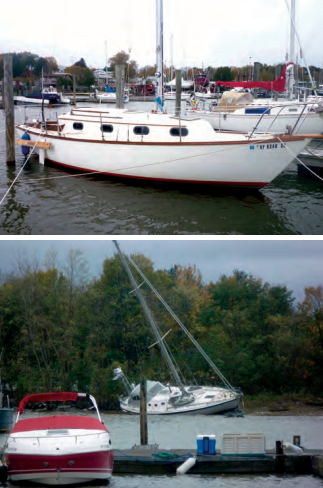
There was bustle, bravado, some folks drinking beer in their deck chairs, and breezy talk about past storms endured. Preparations were under way, some more serious than others. Einar Johannsen, the owner of Viking Marina, and his crew were hauling and blocking boats. The wind was sending a fast-paced mixed concoction of clouds scudding up from the south. As it brewed above, what it was wasn’t quite clear. The news had Sandy’s center hundreds of miles offshore and Cape Hatteras was feeling it.
Would the storm turn? And if so, when? The reports had it likely coming ashore somewhere in New Jersey. I soaked it all in and wondered: would I be better off in the water or tucked up on the stands? I walked around the yard, surveying the situations of several boats that had been put up. An elderly couple had just hauled their 50-foot trawler and were struggling in the wind, trying to pull an enormous tarp over the wheelhouse. I pictured that tarp — one of those gray ones from Home Depot — beating in the stronger wind to come and, worse, pulling like a parachute hard enough to rock the boat off its stands.
Windigo, my Cape Dory 28, was in a slip beside a 34-foot cruiser. Her owner, Ralph, had been tying off to the array of cleats on the main dock and finger piers. His approach — about 13 lines leading to every available anchor point — suggested that, even though no one knew for sure how things would pan out, he planned to be prepared. As he snapped photos of his lines, close-ups of his attachment points, and general photos of the big picture, we talked about what I should do. He suggested that I move my boat around to the other side of the dock. I considered: she would be by herself in a double slip, tucked between two pilings on her aft quarters, rather than in the open, and the cleats were a bit more solid and not already crowded with lines. The pilings at the ends of the finger piers were also about a foot taller, a little insurance should the water rise. Could it rise that high?
I started Windigo up and pulled her around. Then, with my neighbor’s help, we arranged lines and tied her off. I stripped and bagged the sails, unbolted the boom, and called it a day.
Sunday
The pace and tone of the yard had changed decidedly. There was an urgency in the air and the skies were furrows of slate. The sense that this was going to be just another bad nor’easter had disappeared with sleep. Whatever bravado remained was spent in lugging lines out of lockers and cinching them tight around anything that looked like it wouldn’t come loose. Reports were growing more ominous; Sandy was coming true. A replica tall ship used in the movie Mutiny on the Bounty was reportedly taking on water off the coast; its crew was boarding life rafts. Later we would learn the captain and one crewmember were lost. In the yard, the lift was busy. People scrambled and hustled. Wary owners walked the docks, talking into their cell phones. Andy, a marine electrician, who had his 50-foot sloop moored picturesquely in the bay all summer long, had moved her in and tied her off on a long stretch of finger at the end of our main dock. He had built this beautiful sailboat himself, spending, in his words, “all of my adult life” bringing that dream into reality.
The strongest winds in a hurricane are on its right side where, due to the storm’s counterclockwise rotation, its winds are in the easterly quadrant. Forecasts had the center of the storm coming ashore around Atlantic City, New Jersey. But given the size of the swirl — some 900 miles across — it was apparent that New York and the Hudson River were in the path of the most dangerous side of a pounding, historic storm. I looked over Windigo — looked at the lay of my docklines, thought again about having her pulled, then looked over at the lift hauling and blocking boat after boat. I went below and started heaping anything of value into the cockpit — binoculars, splicing fids, inflatable lifejackets, lantern and flashlights, books, cushions that were a winter re-covering project — and I wondered: if she goes down, what will these things mean?
I looked around at others. They all seemed to have the same expression on their faces: “This could be very bad, but what should I be doing?” I put the main boom below and cushioned it so it wouldn’t damage the sole, then lashed it to keep it from moving. As the midday tide came in, I stood silently watching how Windigo moved on her docklines. Ralph, who had suggested I move her around, asked, “You waiting for a train?”
“Yeah,” I replied, a bit grimly, “The Sandy Express,” and he managed a chuckle.
“You’re good,” he said. “You’ve done all you can do.” I wanted to believe that, but as I looked around me and up at the foreboding sky, I wondered.
On my way home along the river, I saw two sailboats anchored in the lee of Croton Point. The wind was predicted to come out of the northeast. There would be little fetch from the eastern shore and as the wind swung around to the south, as predicted, they would be protected by Croton Point. I wondered if Windigo would be better off away from all the docks and the other boats in the marina, some obviously neglected and bound to come loose if things got wild as promised. Then again, how would it be for a boat to weather it out with 85-mph winds doing all they can to yank her off the bottom and send her reeling down the river? I put it out of my mind. There are braver souls than thee in the world, I conceded to myself.
Monday morning
If there was any doubt in anyone’s mind about what might be on its way, it was washed away by Monday’s midday tide. Schools were closed for at least two days, the wind was building fast, and the time for decision-making had passed in the night. Einar, with a helper, was using a forklift to lift up and block the soda machine that sits in front of the marina office — three layers of railroad tie blocks ought to do it. I walked onto the dock. It was high tide and the ramp, which even at high tide would normally be angled down, was level with the land. Water was lapping within about a foot of the top of the bulkhead. Boats were racketing around and halyards were slapping on masts.
The New York Police Department had moved in with three workboats; they were made fast to an old barge that had been brought in and positioned at the mouth of our harbor to prevent . . . what? Boats and debris from washing in? Boats from washing out? If ground zero was New York Harbor, perhaps these boats were being kept behind the lines as part of the backup plan. Out on the river, several big boats and barges were anchored facing south.
It was now a waiting game and the biggest player was about to come through the door. Winds were steady in the 30s and gusting hard and the docks were heaving. The tenor of the situation had become more manic. If there had been any question in anyone’s mind about what he ought to do, it dissolved now into finding whatever ropes might still be stowed and tying them to whatever cleats remained. One sailboat had its mast base roped off to the dock. Lines crisscrossed slips. A couple of larger boats put out anchors, apparently to keep them from floating onto the shore should the tide rise high enough.
I tightened Windigo’s lines and doubled what I could. I cut some polypropylene hose I had stowed to replace water lines and wrapped my springline. It seemed petty at the time. All I could picture was my loose boat being slammed and sunk by whatever might break loose. I had a fenderboard from our trip across the Erie Canal over the summer. I draped it over a pair of fenders to buffer any hits from a nearby piling. I tied another line to the deck cleat and another to the base of a shroud. With 10 lines out, I ran out of cleats. I wrapped the mast with my spinnaker halyard and that was it. There was really no more to do.
Monday night
She came. Or he came. My daughter asked: “Is Sandy a boy’s name or a girl’s name?” We watched the trees in the streetlights blown about like rags in the wind. Then the power went out; the neighborhood went dark, and we heard the sound of exploding transformers and the cracking of branches. Our family slept together downstairs in the living room.
Tuesday
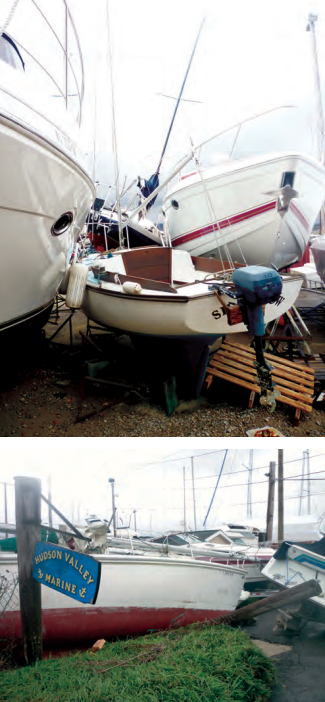
Overnight, an immense oak had fallen at the bottom of the street, taking with it the overhead wires and cracking the poles. In the morning, I had to sneak my car under the police tape and through the wreckage to get to the boat. The wind was cranking and there were few cars on the road. As I came down the hill toward the boatyard, I saw cars lined up and parked along both sides of the road. Motorboats had been blown through the gate at the yard adjacent to ours and now lay in the street. Others were piled up against the fence, the only barrier that kept them from spilling out into the roadway.
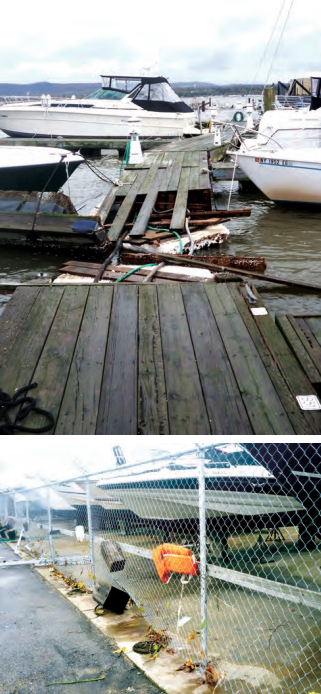
As I neared the gate to our yard, I saw masts pointed skyward at 45-degrees and, looking along our yard’s fence, I noticed lifejackets, ladders, and boathooks lodged between the posts and the mesh, evidence that where I was standing had, some six hours earlier, been submerged up to my waist at least. In the yard, boats that had been lifted off their jack stands were keeled over and sitting on their props and bottoms. In the harbor, finger docks jutted into the air, having been lifted over the tops of their 6- to 8-foot pilings with the rising water. On the shore to the north, Andy’s beautiful sloop lay on its side on the rocks, its mast tipping back and forth as the waves slapped the hull.
The end of the dock where Windigo was tied had broken loose as well, and floated at an angle. Finger docks that had broken off were floating loose among the wreckage. A long dock that ran the length of the marina’s breakwall was gone completely.
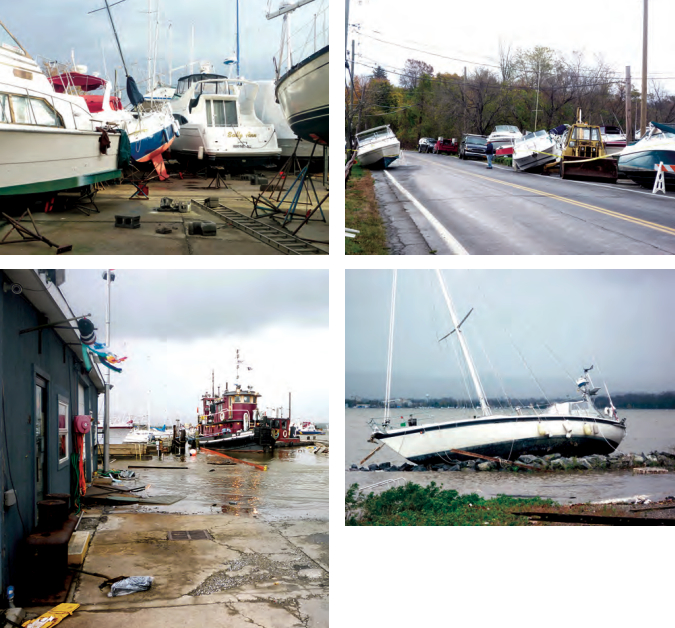
Windigo? She survived with a seriously bruised toerail. Einar said that when he looked out, she was rolling back and forth 45 degrees. The nearby marina office and Einar’s home had been flooded with 6 feet of water. I asked Molly Johannsen, Einar’s mother and the matriarch of the marina, if she’d ever seen anything like it in all her years. In her spirited and ever-optimistic voice she said, “No, we’ve never had anything like this.” Hers was a voice that promised, “We’ll get through this,” as she swept water toward the door.
Clenn Reed grew up and learned to sail on the New York end of Lake Erie. He, his wife, Kate, and their two daughters, 6 and 11, have spent their last few summers aboard Windigo, their 28-foot Cape Dory. Last summer they brought Windigo across the Erie Canal from Barcelona Harbor, New York, to winter over in the Hudson River near their home.
Thank you to Sailrite Enterprises, Inc., for providing free access to back issues of Good Old Boat through intellectual property rights. Sailrite.com