Finding homes for boatyard orphans
Issue 89 : Mar/Apr 2013
I was the kid on the block who rescued strays. My mother once remarked that I was a magnet for every homeless mutt in the neighborhood. They followed me home, tails wagging hopefully, and Mom always fed them while grumbling about muddy paws on her clean kitchen floor. As a grownup, I continued to rescue strays with the help of my husband, Steve. Without Mom around to set limits or complain about muddy paws, the strays we took in usually became part of our family.
Several years ago, Steve and I began noticing boats in need of rescue. It all started at the boatyard where we have wintered our own sailboats for nearly 20 years. Located on the scenic Hudson River, this small, family-owned yard is filled with an eclectic group of sailboats whose designs span a half-century. Steve and I spent so many spring and fall weekends there working on our boat projects it felt like a second home, one with friendly neighbors where help and advice flowed freely. During coffee breaks, we never tired of wandering through the yard, admiring our favorites, and chatting with their owners.
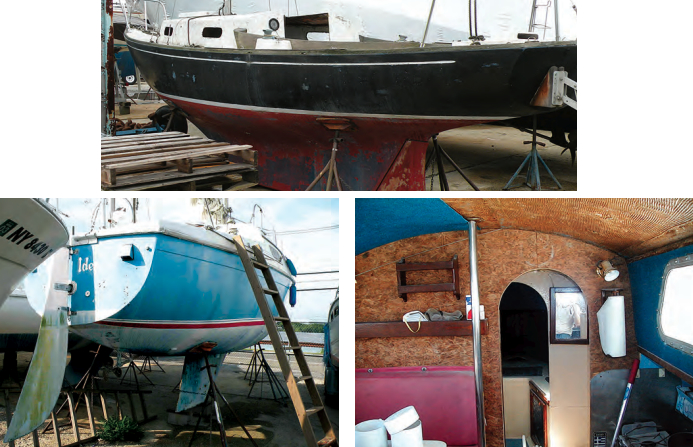
But in the midst of all this activity, it was obvious that some boats were suffering from long-term neglect. They had not seen the water for many seasons. Some slumbered beneath frayed tarps that flapped against their hulls; others lacked even a cover, their gelcoat faded and chalky from continuous exposure to the elements. Scattered across the boatyard, the seemed to be waiting patiently for someone to notice and awaken them.
We learned that since the recession had begun, more boats were being abandoned and the boatyard now held title to a growing number of sailboats that were taking up valuable storage space. They needed new homes or would be chopped up eventually and hauled away in a dumpster. They were all dirty and some needed major repairs, but we believed these boats deserved a second chance. Our “family” already included three sailboats, so taking on any of these projects ourselves (although tempting) was out of the question. The challenge was to find the right sailors for these boats. We knew that making a match of this kind could be a time-consuming project for the busy family that ran the boatyard, so Steve and I volunteered to help.
A motley assortment
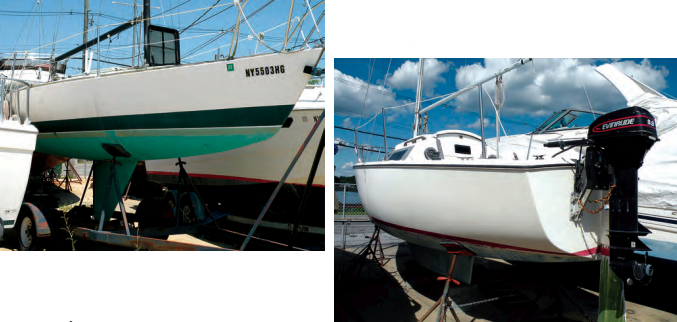
The abandoned vessels ranged from trailersailers to coastal and offshore cruisers. One lovely full-keel daysailer of unknown vintage had been left by a previous owner with her cuddy cabin open to the weather. A more modern design, a Columbia 22 with a bright red hull and no visible damage, sat on a newer trailer, practically ready to launch. At the boatyard entrance stood a pretty little full-keel pocket cruiser. She was a 1970s-era Bristol 24 Corsair that had broken loose from her mooring one stormy night and gone on the rocks, damaging her hull-to-deck joint.
Farther down the row of boats stood a Westerly Centaur 26, a twin-keeled British cruiser designed by Laurent Giles. She was a project boat and her restoration, which included a new diesel engine, was far from complete. The Centaur was a popular design in its day; more than 2,400 had been built and at least one was reported to have completed a circumnavigation. I wondered if some intrepid soul had sailed her “across the pond” from the U.K. Although she was unlikely to win any races, she seemed to be an ideal pocket cruiser, capable of standing up to a blow yet able to wend her way up narrow creeks and into small harbors inaccessible to deeper-draft vessels.
There was also a 1970s-era Tanzer 28 raised-deck sloop that promised plenty of interior space for her size. She was a capable coastal cruiser, structurally sound and, once repaired, would be perfect for a family on a budget. I could already imagine her with new owners: a young couple with kids and maybe a dog, finally cruising in their own boat and having the time of their lives.
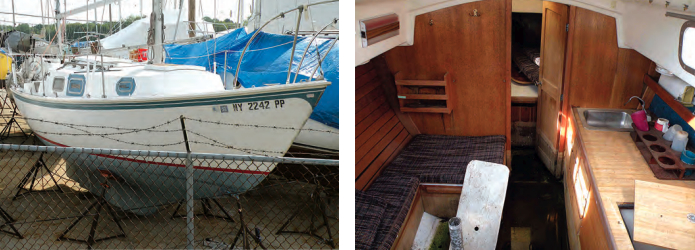
One of my favorites was a Mariner 28, a moderate design with a fin keel from the early 1980s. She must have once been someone’s pride and joy; now her teak interior was ruined, and whenever I entered her cabin to check her bilges I stepped carefully to avoid putting a foot through her rotting cabin sole. Brass dividers lay forlornly on her navigation table. Water stains rising several feet above her cabin sole revealed that she had once been submerged. I wondered if she had sunk at the dock or at sea during a storm. Were her owners aboard when it happened?
These boats were alive to me, even though they had sailing histories I would never know. I could put my hand on the hull of any of them and imagine how they must have been . . . once. Inside their silent musty cabins, the faded charts on their navigation tables, the mildewed books on shelves, and the odd personal item left on a bunk provided glimpses of former owners and their past cruising lives.
Why were these boats abandoned? Most were casualties of the financial storms weathered by their owners. As the recession dragged on, resulting in pay cuts, job insecurity, unemployment, or relocation, owning a boat became a luxury they could no longer afford. Age and health issues had forced the abandonment of at least one restoration project; loss of a job caused another. But on the lighter side, one owner gave his racing sloop to the boatyard in order to teach his kids a lesson when he discovered that, despite their promises, they had been neglecting his boat.
A campaign commences
Steve prefers working on sailboats to working on computers, so I volunteered to post ads for the boats online and answer the initial queries. Most of these boats would be free; a few in better condition would be listed at bargain prices in hopes of a quick sale. Since Steve spends most days at the yard working on our projects, he could show the boats to anyone who was interested. With his background in marine surveying, he would be able to explain what was needed to make them seaworthy again. One chilly spring morning, armed with my digital camera and laptop, I snapped photos of each boat and began posting advertisements online.
The enthusiastic responses to our ads seemed to indicate that the sailing dream is alive and well in the United States and beyond. My inbox was flooded with inquiries and we received calls almost daily. We had expected the appeal of these boats to be limited to local sailors so we were unprepared for the number of long-distance inquiries. Calls came in from across the country and as far away as Sweden. The Swedish caller, a fisherman who was looking for a project boat to restore with his son, explained that the cost of a comparable boat in his country was so much higher that he hoped to find a boat in the U.S. and ship it home by cargo carrier.
The majority of the inquiries came from people who were eager to own a sailboat but couldn’t afford the sticker prices on the new boats they’d seen advertised in the glossy brochures. We received many calls from young women and men who dreamed of going to sea in their own vessels. They had big hearts and big plans and wanted to sail offshore to exotic faraway destinations they had read about in sailing books and magazines. “I’ve never been out of sight of land,” confided one during a phone conversation, “but I know I can do this. I want to sail her to St. Croix and I’ll work on the repairs along the way.”
We were surprised by the number of inquiries from non-sailors who were willing to take a risk and invest their time and money to save one of these boats. “I don’t know how to sail yet,” wrote one, “but it’s always been a dream of mine.” This sentiment was echoed by others. Young and old, college students, employed or retired, they shared the same dream, cruising on a sailboat of their own. Steve gave all who were unfamiliar with boat ownership a crash course in the costs: summer mooring or slip, winter storage if they didn’t have a trailer or backyard, insurance, maintenance, and so on. For some, the costs of ownership exceeded their limited resources and we could sense their disappointment as they saw the dream slipping out of their grasp.
Although we hoped the descriptions and the pictures in the ads made it clear that these were project boats, there were some folks who thought a basic cleanup was all that was necessary. But it would take more than elbow grease and optimism to get most of these boats sailing again. I opened my email one evening to find an inquiry about the Tanzer. “Is she seaworthy now?” the email began. I read it aloud to Steve. “We want to take her down the Intracoastal Waterway then over to Texas. Once we reach Texas we’re planning to have her shipped to California, then we’ll tackle the major repairs.” I thought about the long-neglected Tanzer embarking on such a trip and looked at Steve doubtfully. He said, “Tell them they’ll need to spend at least a week here before they go anywhere — assuming the engine doesn’t need major work since it hasn’t been started for years. And no, they can’t live on the boat while they’re working on it unless they plan to sleep out on deck. The interior is filthy and the bulkheads need major work.”
Steve did his best to inject the dreamers with a dose of healthy reality. Once, after listening to him on a call, I commented, “You really shouldn’t be so negative; you’re going to scare everybody away!” I mimicked him, “This boat is a disaster! The interior is a mess!” We laughed together for a moment then he got serious and said, “I just don’t want someone to take one of these boats unless they’re really prepared for what they’re getting into. Otherwise, they’ll get discouraged and give up, then the boat will just end up abandoned somewhere else.” He was right, of course, and I realized we both felt a sense of responsibility. Beyond finding new homes for these boats, we wanted to find the right homes, “forever” homes. We wanted them to inspire their new owners and fulfill their sailing dreams, however big or small they were.
Faith redeemed
As time went by, a pattern emerged: after posting the ads, weeding out the obvious scammers (yes, even “free” boats attracted Internet con artists), and speaking to dozens of hopefuls, I watched as the list of potential takers slowly evaporated. Every week, I renewed the ads on Craigslist, hoping it would be for the last time. The following week, with no sure prospects for most of the boats, the ads would be relisted. Weeks turned to months, spring to summer, and the abandoned boats remained.
Finding the right sailors for these boats was proving elusive; they needed dreamers with their feet firmly planted on the ground, sailors whose optimism was matched by their skills and determination. These boats might be free, but they came with a price. For would-be boat owners on a tight budget, the right boat would be like a magic carpet, but the wrong boat could consume their meager resources, break their hearts, and end those dreams forever.
As discouraging as it was at times, there were some victories that kept us going. The Mariner, the Columbia, and the Tanzer were the first to find new owners and leave the yard. As the leaves began to turn and summer slipped into fall, the Westerly went to a sailor from Maine who had begged and borrowed a trailer built for a bilge-keeler, a truck capable of towing it, and an agreeable friend to help him bring it home. At the end of December, when the yard was quiet and we were certain nobody would be seriously looking at project boats in the northeast, the racing sloop went to a new home in South Carolina.
Steve and I wondered who would eventually rescue the Bristol 24. She had several suitors now: a young man planning a visit from Kentucky, a boatbuilder on Long Island, and an airline pilot who wanted to restore her and take his son sailing. The Bristol was another of our favorites and we occasionally discussed how, if she were ours, we would fix her up and sail her . . . down the Hudson and around the tip of Manhattan to Long Island Sound, perhaps even to Narragansett Bay and Block Island during summer vacations. She would be an ideal pocket cruiser, we agreed, and we marveled that she hadn’t been snapped up by someone. She probably received more inquiries than any of the other boats, but so far nobody had stepped forward and made the commitment.
Then one day it happened. After an exchange of emails and phone calls, someone new asked to come and take a look at her. Steve gave him a tour of the boat and they discussed the repairs needed in great detail. The visitor liked what he saw and almost before we knew it, had agreed that she would be his. We were thrilled. Not only had the Bristol been saved from almost certain destruction, she would remain at the boatyard while John, her new owner, repaired her and prepped her for cruising. John was inexperienced, but we were confident that, with Steve’s guidance, he would be able to handle the Bristol’s repairs.
In the following weeks, we got to know John better as he began working on his boat. One day I saw a woman aboard the Bristol with a bucket and scrub brush. She introduced herself as John’s mother who had come to help him. I asked her if she liked to sail. “I don’t know how to sail,” she responded with a smile, “but I do know how to clean!” John was busy with a full-time job and graduate school, but he was full of enthusiasm for his new boat. One day he told me how grateful he was for all of the opportunities this boat represented. If he ever parted with her, he planned to give her to someone who, like him, dreamed of sailing but thought he would never be able to afford his own boat.
A new candidate
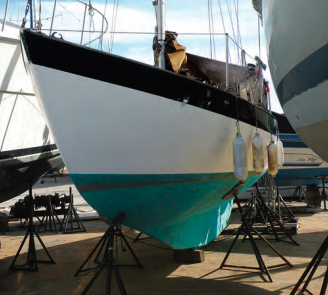
Another year has passed. It is now late June at the boatyard and most of the sailboats have been launched. A few project boats are scattered about the yard and the abandoned boats that remain continue their slumber. A small sloop nearby is beginning to show the telltale signs of neglect. Her faded green tarp has worn through in places, her cockpit is filthy and filled with dead leaves, her varnish long gone, and her owner, an elderly gentleman, has not been seen around the boatyard lately.
But beneath the grime I see a small gem: a flush deck, full-keel double-ender and suddenly I remember her sailing on the river from seasons past. Steve notices my interest and says she is a Chuck Paine design, a Morris Frances 26. I rest my hand on her hull and for a moment I imagine her on the river again, heeling proudly under a press of full sail.
Mary Broderick holds a USCG Masters license and has been sailing coastal New England waters for more than 20 years with her husband, Steve Perry. Together, they are restoring their Nicholson 35, Levity, and planning an extended cruise with their cat, Rocky, as crew.
Thank you to Sailrite Enterprises, Inc., for providing free access to back issues of Good Old Boat through intellectual property rights. Sailrite.com