Take the helm while taking in the view
Issue 89 : Mar/Apr 2013
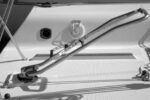
My Catalina 28 has elevated catbird seats in the aft corners of the cockpit that are wonderful places to sit when we’re under sail. I often wished I could steer from them. I’ve seen commercially available extension rods that let you do just that — for $140. A brilliant idea, but expensive. I made my own for less than $5.
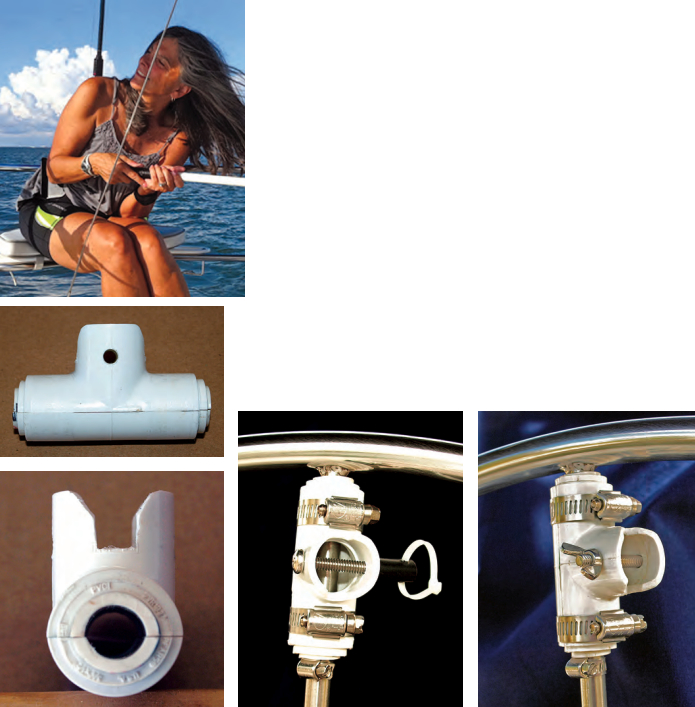
The secret to a successful extension rod of this type is how it’s attached to the wheel. It must be able to swivel in any direction as you swing the wheel from the starboard or port seat, and it must also be designed so it can be quickly connected or detached.
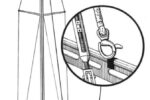
The spokes of my wheel are 1⁄2 inch in diameter. The connector I built will work with spokes slightly larger or smaller. It’s made with a 3⁄4-inch PVC Schedule 40 tee, two 3⁄4-inch to 1⁄2-inch reducers, and two 3⁄4-inch pieces of 1⁄2-inch PVC pipe. The most expensive part is a $2.50 Bimini-top eye end fitting for 7⁄8-inch pipe.
Mounting the connector on a spoke permits it to rotate laterally. The smooth PVC pipe will be kind to the finish on the spoke even when it grips very tightly. The bolt through the eye-end fitting acts as a hinge to allow up-and-down angles for the connecting rod.
Cutting and drilling
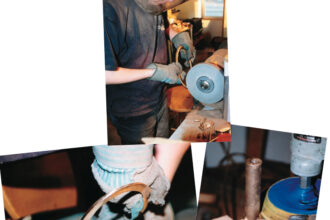
Start by drilling a 1⁄4-inch hole in the center of the tee stub. This will hold a bolt on which the eye end swivels. Then cut slots in the tee stub so the eye end can swing in either direction. I made my slots with a table saw, then widened the mouth with a Dremel tool. A hacksaw will also work if you have a steady hand and a vice to hold the tee. If you use a power saw, stick a piece of pipe in the fitting so you can guide it through the blade without endangering your fingers.
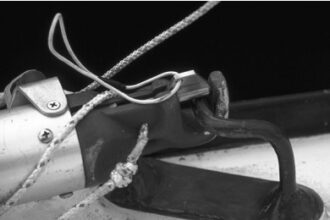
Push a 1⁄4-inch machine screw through the tee and eye end. When you’re happy with the swing of the eye end, glue the reducers and small pieces of pipe into each end of the top of the tee. Then slice the top of the tee in half. It will fit the spoke very nicely now and swing left and right in a wide arc.
The best way I’ve found to keep the modified tee in place on the wheel spoke is with stainless-steel hose clamps. A 1⁄4-inch stainless-steel machine screw goes through the connector fitting and Bimini eye to attach the rod.
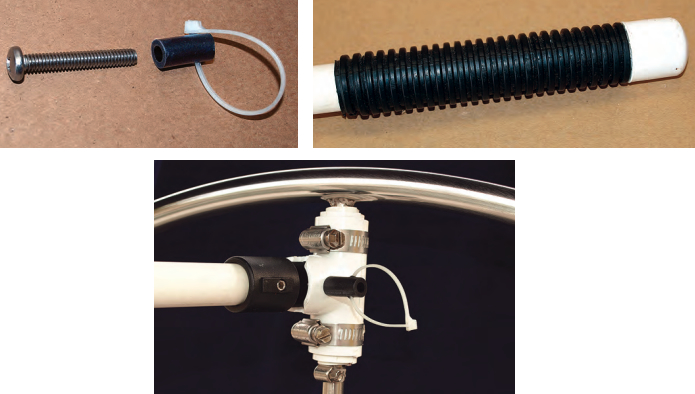
In the first incarnation, I used a wingnut to keep the 1⁄4-inch bolt in place. I later came up with a poor man’s fast pin that lets me attach or remove the rod in a flash. To keep the bolt in place, I use a short piece of rubber hose that fits tightly on the bolt. A tiny hole drilled in the hose holds a plastic wire tie that becomes a ring with which to quickly pull the hose off the bolt: push the hose on to keep the bolt in place; yank the hose off to remove the bolt.
Make sure the connector won’t hit anything on the pedestal when it’s swung hard over. If you’re really cramped for clearance, clamp the working side of the fitting to the spoke (the side with the tee) and eliminate the back side. A small clamp or several wraps of tape on the spoke below the fitting will keep it in place at the wheel rim.
A length of 1⁄2-inch PVC pipe will fit nicely into the Bimini eye end to become the extension rod. The Bimini fitting has a setscrew to keep the pipe in place. I added another screw on the opposite side for strength. The handle for the rod is a short length of ribbed hose and a PVC cap glued onto the end of the pipe.
I used a 32-inch length of pipe forthe extension rod at first but made a new one 4 inches longer that I can wedge into the pulpit rail when I need both hands free. I can’t turn the wheel enough to bring the boat about with this extension but it offers all the steering I need most of the time we’re cruising.
If you want to be really fancy, use polished 7⁄8-inch aluminum pipe instead of PVC for the rod. You can pick up a scrap at a shop that makes Bimini tops. It will double the cost of your steering-wheel extension . . . to about $10.
Clarence Jones is a writer, news media consultant, photographer, sailor, tinkerer, and inventor. He and his wife, Ellen, live, work on, and sail their Catalina 28 from Anna Maria Island in the mouth of Tampa Bay. Clarence recently published his ebook, Sailboat Projects, in which he describes inexpensive ways he has enhanced his boats and his sailing enjoyment.
Thank you to Sailrite Enterprises, Inc., for providing free access to back issues of Good Old Boat through intellectual property rights. Sailrite.com