Decorative work occupies a quiet sea passage
Issue 89 : Mar/Apr 2013
On a passage from French Polynesia to the Cook Islands a couple of years ago, nothing major had broken, the weather was benign, and neither of us was seasick. Something I had wanted to do for a long time was to coachwhip the wheel and this seemed like a good opportunity to work on it.
Coachwhipping is a traditional decorative form of ropework that results in a beautiful herringbone pattern. While a four-strand coachwhipping is the most common, I found that it left diamond-shaped gaps between the strands when I first tried it on the wheel. I decided to use a six triple-strand pattern, and the result was outstanding.
After a bit of practice, it wasn’t all that difficult. The hard part was keeping all those strands straight. I practiced on a wooden deck-brush handle with a pattern of six single strands.
I started with six lengths of line each about 24 inches long and, to begin with, used different colors to reduce confusion while I became comfortable with the plaiting process. I used a hot-glue gun to temporarily tack each line in place equidistant around the wood, then seized them with another short piece of line. I used a constrictor knot to seize the ends. If you aren’t familiar with it, directions are posted on our website (see “Resources,” page 47).
Color demonstration
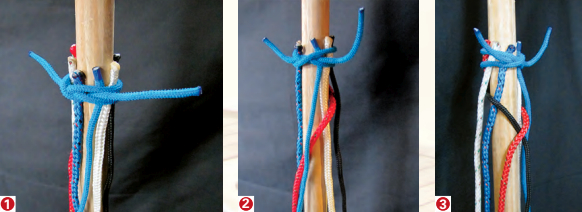
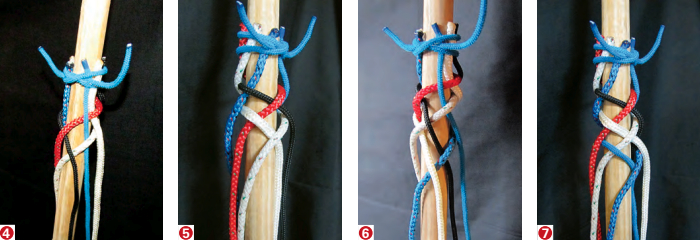
In the description that follows, and in the photos, I refer to the lines on the left as blue with specks (Bl/ Sp), white with specks (Wh/Sp) and red. The lines on the right are referred to as blue, white, and black.
To begin the pattern, take the red line behind the wood and under the black, over the white, and under the blue. Then pass the black behind the wood in the opposite direction, under the Wh/Sp, over the Bl/Sp, and under the red.
Continue alternating, first a left-hand strand then a right-hand strand behind the wood to the opposite side, then under one, over one, and under one, and across the front of the wood back to its own side again. The photos show how the pattern should look after each strand is routed.
At this point, you will have made one complete cycle with each strand. Draw each strand up tight and arrange them so the design is tight and uniform. Repeat the procedure until you have three or four complete cycles, then seize the bundle of lines. I performed the exercise again with all-white line to ensure I would like the final pattern.
This pattern has a nice appearance, but the pattern created with six triple strands is much more elegant. The process is exactly the same, except that I substituted a bundle of three strands for each single strand.
Yards and yards of line
The wheel on Nine of Cups has six spokes. I coachwhipped the wheel in six sections, each one beginning and ending halfway between two spokes. After a bit of trial and error, I found that when using 1⁄8-inch line, each strand needed to be slightly more than four times the length of the wheel section. Since the distance between spokes was 19 inches, the length I needed for each strand was 78 inches. The amount of line needed for the entire coachwhipping was 78 inches x 18 strands x 6 sections, or a bit more than 700 feet of line. In addition, I wanted to finish each section by covering the raw ends where the sections met with a Turk’s head, so I added enough line for these embellishments. In total I needed 800 feet. I had been planning this project for some time and had the line on hand.
Section by section
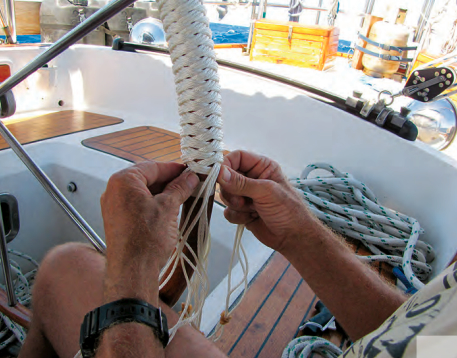
I began by cutting the 18 strands for the first section. I marked the beginning and end points on the wheel and used a hot-glue gun to tack each strand in place. Just as I had done with the practice broomstick, I seized them with a small piece of line. I next gathered the strands into sets of three and taped the loose ends together. To help keep the sets of strands from tangling, I coiled all but a short length of each set and held them in place with rubber bands.
I did the plaiting the same as I had for the practice section. It takes a bit more patience and effort to keep all the lines organized and to work out the twists and kinks, but it was not significantly more difficult than the six single-strand version.
Once I reached the end of the first section, I seized the bundle with a constrictor knot and, using needle-nose pliers, went back through the section working out twists and drawing all the strands tight until the entire section was uniform and firm. I then used the hot-glue gun to tack each strand in place, adjusted the constrictor knot, and cut each strand as short as possible.
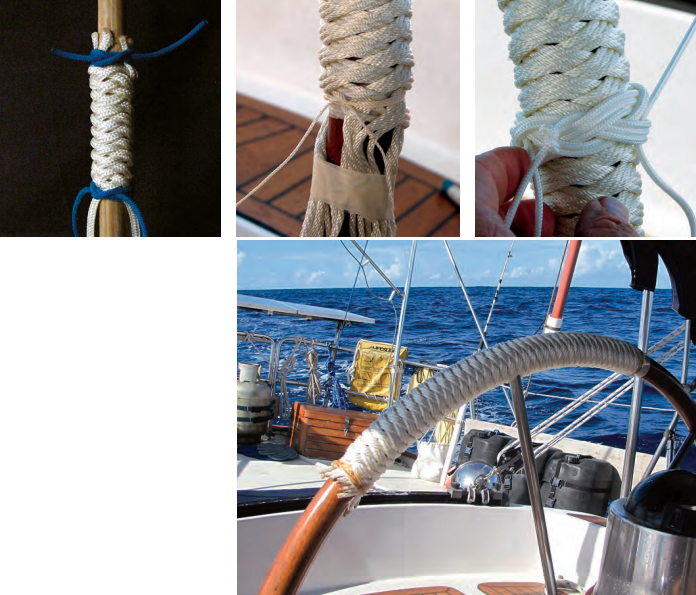
I started the second section and each subsequent section in the same way, butting the next 18 strands up against the strands of the prior section. I needed two to three hours to complete the first section, but I was much more efficient by the time I reached the last section and was able to complete it in less than an hour.
Once all the sections were complete, I finished the ends of each section by covering the loose ends with Turk’s heads. Directions for making a Turk’s head are also posted on our website.
The overall time to complete the project was about 24 hours, including the practice time and learning curve. It was a good task for a long passage since I could do one or two sections each day.
David and Marcie Lynn have lived aboard Nine of Cups, their 1986 Liberty 458 cutter, since purchasing her in Kemah, Texas, in 2000. Since that time, they have sailed her more than 70,000 nautical miles in their ever-so-slow world circumnavigation and at press time were cruising Tasmania. Find them on their website at www.nineofcups.com or their daily blog at www.justalittlefurther.com.
Thank you to Sailrite Enterprises, Inc., for providing free access to back issues of Good Old Boat through intellectual property rights. Sailrite.com