You can’t take all of them with you . . .
Issue 91 : Jul/Aug 2013
One of the things I knew I’d miss most, once we cast off the docklines and went cruising on the 31-foot Cape George cutter I’d built from a kit hull, was my power tools. For the three years it had taken to put Ganymede together, I had practically lived in my dirt-floored pipe-framed tarp shop, spending every minute I could spare from family or work among my table saw, drill press, planer, and router. When it came time to sell them — an essential part of padding the cruising kitty — it was a lot harder than I had expected. To store them against some future need was impossible. We wanted to sail away and return only for visits, so the only things to leave behind were those we couldn’t dispose of with ease. Another hard decision to make was which tools to bring along on the boat. With three small children and all the clothes and toys and diapers they required, we had to maximize every inch of space, bringing only the barest essentials.
That, of course, ruled out the drill press, which I had briefly hoped might somehow be made to fit in the sail locker. And reason told me that my treasured mini-lathe, so handy for turning belaying pins and toggles, would only get ruined in the damp under the foredeck. What I did bring, in the end, was still too much, but after a 7,000-mile, seven-country cruise, I have a pretty good notion of what I really need.
Minimal electrics
Ganymede doesn’t have an electrical system, so we carry only two corded power tools, a Milwaukee 45-degree drill and a Makita saber saw. These are not useful for repairs at sea or at anchor, but come in very handy for projects that can be unshipped and taken ashore and for times in the boatyard. They’re stored in double heavy-duty Ziplocs at the back of the tool locker and are worth their weight in gold when an outlet on shore is handy.
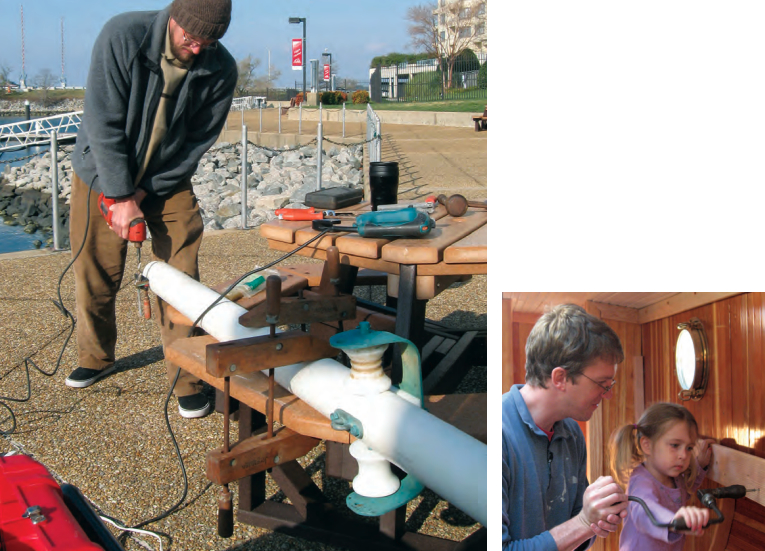
For those times when power is not available, I have a secret weapon: an old-fashioned ratcheting hand brace. It was one of the tools I used most in the construction of the boat. I drove hundreds of screws and lag bolts with it and I’ve come to prefer it over an electric drill for that purpose. After all, it never runs out of batteries, weighs a fraction of what an electric one does, and the slower speed is less likely to strip a screwhead. At anchor, I’ve used it to drill weep holes in Ganymede’s aluminum spars and through fiberglass, as well as for boring countless holes in wood.
A versatile workbench
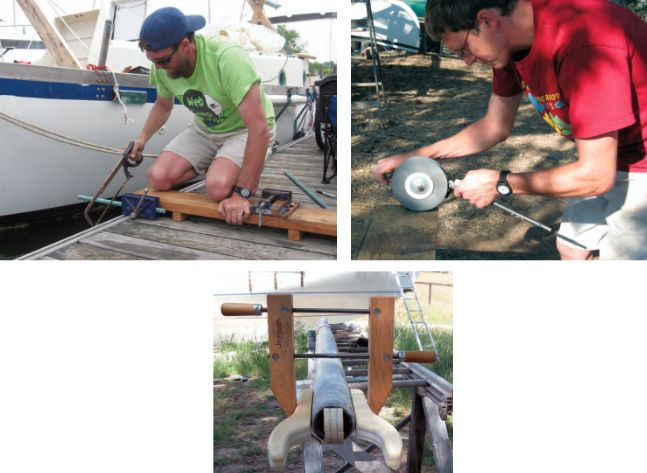
Another vital element of my shipboard “shop” is a portable workbench. Since the brace takes two hands to operate, being able to hold things still is vital. For this, I screwed two strips of wood to the underside of a yard-long 2 x 6 Douglas fir plank. This allows it to sit on the forehatch coaming without slipping around. I mounted two low-profile but powerful vises to this plank — one a woodworker’s bench vise and the other a drill-press vise. When not in use (that is, most of the time) the bench sits in the back of the sail locker out of the way, but is easy to pull out and take anywhere.
A couple of big wooden clamps are the next essential pieces of gear. Mine are about a foot long and open to 8 inches. Not only are they useful for holding workpieces still, they also can clamp the workbench to a marina picnic table without causing damage.
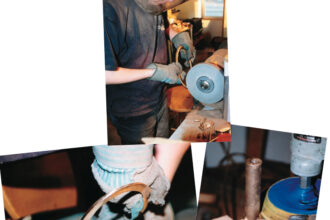
I have mixed feelings about my last unconventional tool — the debate about whether I use it enough to justify its storage continues within — but it’s such a moneysaver in the long run I suspect I’ll not be able to part with it. It’s a small hand-cranked grindstone with a clamp that allows it to mount handily to the edge of my workbench. During Ganymede’s construction I used it to sharpen drill bits dulled by repeatedly chewing through the solid fiberglass hull, thus restoring them time and again to usefulness. The slow rpm means the bits don’t heat up too much as they’re ground and it’s still far faster than a file and whetstone. It also serves well for de-burring sawed-off bits of rod stock, sharpening scratch awls, and grinding notches out of chisels and planer edges.
Eliminating the unused
As for the rest of my tool collection, swap meet by swap meet I am slowly, divesting it of surplus items. What cruiser needs three sets of box-end wrenches or four dozen 5-inch wood clamps? But whatever compromise between storage space and usefulness I’m forced to make in the end, these four bastions of my onboard shop have proved indispensable enough to secure their future. And someday, I fondly think, when the children have sailed from the nest, perhaps there will be room for a mini-lathe. I’m already eyeing one of their bunks for size.
Ben Zartman lives with his wife, Danielle, and three young daughters aboard Ganymede, the 30-foot Cape George Cutter he built from a kit hull. They spent last winter in Newport, Rhode Island, contemplating an Atlantic crossing. Follow them on their blog at www.zartmancruising.com.
Thank you to Sailrite Enterprises, Inc., for providing free access to back issues of Good Old Boat through intellectual property rights. Sailrite.com