Boat evolution is a non-linear process
Issue 90: May/June 2013
Any search for exactly the right words can be a frustrating experience. This is especially true if you’re trying to explain a fundamental concept you understand deep in your core, so deep perhaps that you normally don’t have to articulate it.
I had one of those deep-in-the-core feelings about the evolution of our good old fiberglass sailboats over the years. The evolution, as I perceive it, begins with one or two designers who modified their favorite classic wooden sailboat designs just as the fiberglass era began. The current sailboats at the time were of course the models for the next ones . . . but with additional tweaks to accommodate the new plastic material. All good old boat sailors have tales of overly strong scantlings based on the frames of the wooden boats of the time.
Another designer borrowed one or two of the first ideas and took them to the next step. Then the first designer was hired by a different manufacturer and took his evolved thinking there, where he taught six or eight young wannabes. Each of these novice designers went off in various directions with further modifications. Some of them changed firms several times. Each of them taught several more. And all of them were watching all the others’ designs to see which won races and which sold boats and they made further modifications accordingly.
Over the years — as we’ve printed articles about the designers and manufacturers of our fiberglass sailboats and about the evolution of the boats — I have developed a deep awareness that the very small field of sailboat design and development was truly a tangled web of competitive pressures and good-old-boy interrelationships.
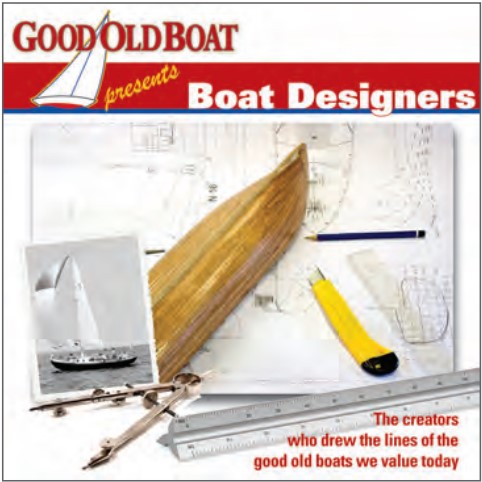
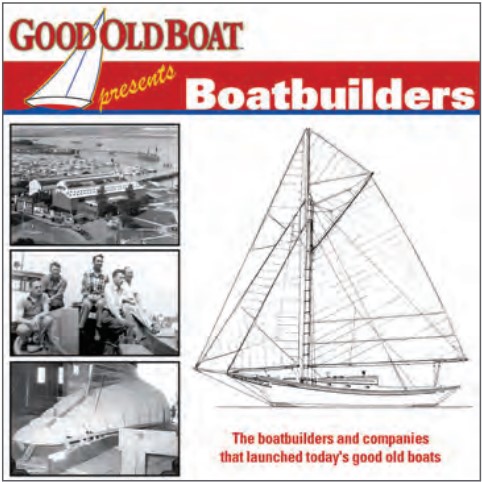
I tried to put all this into words not long ago when we introduced our two newest Archive eXtractions. These are downloadable PDF collections of articles we’ve published over the years. The collections on my mind at the time were our two new historical perspectives called Boatbuilders and Boat Designers.
In those introductions I used words like “these companies played a significant role in the evolution of the cruising sailboats we treasure today” to describe the boatbuilders. And I tried something like this to describe the designers’ relationships: “The designers in this book were instrumental in guiding the design of our pleasure sailboats — step by baby step — from the wooden workboats of yore to today’s family yacht.”
Imagine my surprise when I found the perfect description in a recent copy of WoodenBoat magazine: the design spiral. In his editorial in issue 230, Matt Murphy tells about Paul Gartside, who was well acquainted with John Atkin and worked for a time for Bill Garden. Matt describes Paul Gartside as “one of the most prolific designers of stock plans today.”
Then came the bolt of lightning. Matt says, “It was Garden who introduced Gartside to the concept of ‘the design spiral’ — a method of work that allows a designer to build on the knowledge gained through previous designs, rather than starting from zero with each new boat.” In actuality, the concept Matt describes has more to do with using the parameters and numbers developed for a previous cutter to save time when designing a second cutter . . . and so forth. But Matt sums it up with words I could have used in my own description: “It’s a fascinating thing to watch the Darwinian progression of boat design — to see the fishing schooner type morph into the New England dragger as a result of economic and environmental triggers.”
There you go. That’s exactly what I wanted to convey about the designers of our good old boats. The design spiral is exactly the concept I was looking for when I added, “Taken together, the designers we present here were an inspired lot who made sailing for pleasure affordable and available to middle-class boat lovers everywhere. They have made our boats what they are today and they have made our favorite pastime what it is today.”
To pursue the intricate path of who trained whom and who begat which design changes, download our two Archive eXtractions from AudioSeaStories.com and enjoy the stories about the designers and builders responsible for creating our good old boats.
Thank you to Sailrite Enterprises, Inc., for providing free access to back issues of Good Old Boat through intellectual property rights. Sailrite.com