When it’s time to replace them, think swageless
Issue 92 : Sept/Oct 2013
Most good old boats were delivered from the factory with swaged terminal fittings on their standing rigging — the shrouds and stays. Those fittings are now old and perhaps no longer reliable. With all sailboats, there comes a time when the standing rigging should be replaced and it’s better to tackle this job too early rather than too late.
There are two options. You can hand over the job to a rigger and write a check or you can do the job yourself. If you decide to do the work yourself there are, again, two options. You can replace the entire cable and both the upper and lower terminal fittings or, if one of the terminal fittings and the cable are still in good condition, you can replace just the damaged or failing terminal fitting.
Lower terminals first
Swaged fittings on the upper ends of shrouds and stays tend to last longer than those on the lower ends. This is due to the wire inside the swage in an upper terminal fitting being protected from the elements, to a degree, by the swage itself.
At the lower end, however, rain and spray (in coastal areas this is saltwater spray) tend to run down into the swage, causing corrosion and, possibly, freezing problems in winter. Consequently, the lower terminals on the standing rigging are most likely to need replacing first.
From swaged to swageless
For the do-it-yourselfer it’s a good idea, when replacing a terminal fitting, to consider swageless fittings. Not only are they easy to install using simple hand tools, but they also have greater longevity than swaged fittings with the added bonus that they can be reused by just replacing the small inexpensive internal cone. The only tools required when installing a swageless fitting are two wrenches and either a hacksaw with a fine-toothed blade or a cable cutter.
If you plan to replace the 1×19 cable as well as the terminal fittings, it’s just a matter of measuring the pin-to-pin length of the rigging and constructing a duplicate. If the old rigging cable still looks reasonably good, coil it up and keep it aboard . . . you never know.
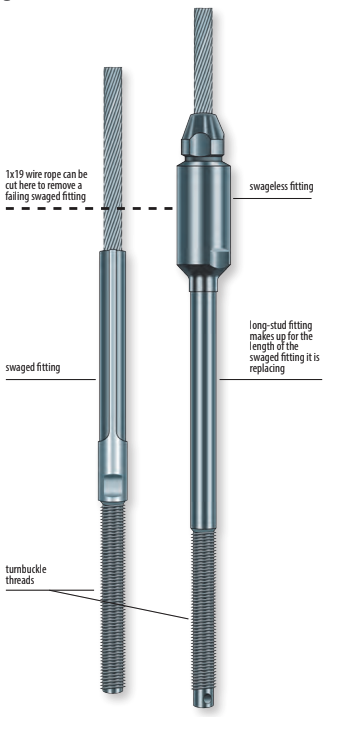
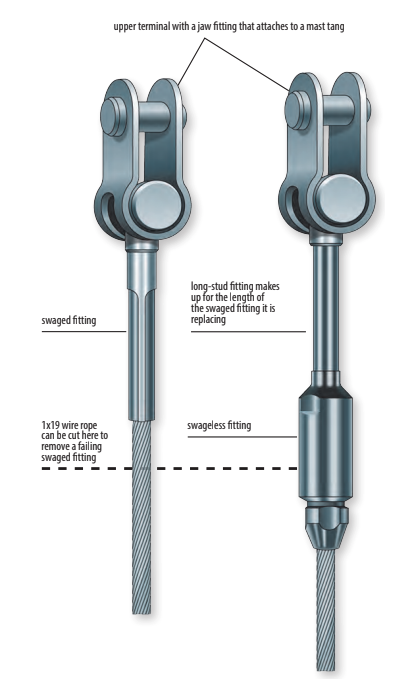
If only one of the terminal fittings needs to be replaced, there’s a problem. The swage fitting is considerably longer than a comparable swageless fitting so, when a swaged fitting is cut off, the cable will be too short. But, not to worry, special swageless fittings, known as long-stud fittings, are made to solve this problem.
The long-stud fitting for the lower terminal has a long extension between the right-hand thread on the end that screws into the turnbuckle and the swageless fitting for the 1×19 cable on the other end. This makes up for
the length of the removed fitting and the resulting reduced cable length.
If the upper fitting needs to be replaced while still retaining the old 1×19 cable, the replacement terminal should also be a long-stud fitting. The upper fitting usually has a jaw end that attaches to the mast tang and a long extension between that and the swageless fitting for the 1×19 cable.
Ordering parts
There are several manufacturers of swageless fittings. When you place an order for parts, certain specifications have to match the old rigging if you are to receive the correct fitting. For the lower terminal, the thread must obviously match that of the turnbuckle. This is almost universally a right-hand thread. The turnbuckle thread might be metric or UNF, depending on where your boat’s rigging was manufactured. (UNF threads are exactly the same as those called SAE before thread dimensions were unified.) The diameter of this threaded section must be measured in millimeters for metric threads or in fractions of an inch for UNF threads.
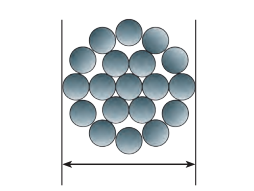
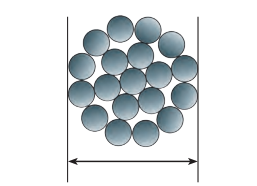
The diameter of the 1×19 cable must also be known. This requires measuring the diameter properly, as illustrated in the diagram above.
When the upper terminal is being replaced on the original 1×19 cable, the swageless fitting must be specified to match the cable diameter. Also, whether reusing the old cable or fitting new, the diameter of the clevis pin in the jaw of the fitting must match the diameter of the hole in the mast tang.
Don Launer, a Good Old Boat contributing editor, built his two-masted schooner, Delphinus, from a bare hull. He has held a USCG captain’s license for 40 years and has written five books. His 101 articles through November 2011 can be downloaded as a collection from the Good Old Boat download website, www.audioseastories.com. Look under Archive eXtraction Download.
Thank you to Sailrite Enterprises, Inc., for providing free access to back issues of Good Old Boat through intellectual property rights. Sailrite.com