After the storm, it’s decision time
Issue 93 : Nov/Dec 2013
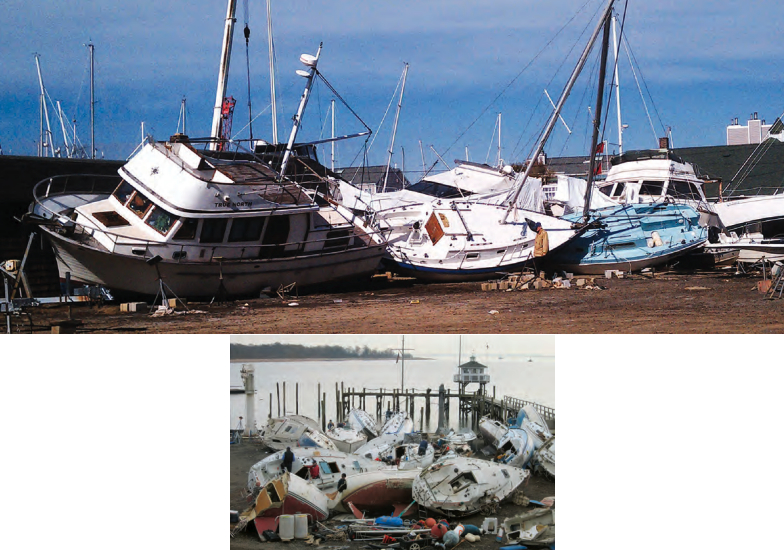
For some sailors, after a storm or hurricane comes relief. The mooring held. The neighboring steel boat didn’t break loose during the night and wreak havoc. The docklines held up. Others are not so fortunate. The storm surge has lifted boats up like twigs and deposited them in front yards half a mile away. Or the docks rose above the pilings and hundreds of boats were set free to crash on shore. Or, what seems like the ultimate insult, the boats just sank.
Sailors preparing for Hurricane Sandy last fall took some solace when it was downgraded to “merely” a tropical storm. But the respite was short-lived. Thanks to a funnel-shaped and steep shoreline, a full moon, a higher-than-normal tide, and a slower-than-predicted forward movement, Sandy stunned stormwatchers and left a horrifying trail of death and destruction. Huge Staten Island ferries snapped their hawsers and had to be held in place by their masters, probably eternally grateful for engines at bow and stern. Low-lying communities were inundated by a surge of salt water combined with high winds and an extraordinary amount of rain. One hundred sixty people died, thousands were injured, and untold households had to make do without electricity well into the frigid winter.
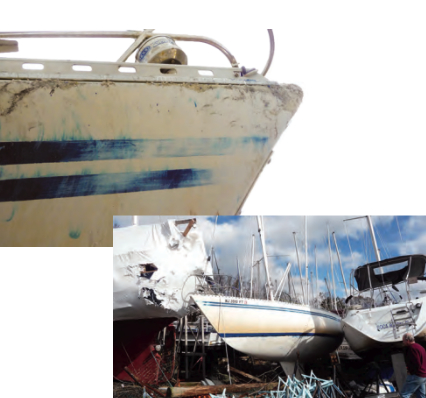
For sailors, the huge (940-mile-diameter) storm caused an unprecedented amount of damage. Marinas disappeared. Boats either sank or were hurled onto the surrounding shores. Yacht clubs were under water. The HMS Bounty replica sank with the loss of two, including the captain.
BoatU.S. spokesman Scott Croft said, “In terms of boat damage, this will surpass all other storms. We’ve never seen anything like it.” BoatU.S. estimated that more than 65,000 recreational boats were damaged or lost as a result of Hurricane Sandy. The company estimated that dollar damage to all recreational boats was more than $650 million, making the late October storm the single-largest industry loss since the association began keeping track in 1966. To put that number in perspective, it’s about the same as hurricanes Wilma and Katrina combined.
Picking up the pieces
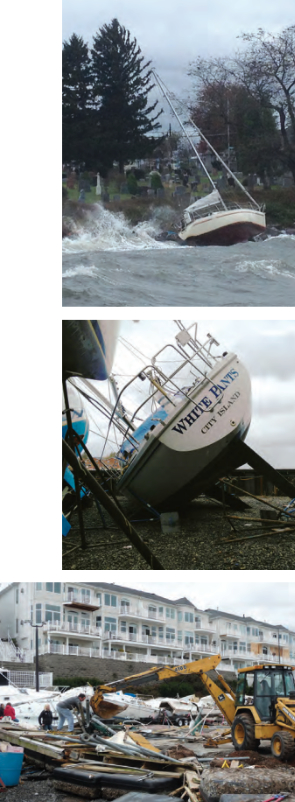
When the skies cleared, many boat owners faced the question, “Now what do I do?” For some, immediate action was paramount. Their boats were blocking roads or railway lines or were leaning against high-voltage wires. Workers and machines toiled 24/7 to deal with the most pressing cases.
For many, their boats were the last thing on their minds. Houses were gone. There was no heat or electricity. Food was scarce. Relief organizations, schools, churches, and other groups banded together in unprecedented numbers to provide help. Tales of heroism were told nightly on the television news.
On top of the other problems brought on by the storm, boat owners had decisions to make and work to do. All over the New York tri-state area (that includes New Jersey and Connecticut), marinas had disappeared, yacht clubs were destroyed, and shore facilities had been disabled. The only silver lining was the date: October 29. By late October, a good percentage of boats were already hauled for the season and on jack stands. This worked against some, as it made it easier for the surge to lift and deposit boats farther inland. One NPR listener called in and pleaded, “Help! What do I do? There’s a 35-foot sailboat in my front yard!”
At what was left of Nichols Great Kills Park Marina on Staten Island, New York, manager Eddie Tominack surveyed the unbelievable damage. Three hundred fifty slips were literally gone. Worse, the National Park Service announced that, after 37 years, it would not renew the franchise to maintain the marina, which is located in Great Kills National Recreation area and is the largest on Staten Island. A two-year study had already been under way to determine how to best develop the 350-acre park when Sandy hit.
“Boat owners who did elect to receive a replacement check,” Eddie told me, “can’t buy another boat because they have nowhere to dock it. Then you have the people whose boats were worth between $5,000 and $10,000. Most of those don’t have insurance at all. They’re really out of luck. And this is the kind of marina where most people do their own work.”
Several months later, Eddie and boat owners received better news. A grassroots effort assisted by Senator Charles Schumer (D-NY) and Representative Michael Grimm (R-Staten Island/Brooklyn) resulted in a last-minute victory and an announcement from the National Park Service that it had agreed to renew the lease for three years.
Stories like Eddie’s were repeated endlessly in the 15 states hit by Sandy. Sailors soon reached the next level of response as they faced whether their boats were salvageable or a total loss.
Salvage or abandon?
Yacht salvage is something most sailors never think about. It conjures up boats being raised from the briny deep, dripping with seaweed and headed for the junk pile. But fiberglass boats don’t disappear easily. They don’t decompose in a landfill. You can’t chop them up and burn them. Maybe, just maybe, they can be salvaged.
I was introduced to the word “salvage” not too long ago. A stately 32-foot Cheoy Lee double-headsail ketch we owned was dismasted halfway between Block Island and Greenport, New York. The damage was extensive and repairs were expensive, especially on paper in the surveyor’s report. New mast, rigging, sails, lifelines, and so on added up to more than the boat was worth. BoatU.S., our insurer, wanted to write a check for the replacement value. To make a long story short, we took it. However, a local sailor purchased the boat from the salvage company and, with a little cash and a lot of ingenuity and hard work, had himself a beautiful boat that, as they say, “turned heads.”
The majority of Sandy’s victims were not so easy to categorize. For example, if there was a 6-foot gash in the hull, would you attempt to buy the boat back and make the repairs? Yourself? Or if the boat sat at the bottom of New York Harbor for six weeks, would you — and, more important, could you — tear down the engine as part of your salvage effort?
As viewers of Good Old Boat’s Fixer-Upper Sailboats web page know, there’s an abundance of cheap or free boats to be had. Most can scratch the itch to rebuild an old beauty by acquiring one from the yacht graveyard. So why even think of salvaging your own?
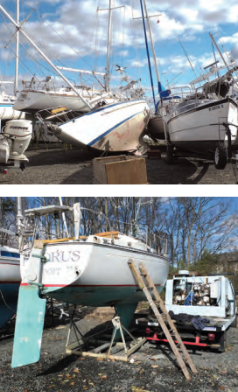
The most common reason is you know the boat. The fact that it is yours, of course, means your emotions cloud the waters a little. But let’s say, for the sake of argument, that your old Pearson has sunk in a storm. You know the old 1-cylinder Yanmar was on its last legs, the wiring was a hodgepodge that more often than not had you hanging upside down in the bilge like a tree lemur, and the sails had what we might kindly call “a cruising shape” to them. You call your insurance agent, who asks if you would like to salvage your boat. The company will even write you a check to cover the cost of repairs after you buy the boat back from the salvage company. What to do?
If you have the time, money, and ingenuity you might salvage your boat. The key part is ingenuity. Maybe you don’t know how to strip down a diesel and rebuild it, but you know someone in your yard who is upgrading and has a perfectly usable 1GM for sale. Cheap. In fact, if you help him remove it from his boat and help him install his beautiful new 3GM, he’ll give it to you. The boat’s wiring? That had to be upgraded anyway, so write it down in the budget.
Most sailors would not try to repair a 6-foot gash in the hull. But they can find someone who can. And if the hull needed repainting anyway, the numbers might add up.
The same goes for sails and rigging. Does the bottom line justify the time and effort required to put your baby back on her mooring? For some, the answer is a resounding yes!
Getting competent salvage and repair help for a damaged boat after a hurricane is difficult. Some insurance programs will arrange for and pay to have their clients’ boats salvaged; others will at least provide some assistance. But boat owners without insurance don’t have anyone to lean on. For those going it alone, BoatU.S. offers a wealth of detailed information, including organizations, resources, and just plain good advice. Search for “salvage” on the BoatU.S. website.
No one makes a killing salvaging boats. Mike Costa of YachtSalvage.com says that, not surprisingly, the salvage boat inventory was high following Hurricane Sandy. But there were also plenty of buyers, especially from Europe. “They buy them sight unseen,” he says.
If you have a surveyor carefully look the boat over and go in with your own eyes wide open, you can get a good deal. And you could have fun bringing that good old boat back to life.
Gary Miller is a photographer, writer, and good old boater whose last ride was a beautifully restored Pearson 35 sloop, Viridian. Instead of sailing, he spent the past spring and summer hoofing it . . . northbound on the Appalachian Trail.
Thank you to Sailrite Enterprises, Inc., for providing free access to back issues of Good Old Boat through intellectual property rights. Sailrite.com