Mitigating mayhem might be your best hope
Issue 98: Sept/Oct 2014
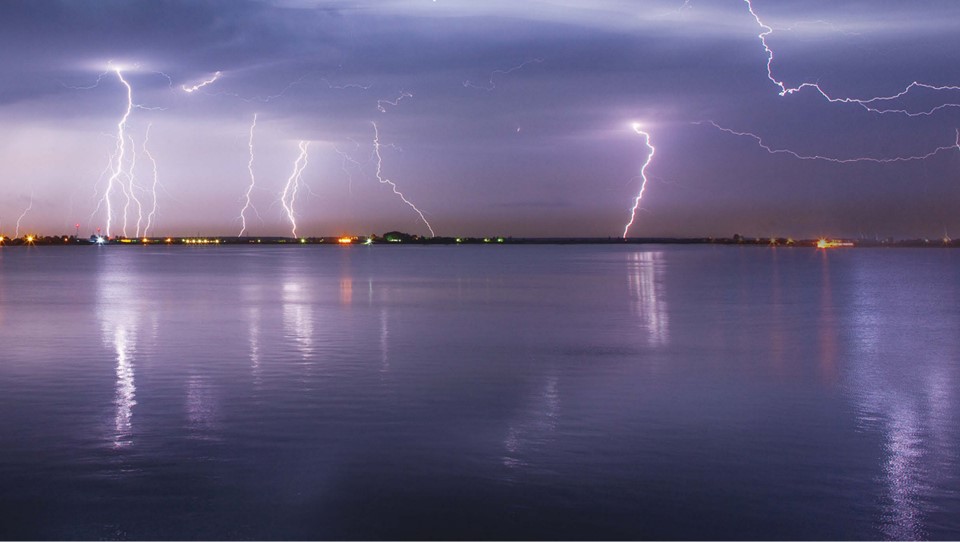
In our travels aboard Nine of Cups, we’ve seen some dandy thunder-and-lightning storms. In some places, like the mid-latitudes in the southern hemisphere, they seem to be pretty rare, while in Florida and Panama hardly a day in the summer goes by without at least one big thunder-boomer. While we know quite a few boats that have been struck, ours has been fortunate so far.
Actually, the odds of any one boat getting hit are low. According to BoatU.S. statistics, only 1.2 boats out of 1,000 are hit by lightning each year in the U.S. Even in Florida, where the most claims occur, only 4 sailboats in 1,000 are hit. If my calculations are accurate, that means Nine of Cups would have a 50-50 chance of getting hit if we spent the next 125 years in Florida. That’s pretty good odds, but knowing the odds provides very little comfort when you are aboard a boat watching a big lightning storm approach, especially at sea.
Four questions come to mind about lightning protection.
- Can a lightning hit be prevented?
- If you are hit, can you protect the boat from major damage or sinking?
- How safe is the crew?
- Can you prevent damage to the electronics?
Unfortunately, there are no tried-and-true answers. Even experts disagree and change their minds. The American Boat and Yacht Council (ABYC) has revised its stance over the years and in 2006 downgraded its standard (E-4) to a technical report (TE-4), which now includes the following wording: “Complete protection from equipment damage or personal injury is not implied.” Likewise, the National Fire Protection Association (NFPA) has changed its position in the last decade. Members completely rewrote its standard for lightning protection in 2011. After reading through the standards and literature, I offer the following thoughts.
Can a lightning hit be prevented?
There are quite a few suggestions on how to do this. My own surefire method is to stand on one foot, then rub my stomach in a circular motion while patting the top of my head. It works every time — we’ve never been hit by lightning.
My method makes as much sense to me as most of the other methods I’ve read about. A BoatU.S. paper cites the following example: a boat “fitted with a popular ‘fuzzy’ static dissipater at the top of the mast was struck twice in one year; ironically, the second time the bolt hit the dissipater even though the VHF antenna right next to it was higher (claim #0308082).” Until a statistically valid study is done, I will remain skeptical that lightning can be prevented from striking a boat.
Can a boat be protected?
Conventional wisdom seems to be that a boat can be protected from major damage and/or sinking in the event it is struck by lightning.
In a dated but still relevant paper published in 1992, Ewen Thomson, Ph.D., compiled information on 71 boats that had been hit by lightning. Some of these vessels had protective systems involving large conductors and grounding plates while others had no lightning protection at all. While this is hardly a statistically significant number of boats, his report is informative. His conclusion was that boats equipped with lightning protective systems were less heavily damaged than those without. (In his study sample — see “Resources,” below — Dr. Thomson noted that boats struck in fresh water suffer more damage than boats struck in salt water –Editors.)
As an aside, he also concluded that boats equipped with lightning protective systems were no more likely to be hit by lightning than those without. It would be ironic if the system you installed to protect your boat actually increased the risk that it would be hit by lightning.
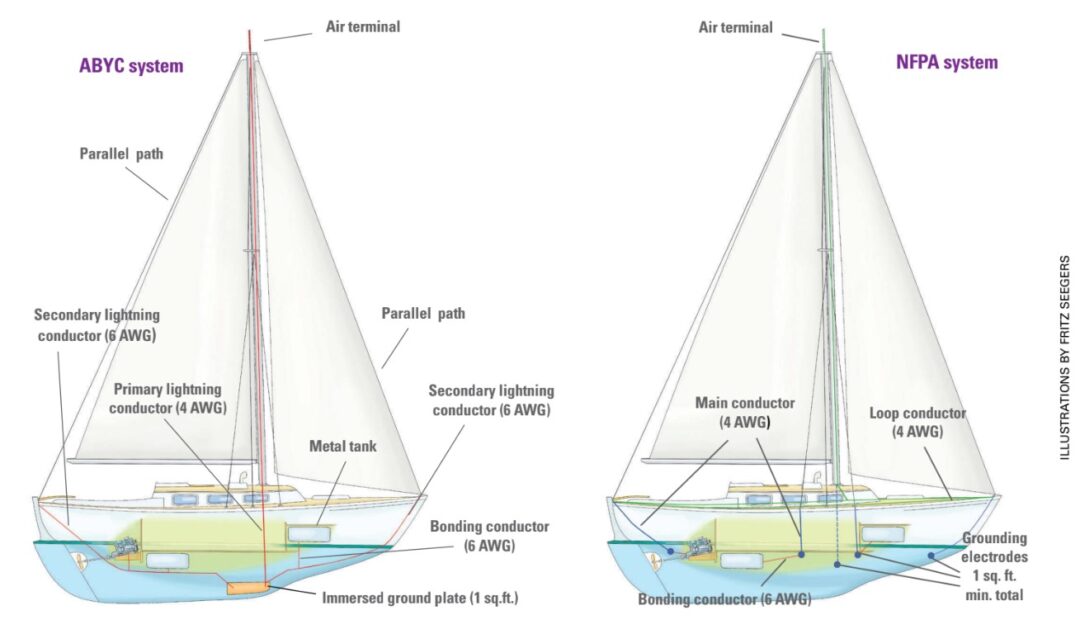
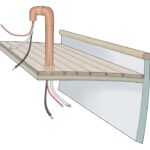
How do you go about protecting a fiberglass sailboat? Until a few years ago, most experts agreed the best way was to provide a single direct path down the mast and from there to a grounding plate attached to the outside of the hull below the waterline. A lightning rod (or air terminal) should extend at least 10 inches above the mast and should be pointed. If the VHF antenna is metal, it can serve as a sacrificial air terminal. The grounding plate should be at least 1 square foot. Connecting the mast to the metal in the keel in an externally ballasted boat would also provide an adequate ground connection for the lightning. It is, however, dangerous to connect the mast to an encapsulated metal keel. At the very least it would result in hundreds of pinholes through the fiberglass encapsulating the keel. All other large metal objects, like the stays and shrouds and metal tanks should be connected to the lightning protection system.
Let’s assume you have a typical sailboat with an aluminum mast. You have installed the lightning protection system described above and your boat is hit by lightning. The lightning will probably strike the highest point, the VHF antenna at the top of the mast. The voltage potential of lightning has been estimated to be 100 million volts. This voltage will generate a tremendous current that will find its way to the water however it can. Even if the bulk of the current travels down the mast and into the water via the grounding plate, huge voltage potentials still exist in the other metal objects in the boat such as stays and shrouds. Even though these are connected to the grounding plate, arcing may occur across materials usually thought of as insulators (such as air and fiberglass), due to the tremendous voltages. This arcing results in side-flashes as the lightning finds alternate, shorter, and more direct paths to the water. These side-flashes can create an electrocution hazard to the crew and/or damage the hull.
We know of a boat that was hit by lightning and a side-flash occurred from the forestay into the chain in the chain locker. From there it passed through the hull just above the waterline, leaving a sizable hole in the hull.
We have friends on a steel boat that was hit in the South Pacific. Since the mast and all the stays and shrouds are connected to the steel hull, you would think the current would pass harmlessly through all these paths to the steel hull and into the water. The backstay also served as an antenna for the HF radio, however, and incorporated two commonly used backstay insulators. Even with all the other low-resistance paths to the water, there was still sufficient voltage potential in the backstay to cause a side-flash that vaporized one of the insulators and the vessel was dismasted.
Friends on another boat experienced a side-flash that traveled from an embedded shroud chainplate to an internal fuel tank and then to a bronze through-hull. Fortunately, the through-hull was only slightly damaged and maintained its integrity.
So the answer to the second question is a definite maybe.
How safe is the crew during a lightning storm?
In general, the mast of a sailboat generates a protective cone, making it unlikely that a person on deck will suffer a direct hit. As long as a crewmember does not become part of the conductive path as the lightning makes its way from the masthead to the water, he or she should be safe. A person is a much better conductor than air or fiberglass, however, so it’s important to avoid being part of a side-flash. Go below if you can and stay away from any metal object that could be part of the lightning path, such as the boom, mast, stays, shrouds, and lifelines.
Can on-board electronics be protected?
Most sailboats hit by lightning lose most, if not all, of their onboard electronics due to electromagnetic induction. A current passing through a conductor generates a magnetic field. Conversely, a current is created in a conductor that is exposed to a changing magnetic field. So if you apply a changing electrical current in one conductor, it will create a changing magnetic field, which in turn will induce a changing electrical current in a nearby conductor. This phenomenon, called electromagnetic induction, was first described by Michael Faraday in 1831 and is the basis for many of today’s electrical devices, like transformers, motors, generators, and induction ovens.
When a bolt of lightning hits your sailboat, a sudden and immense current flows through the mast and other conductors, inducing currents in any nearby conductors like antennas, electrical wiring, and even the conductors on circuit boards. These induced current surges create voltage surges. Unfortunately, most of our modern electronics, like laptops, chart plotters, GPSs, and autopilots are quite intolerant of voltage surges. Some protection for the electronics can be provided by adding transient voltage surge suppressors (TVSS) to antenna and data cables and a metal oxide varistor (MOV) across the power cables, but these are not always effective.
Michael Faraday also discovered that if you construct a conductive enclosure, nearby electromagnetic fields will only produce currents on the surface of the enclosure itself, isolating any conductors inside the enclosure. Such an enclosure is called a Faraday cage. A metal building is a type of Faraday cage, and while it may cause problems with cellphone reception, people and electronics within are usually safe from lightning strikes. If you have an oven or microwave aboard, these may work as Faraday cages for your electronics. While it isn’t practical to move all your electronics to the microwave oven whenever a thunderstorm approaches, we do store a backup GPS and VHF there. (Be aware that the U.S. Coast Guard frowns on, and may issue a citation for, storing anything inside your standard gas or electric oven.)
Protection revisited
In its rewritten standard in 2011, the NFPA suggested another approach for lightning protection. While there isn’t much empirical data on lightning strikes to boats, there are several centuries of information on how to protect buildings on land. Buildings are not protected by putting a large conductor down the center of the building to a grounding point in the basement. Instead, a number of heavy conductors are placed at intervals around the outside of the building. These conductors are connected to one or possibly several terminals on the roof and to grounding stakes buried in the earth at the bottom. In addition, all other metal conductors that a person might come in contact with, like gutters, downspouts, exterior railings, pipes, etc., are connected to the lightning protection system.
Applying this approach to boats, the new NFPA standard recommends using the stays and shrouds as well as the mast as conductors to the deck. All these conductors are to be connected together in a loop at deck level, then several large conductors are to be used to provide parallel paths to electrodes below the waterline. The total area of the electrodes must be at least 1 square foot. This, in theory, will greatly reduce the likelihood of side-flashes. All these conductors will form a rudimentary Faraday cage that might help protect on-board electronics as well, especially if TVSS and MOV devices are also incorporated in the lightning protection system.
How you implement this new approach is not defined. One method might be to connect one end of a conductor to each of the stays and shrouds and to toss the other end into the water whenever there is a threat of lightning. As long as you remember to deploy the conductors whenever you leave the boat and don’t mind the ends of the conductors thumping against the hull when you are under way, this might meet the standard.
Another method that is recommended by a few commercial firms is to pass the conductors through the deck, along the inside of the hull, then to electrodes that pass through the hull at or below the waterline. For a couple of reasons, I am more than a little wary of taking the plunge and incorporating an expensive new lightning protection system that involves drilling a number of holes in the deck and in the hull below the waterline. First, there is no one formula for every boat. Each boat design has to be carefully evaluated with respect to stays, shrouds, chainplates, internal metal tanks, through-hulls, metal lifelines, and other metal objects and how best to route the conductors from the deck to the electrodes below the waterline. There is no doubt in my mind that a poor or inadequate implementation would be worse than doing nothing at all.
In addition, since the NFPA standard is relatively new, not many boats have incorporated the new requirements. Not much data has yet been accumulated to show whether the system really works or whether the standard will need to be revised again in the future.
The Nine of Cups solution
So what have we done on Nine of Cups? It’s a dilemma, since the two big standards committees, the ABYC and the NFPA, do not agree with each other. To date, we have virtually no lightning protection system and we will take a “wait and see” position on the new standard. And of course, we will continue with our lightning prevention technique that has worked so well for us: standing on one foot while rubbing our stomachs and patting our heads and hope the odds stay in our favor. So far . . . so good.
A word from the technical editor — Jerry Powlas
We don’t publish much about lightning and for good reason. In fact, I believe lightning is a subject about which much is said and much is believed to be “known,” but little of this recycled “conventional wisdom” is accurate or valuable. David Lynn’s skepticism is appropriate. This is why, among the zillions that have been submitted on this subject, we chose his article to publish.
Karen and I were not standing on one foot and rubbing our stomachs when our boat was hit by lightning in the summer of 2001. In fact, we were showering. Thus I can assert that David’s prevention scheme may be correct. The damage to our boat was so severe that, had I not done much of the repair myself, the cost of professional repair would have exceeded the insured value of the boat.
From these repairs I formed some maverick opinions of my own. There are high voltages and low voltages. I will arbitrarily set the dividing line at somewhere around 460 volts. One reason for this dividing line is that most people’s knowledge of electricity is confined to voltages below 460 volts. Another is that I was once shocked by 447 volts and lived to tell about it (although some people think I was a little strange after that). Don’t try that at home.
With low voltages, we who think we know something about electricity have a sense of what is a conductor and what is an insulator. We run our electricity around in insulated copper wires and the electricity cooperates by staying inside those wires. Copper is a conductor; air and various forms of plastic and rubber are insulators.
At 100 million volts, however, our sense of “conductor” and “insulator” are of no value. The lightning strike has come thousands of feet through air to visit your boat. So do you really think you are going to make any difference in the outcome by how you arrange the copper and other metals to welcome it? Probably not.
Major conflicts develop in boat wiring when the boat is wired for 12 volts DC, 115 volts AC, radio-transmission voltages, radio ground planes, the prevention of galvanic corrosion, and the would-be management of a 100-million-volt lightning strike. Various groups publish opinions about this spaghetti of wire and myth, but you are best served by understanding that these opinions are not too tightly wrapped, and some of them are based on the rules for low voltage.
So what can you do? Make sure the metal mast is attached by very heavy wire to the keel. Unlike David, I’d say connect to any metal keel, encapsulated or not. Yes, the encapsulation will be damaged. If hit, be sure that you can still operate your boat after everything that depends on electricity for its function is a smoking ruin. If you read other treatises on lightning and you see the phrase “electricity (or lightning) follows the path of least resistance,” you may safely stop reading the article. The phrase is correct, but it misinforms the reader. Electricity and lightning follow all paths and, in the case of lightning, some that are normally thought to be paths of very high resistance.
Finally, stand on one foot, rub your belly . . . and don’t shower during a lightning storm.
Resources
ABYC TE-4 Lightning Protection, 2006: www.marinesurveyorschool.org/seminar_files/Lightening%20Protection.pdf (yes, include the typo: Lightening –Eds.)
NFPA 780: Standard for the Installation of Lightning Protection Systems, 2011: www.nfpa.org/aboutthecodes/AboutTheCodes.asp?DocNum=780
BoatU.S. Newsletter, August, 2010: www.boatus.com/seaworthy/swlightning.asp
Lightning and Sailboats, Ewen Thomson, 1992: www.kp44.org/ftp/LightningAndSailboats_byFloridaSeaGrant.pdf
David Lynn is a Good Old Boat contributing editor. He and his wife, Marcie, have lived aboard Nine of Cups, their 1986 Liberty 458 cutter, since purchasing her in Kemah, Texas, in 2000, and have sailed more than 80,000 nautical miles in their ever-so-slow world circumnavigation. Their first ebook about their travels, Nine of Cups Caribbean Stories, can be downloaded at www.audioseastories.com. Visit their website at www.nineofcups.com.
Thank you to Sailrite Enterprises, Inc., for providing free access to back issues of Good Old Boat through intellectual property rights. Sailrite.com