Shapely support when steering
Issue 99 : Nov/Dec 2014
For years I used several seat cushions as a helm seat. When the boat heeled, I slid them over and sat half on the cushions and half on the seat. It worked fine (nice and soft!), but I was forever rearranging them or picking them up from the bottom of the cockpit. I needed a cool-looking rounded helm seat like those I saw on other boats, but I also needed access to the lockers under the seat. This simple helm seat did the trick.
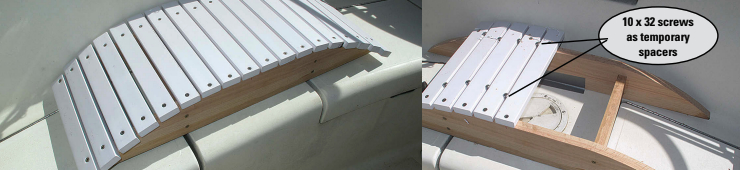
The lengths of the spacers, rails, and top slats will need to be adjusted to fit any particular boat, but these are the dimensions that worked on my boat. For the base, I started with two 32- x 5-inch pieces of white oak. I cut the tops into a curve I thought would be comfortable but left an 8-inch section in the middle flat. I connected them with two oak spacers 8 inches long. Since I’ve had good luck with clear urethane spar varnish on my deck railing at home, I used the same product on the oak. For the slats I used 3⁄4- x 1 1⁄2-inch vinyl composite house trim. This stuff is available at most big-box home improvement stores. I could have used wood, but I wanted to avoid the refinishing cycle.
The stern seat in my boat has a curved backrest that forms the back of the cockpit, and I wanted to assemble the seat to match that curve. My solution was to install the slats on top of the two oak rails in situ. With the two main rails taped in place to keep them from moving, I fastened the slats to the rails, starting with the middle slat, using a stainless-steel flathead screw on each end. I used 10 x 32 screws as spacers between the slats, and pressed the slats against the back of the seat so I could duplicate the curve of the back of the cockpit. I rounded the front edges of the slats with a router to soften them.
Anyone used to tackling simple projects like this should be able to build the oak frame at home in an hour or so. Another half hour on the boat fastening the slats and the job is done!
Jim Craighead and his wife, Annie, are primarily weekend sailors. Midweek, while their good old S2 9.2A sits alone in Schooner Bay Marina, gateway to the Apostle Islands, Jim is soldering, sewing, gluing, or welding on projects to make her “better.” While Jim and Annie know there is no better place to sail her, they are considering adding a trailer-sailer to their fleet.
Thank you to Sailrite Enterprises, Inc., for providing free access to back issues of Good Old Boat through intellectual property rights. Sailrite.com