Why does cleaning it require taking a bath?
Issue 101 : Mar/Apr 2015
Now that we have mapped the human genome, it’s time to tackle the real technological challenge of the 21st century — foul-proofing that little paddlewheel at the bottom of the knotmeter.
Admittedly, this is no small task. No sooner is my knotmeter tidy and reinstalled than every molecule of marine life in the seven seas promptly moves in and takes up residence. There they date, mate, and multiply in a frenzy of biological ecstasy, rapidly reducing my knotmeter to an inoperative something that looks like the herb garden of Jabba the Hutt. I may be granted a day or two of weed-free knotmetering, but rarely more. In the tropics, I get little barnacle hitchhikers on the wheel; in northern waters, I get clams; in the Gulf Stream, itsy biospheres of gulfweed halt the rotation. Then it’s into the cabin for that always-suspenseful operation requiring 11 fingers and an eyeball on a string.
It is, of course, a two-step process. Whatever the joys of actually cleaning the wheel, they pale beside the suspense of getting to the darned thing. No boatwright has ever made the knotmeter easily accessible. Since its little wheel is turned by water flowing past the hull, it is always located under a lot of stuff: cabinets, cabin soles, the de-inflated dinghy, the case of beer there’s not room for in the fridge. In the case of Whisper, my 40-year-old Tancook Whaler, it’s on the port side just forward of the mainmast under a bunk piled high with mattresses, sailcovers, and the odd gearbag. Once I clear them away, I can reach into that cloacal portion of the bilge among those pigs of lead ballast from Adelaide, Australia. Then comes the real thrill: opening a hole in the hull below the waterline.
I remember my alarm at first learning how this is done. I was crewing for an impressively profane sailing mentor named David who explained that the excreting and fornicating knotmeter had to be cleaned before we could get under way. I asked to be instructed in this process.
“Actually, I’ll need you,” he said, soberly. “It’s dangerous work.”
We cleared away the requisite boat bags, opened the proper cupboard, and pushed various wires aside. By this time, naturally, we were crammed into a space too small for two sets of shoulders and barely large enough for four hands. He handed me the dummy plug and began unscrewing the sending unit. A trickle of water began leaking into the bilge.
“Now,” he said, “When I say ‘Go,’ I’ll pull the unit out and you stuff the plug in the hole.”
“Wait a minute,” I said. “We’re below the waterline. When you pull out the unit the whole damn Chesapeake Bay will try to come in through that hole.”
“That’s right.”
“The Chesapeake empties into the Atlantic, which is connected to the Pacific, the Arctic Ocean, and all the oceans of the world.”
“That’s right.”
“They’re all gonna try to pour in here!”
“That’s why you have to work fast. If you don’t, we sink.”
He repeated the instructions slowly, emphasizing my role and raising the suspense. Then he shouted “Now!” and pulled the unit.
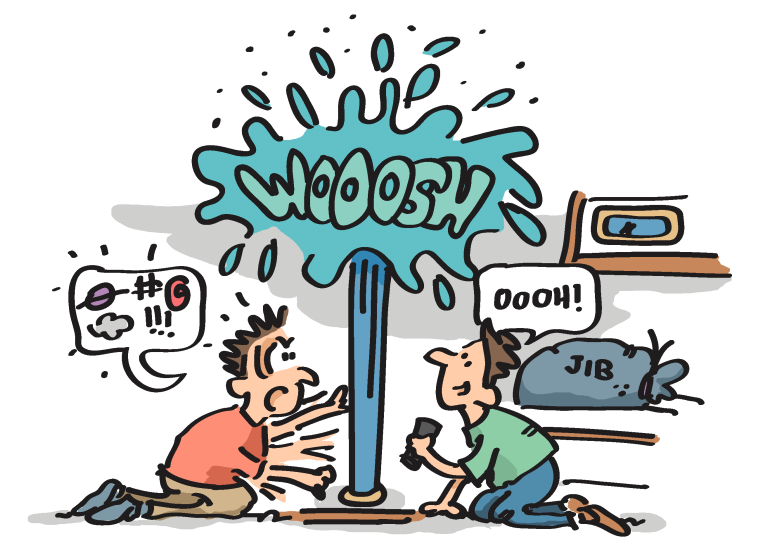
The wrist-thick geyser of water that shot into the boat was at least a foot high. I didn’t move. What froze me was not the water, but the light. I was looking right out into the sunlit submarine waters of all the oceans in the world. And they were coming to get me. But they didn’t look menacing. They looked kind of, well, pretty.
“Put the goddam plug in!” David shouted, immune to undersea aesthetics.
I shoved valiantly against the stream, eventually blocking the inflow. Several gallons of water were now slopping around the cabin. Cursing eloquently, David scraped frantically at the paddlewheel. I seem to remember he used some girlfriend’s bobby pin, but he may have used his rigging knife. These days on Whisper, I use a toothbrush I keep in the bilge, but my de-fouling pièce de résistance is the oyster fork on my Leatherman supertool. It’s just slender enough to get between the paddlewheel and the side of the sender to attack the ichthyological goo around the paddlewheel axle. (What? You don’t have an oyster fork on your Leatherman? And you call yourself a sailor?)
What continues to awe me, however, is the growth on the wheel itself. It’s neither animal nor vegetable, but somehow both. Impervious to the antifouling paint on the surrounding hull, it rapidly morphs into something bulbous, leafy, and crunchy, with a texture reminiscent of the pulmonary “dead man” of a boiled Chesapeake blue crab. Maybe it’s some sort of biological weapon. What if terrorists drop it in our drinking water?
I don’t remember reinstalling the sanitized sender during that first knotmeter cleaning. All I had to do at that point was reopen the hole into the watery world, not close it. But the operation has never lost its aura of adventure, whether performed in a shallow creek or the fathomless Tongue of the Ocean.
The real tongue of the ocean, I always know, is the one that comes in through that hole in the hull.
Some will say I make too much of all this. These sterile souls rattle on about GPS readouts, speed over ground, and the relative unimportance in these digital days of any device propelled by the same principle of physics that drove a gristmill in 12th century Spain.
But what do they know of determination, daring, and the view through Neptune’s porthole?
The other day my 16-year-old daughter asked to learn how to clean the knotmeter.
“Wait a minute,” she said when I explained the process. “As soon as we pull the sender out, the whole Chesapeake Bay is going to come through that hole!”
“Not if you work fast,” I said. “If you don’t, we sink.”
Ken Ringle, a longtime Washington Post writer, is master and commander emeritus of the schooner Whisper, which he sailed out of Galesville, Maryland.
Thank you to Sailrite Enterprises, Inc., for providing free access to back issues of Good Old Boat through intellectual property rights. Sailrite.com