Reflections upon entering the good old years
Issue 101 : Mar/Apr 2015
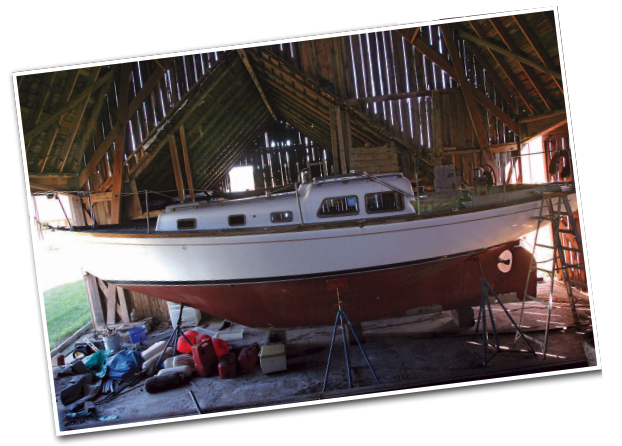
Most of the time it is dark and hot inside during the summer months. It’s late July and for the past nine months I have lived in an old wooden barn on a back road in northern Wisconsin. I’m not complaining, as this is the best I’ve had it for quite some time. My wonderful new owner, Joel, stops by as often as he can. When he does, he opens the north and south doors, giving me fresh air, light, and a breeze. He climbs the ladder and his dog, Jack, rummages around in my belongings on the floor of the barn. Joel can only stay several hours at a time in the summer, as he owns a popular restaurant down the road that leads to the bay. In fact, he bought this barn and the farm it sits on just for me.
My name is Finisterre. No, not that Finisterre, but I’m a classic sailboat nonetheless. The name is French for land’s end, I think, and I have lived and sailed within a 10-mile radius of this barn for the last 30 years.
I come from a prestigious family lineage, Cheoy Lee, and was designed by the famous L. Francis Herreshoff. My birth certificate shows that I’m an Offshore 31, built in 1969 in Hong Kong, which was then a British Crown Colony but is now a Special Administrative District of the People’s Republic of China. Cheoy Lee, which has been building boats in Hong Kong for almost 150 years, was an early adopter of fiberglass technology in boat construction in the early 1960s. Eventually, wooden hulls were phased out, but many of us continued to feature the lavish use of Burma teak in our decks, cabin houses, and interior cabinetry. Many of our metal fittings were hand-wrought.
Sailors all over the world were amazed at the unsparing attention to detail and the overall craftsmanship that were visible in all of Cheoy Lee’s boats. The shipyard is located on the bustling Hong Kong waterfront, where labor rates were lower than in Europe or the U.S., so it was possible for the company to keep construction costs down without cutting corners in the overall quality. A boat built in the U.S. at the time I was and to the same level of quality would have been sold at more than double my price.
My first home
My enthusiastic original owner journeyed all the way from San Francisco to see me being built. Once I arrived at my nice comfy slip in Sausalito, he and his family enjoyed sailing with me for seven years on San Francisco Bay with occasional cruises up into the Delta. That was rigorous sailing for a young boat, let me tell you. Tidal flows up to 5 knots, wind regularly in the 20-knot range, fog, and even cold weather tested my endurance right from the start. My ketch rig was greatly appreciated by the crew as they could shorten sail easily by dousing the main and using the jib and jigger to balance the helm. After seven years as an essential part of this sailing family, I was shocked to hear that I would have to leave by truck for a new home in Chicago.
I was skeptical of my new sailing grounds . . . an inland lake? Really, for a boat of my stamina? When I came down the Chicago River for the first time though, I was amazed by the towering skyscrapers, the endless opening bridges, and even a lock to pass through to gain access to Lake Michigan.
Well, as we sailed out in a fresh southwest breeze past Navy Pier, I was delighted. I couldn’t even see the other side of the lake and was taken aback by huge freighters, tugboats, barges, and weekend warriors as far as the horizon. My new owner was delighted at our sprightly pace. Before I was launched, he had treated me to a full spa treatment of polish, new varnish, re-stitched sails, and even a deck sanding. I was looking terrific for my first sail in sweet fresh water.
I couldn’t imagine a better place for a ketch like me to cruise than Lake Michigan. We made many lake crossings, usually on a reach (my favorite point of sail). Once we were across on the Michigan shore we hopscotched north from one delightful port to the next, each within an easy day’s sail.
After seven seasons, I overheard my owner quietly discussing the amount of money he was lavishing on my care and feeding. All my wooden spars, my teak decks, and my varnished rails need to be tended to, after all. “I’m worth it,” I thought. Many came and admired me but none made an offer. Just as I had about given up hope, Bill Clancy decided to buy me and take me to Door County. It was about a 200-mile sail to the small town of Ephraim on Green Bay at the north end of Lake Michigan.
A little pampering
Bill was a caring owner and each fall took me to the main Palmer Johnson yard in Sturgeon Bay for a few winter projects. As a mature boat, now almost 20 years old, I was still going strong, but my sails were sagging, my engine was wheezing, my winches were getting sore, and I needed a facelift.
Bill Clancy sold me to Bill Clay, who was determined to make me the prettiest boat in Fish Creek Harbor. He dressed me in a brand-new suit of sails and had Palmer Johnson do a transplant in the engine room, installing a new Volvo Penta diesel. He compounded and polished my fiberglass hull, stripped my varnish, sanded my decks, and replaced most of my rigging. The following spring I was absolutely dazzling. Every day, the first rays of the rising sun highlighted my freshly varnished spruce spars against the background of dark green cedars surrounding the harbor. Early each morning that first summer, a young boy rode his bicycle down the dock just to stand and stare at me. I was so proud.
After about five years, Bill stopped coming down to the harbor regularly. I learned he was having health problems. The following summer, I met my new owner, Merv Massey. He had owned a number of smaller boats but wanted a boat that could take him anywhere in any weather. He was aware of the Cheoy Lee quality and that I had been constructed to meet Lloyd’s offshore specifications. He had not owned a split rig before but soon found out how effectively my sails on two masts handled heavy weather. He put me in Eagle Harbor, where he was the harbormaster, so he could check on me almost every day.
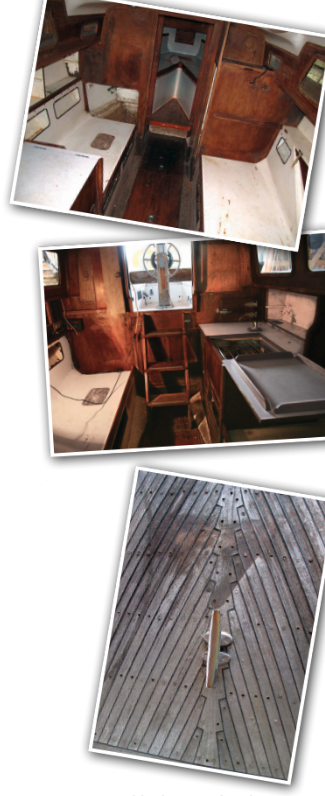
For the next six seasons, Merv and his wife, Bev, sailed me to all my familiar haunts on Green Bay and also to places I had not visited before. Eventually, Merv had me hauled and trucked up to his house in the country. He covered me with an aluminum frame and hefty fabric tarp, but a fierce winter storm blew in and tore the tarp to shreds. Merv had gone south to escape the cold that year, so I sat out in the open all winter. My varnish peeled and my wooden decks dried and cracked. Water seeped in through deck leaks, portholes, and cabin sides and accumulated over my floorboards. I began to think the end was near.
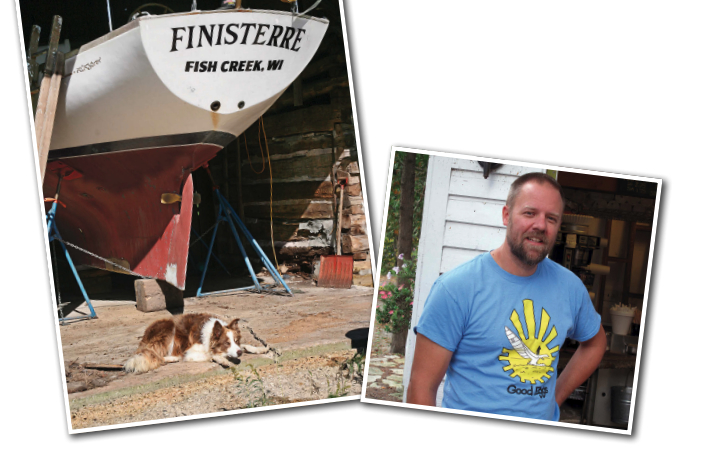
One sunny March day, a young man drove into the driveway. He looked me over and knocked on Merv’s door and introduced himself as Joel Bremer. He explained that as a boy he had admired the boat called Finisterre frequently when riding his bicycle near Fish Creek. Merv, with tears in his eyes, accepted Joel’s offer and they closed the deal with a handshake. A few weeks later, Joel had me trucked to a farm he had purchased a few miles away.
Hopes for the future
This is my second year in the barn. I’m hopeful that Joel will have the time to get me back in the water soon. He’s young, extremely handy, and has a great deal of energy. He even built his own house a short distance from the farm.
I’m sure we share some concern about what comes next. To begin with, I am now about 44 years old, have been with five previous owners, have not had any serious work done in more than 20 years, have sailed in both salt water and fresh, and most recently suffered from exposure to the worst kind of weather a Midwest winter can throw at you. No doubt I’m showing my age, but is that so bad? Other than the finish on most of my woodwork, wear and tear on some of my systems (electrical, plumbing, and engine), I could probably be vacuumed out, dusted off, scraped, varnished, and launched.
Joel has an interest in old things kept pretty much in their original condition. “Patina” he calls it. This barn, the original farmhouse, the toolshed, and even Joel’s ancient bus are nearby. These things are not pristine, restored, or glorified, but taken together the whole scene smolders of comfort, beauty, and a casual, rustic way of life. I hope to fit into the picture, not only here at the barn, but also back in the clear blue waters of Green Bay with Joel, Lauren, and their children Finn and Margaret, and of course Jack, enjoying a family sail.
So my guess is that my life going forward as a good old boat will not shout, “Hey, look at me and how beautiful I am.” As a mature sailboat, my patina will be my calling card.
Bill Jacobs has spent nearly 50 years in sailboats and powerboats. His marine photography is displayed in galleries, private collections, and museums, and has been printed in boating publications. His articles have been published in boating publications since 2004. Bill winters in Sarasota, Florida, and cruises on a Mainship 34. In the summer he can be found sailing his Cape Dory Typhoon on Lake Michigan off the shores of Door County, Wisconsin.
Thank you to Sailrite Enterprises, Inc., for providing free access to back issues of Good Old Boat through intellectual property rights. Sailrite.com