A first cruise that might have been the last
Issue 103 : Jul/Aug 2015
Though it’s not the ocean, Lake Ontario demands a certain amount of respect. My husband, Chris, and I were reminded of this not too long ago during the maiden voyage of our “new” 22-foot trailersailer. Despite our collective seven decades of sailing here, we needed reminding and were humbled by the reminder.
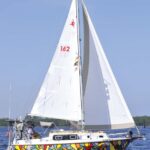
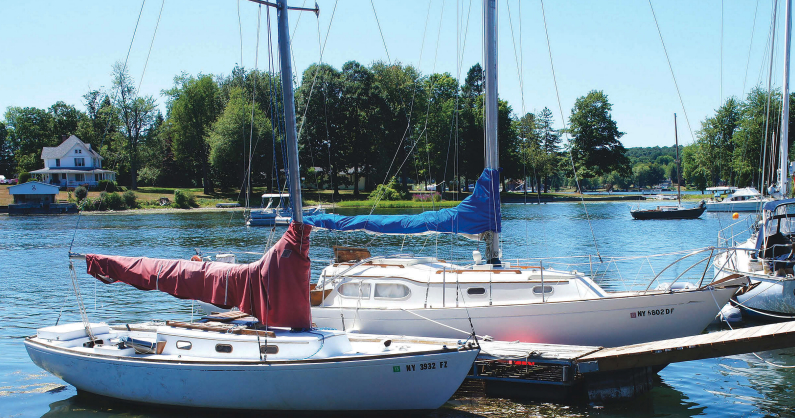
The new boat’s name, until we come up with something better, is LC. (This stands for Little Craft, and is pronounced Elsie). She’s a 1965 Seafarer Kestrel 22. We liked her full-keel centerboard design and her traditional lines when we viewed her on craigslist. We already were owned by a 32-foot Chris-Craft Cherokee and a 47-foot wooden Tancook schooner when we decided to add LC to the fleet. “She’ll be our retirement boat,” we declared. With her shoal draft, she’s trailerable and we can go canal cruising on upstate New York’s Erie or Canada’s Rideau or maybe even do the Trent Severn and Georgian Bay, once we finally get rid of all the ridiculously labor-intensive big boats.
Our evaluation on a hot sticky Sunday afternoon in July revealed a few issues, among them a very mushy 47-year-old balsa-cored cabintop and sidedecks where poorly bedded hardware had taken its toll over the years. But my spouse has saved three boats from the landfill over the last 20 years and didn’t seem too worried about redoing a deck. We figured fixing up a 22-footer would be a piece of cake after the two-year refit of the 47-foot woodie we had just finished. So $600 exchanged hands and we took possession of the little sloop, sails, and 6-horsepower outboard motor.
The Seafarer was located at the east end of Oneida Lake about 60 miles by water from our homeport of Fair Haven on Little Sodus Bay. Much of the trip would be on the New York canal system, though we faced stretches of open water at the start and conclusion of our passage.
Oneida Lake is a good-sized but shallow body of water in central New York. It’s quite capable of kicking up a Chesapeake Bay-style chop of 3- to 4-foot waves with “corners” on them in a very short time. The canal crawlers treat it with respect. Our early-morning transit, however, was over mirror-smooth water and the unproven boat and her elderly outboard performed flawlessly . . . much to our relief.
We anchored in a cove at the lake’s west end, lowered the deck-stepped mast with our pivoting A-frame made of two Sunfish booms lashed to the chainplates, and proceeded into the canal.
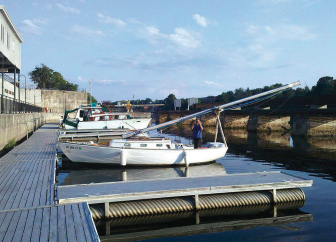
New York’s 500-plus-mile canal system is unique. It follows the route of the old Erie from Albany to Buffalo with side trips to Lakes Ontario, Champlain, Seneca, and Cayuga. We traveled a short but scenic portion on the Seneca and Oswego rivers for one day. You could easily spend a summer here exploring backwaters, villages, and wide-water interludes. The secluded oxbows and quiet coves with wading great blue herons, colorful pickerelweed, loosestrife, tall pink joe-pye weed, and white boneset tempted us, as did the deep shade of the forested shorelines. But we had a schedule and so buzzed on under outboard motor through the blaze of a hot July afternoon.
We spent the night at the old canal city of Fulton and locked down the next day to Oswego, where the lake’s wide blue waters welcomed us. We raised the mast and considered our options. We had planned previously that, if the forecast called for wind and waves, we would wait it out with our untried vessel. But the boat and motor had performed well during our canal passage. Home was just 10 miles away and the forecast was for offshore winds.
Chancing the weather
True, it was predicted to build to 10 to 20 knots in the afternoon and there was a slight chance of thunderstorms. But it was still morning. We could be home in time for a late lunch. The lake should be pretty flat with a southwest wind and we’d stay close to shore. We decided to take a chance. We both should have known better.
Once clear of the harbor, we raised sail, eager to see how our little boat would behave. A cat’s-paw darkened the waters around us and she accelerated and scampered off across the wavelets with a will: light helm, quick and lively but steady and solid for a 22-footer in the puffs. This was grand! We knew we had ourselves a winner. We were delighted with our mannerly little $600 boat and it was sweet to sail again after a long hot stretch of motoring on narrow waters.
By the time we got to the Oswego steam station, a mile or so from the harbor, however, it was pretty obvious that we had more wind than we wanted and it had just enough west in it to push us well offshore as we sailed close-hauled on a port tack. As the lee rail began kissing the water, we were already more than a mile out. We said this is not what we should be doing with an unknown boat and a mushy deck. But we kept going.
Ford Shoals lurks 4 miles west of Oswego and, shoal draft notwithstanding, we decided to go outside the buoy. This took us well offshore and LC was soon vaulting over a short steep 1- to 2-foot chop pounding along close-hauled with a will. “Ouch!” I thought as she smacked into another wave. “Hope everything holds together. Wonder how those chainplates are.” I peered below and stared hard at them, but I saw no signs of movement. Our little craft was a bit overpowered.
“Maybe we should reef,” I said.
“We’re doing fine,” said my spouse. We charged on.
Ominous signs
Perhaps 20 minutes later I thought, “Boy, those lee shrouds sure are loose, I don’t remember that much slop in them when we set the mast up.” I looked aft as we heeled to another gust. The backstay was pretty loose too. I pointed this out to my spouse. We sailed on. A worm of fear began crawling around in my stomach. I was growing increasingly concerned that something wasn’t right. Suddenly the lake felt very wide and empty without another boat in sight anywhere.
“Let’s take a tack and work inshore,” I suggested.
“Then we won’t be going toward Fair Haven,” he said.
“But it won’t be as rough in there,” I argued. Eventually we tacked. It was calmer, but also very gusty.
“We should reef,” I said. A couple of really hard gusts came along. We reefed. But still I felt uneasy and fretted, watching the leeward shrouds flop around. “Man, you could tie a knot in them,” I thought. Then I looked below.
A disturbing discovery
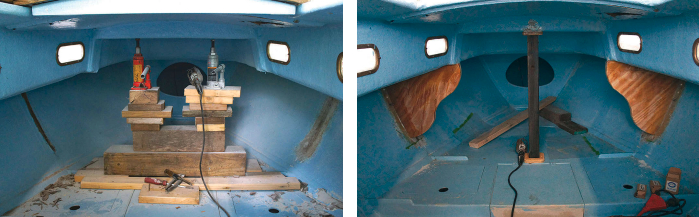
Was that crack in the fiberglass covering the chainplate attachment there before? Something about the glassed-in reinforcing knee that ran between the sidedeck and the hull looked different. Then I noticed another crack. And it was showing movement.
“Hey!” I said, pointing below, “I know that crack wasn’t there before!” My spouse went below and looked. He came back up after about 10 seconds.
“It’s worse than you think,” he said. “Better get the jib down.”
“No it’s not,” I thought, as I crawled forward to pull the sail down. “I knew it was bad.”
We realized now the painfully obvious fact: the entire mushy foredeck of our new boat had begun to cave in as the compression thrust of the mast buckled the rotten reinforcing knees the chainplates were attached to. Like wet cardboard, the knees were folding and the cabintop — with no compression post under the mast — was sinking. It was just a matter of time before a catastrophic failure occurred and we were left dismasted, quite possibly holed by the mast butt, and maybe sunk with a strong wind blowing us offshore. Could we hang on to the beer cooler long enough to make it to Canada? We were in deep doo doo now.
Belatedly, we put on our life jackets, started the 6-horse-power motor and headed inshore, motorsailing against the wind with the reefed main. Once we got into smoother water within swimming distance of the beach and began working west again, I dared to peer below at The Crack. It had closed up noticeably with the reduction of sail. Maybe if the motor kept going, we’d be OK. At any rate, if she did fall apart, we knew we could get ourselves ashore.
Racing a cloud
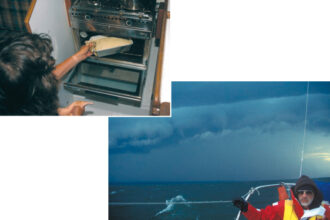
Then I looked up at the horizon and noted the thunderhead out to the west that I’d been watching earlier. It definitely looked bigger. It was developing a real nice anvil top on it too. “I wonder how fast that Bad Boy is coming down the lake,” I mused out loud.
The tech department got out his smart phone and checked the radar. “Looks like it’ll get here about 5 p.m.,” he announced. We were halfway to Fair Haven and the little motor was buzzing along pushing us at 4 knots. We would be at the channel by 3. If we didn’t run out of gas.
Sure enough, as the thunderhead filled the entire western sky, we were motoring down the channel. As the sun disappeared behind it, we picked up our mooring and stowed the sails of our poor little broken boat. We rowed ashore under an intensely dark sky and began loading the car, pausing to watch the moored boats swing into the wind shift.
Then the blast hit. A couple of the shade umbrellas on the restaurant deck by the parking lot took flight. Probably 50 knots.
The faithful Johnson had saved our boat and maybe us too. Two “old salts” with 70-some years of collective experience had learned a little lesson that day. We had gotten overconfident, if not downright cocky. This time the lake cut us a little slack. Next time might be different.
Susan Peterson Gateley writes and sails on Lake Ontario. Find her books, including Living on the Edge With Sara B: A Sailing Memoir and Maritime Tales of Lake Ontario on sale at www.chimneybluff.com.
Thank you to Sailrite Enterprises, Inc., for providing free access to back issues of Good Old Boat through intellectual property rights. Sailrite.com