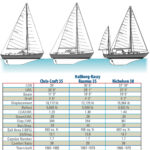
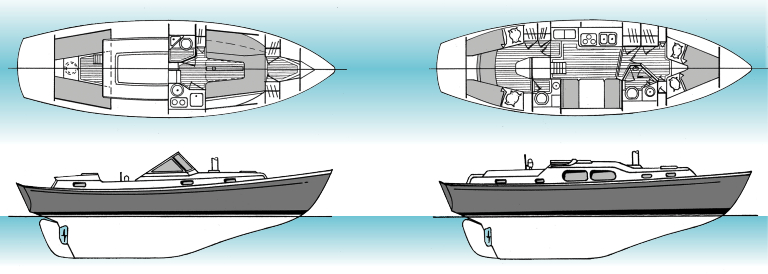
Two Chris-Craft 35s illustrate the designer’s dilemma
Issue 103 : Jul/Aug 2015
When doing design comparisons for our feature boat articles, it’s important to find the proper variation of the model in question, since a lot of boats from the same manufacturer go through production “upgrades” or are offered with a number of rig, keel, and interior options. In the case of the Chris-Craft 35, there were two variations of this hull. The feature boat, Yellowbird, is the original Chris-Craft Sail Yacht 35. Introduced in 1963, it was the first sailboat and the first fiberglass hull that Chris-Craft built. The story of Chris-Craft’s entry into the fiberglass sailboat market is well documented in Dan Spurr’s book, Heart of Glass.
Of equal interest to me is the second variation of this hull, introduced by Chris-Craft in 1965 as the Caribbean 35. In my time with C&C, Mark Ellis Design, and Hunter Marine, it was not uncommon to periodically “update” a production model to add new features, adapt the hull and rig to the current rating rule, or introduce a new variant to the market on the assumption that the older model was approaching the end of its production life. This usually involved using a modified version of the existing hull and adding a new deck and interior. The Caribbean 35 is a good example of this phenomenon. However, in most cases, when the new model was introduced the older one was discontinued. That was not the case with Chris-Craft; the Sail Yacht is listed as having a longer production life than the newer Caribbean configuration.
What’s fascinating to me about these two versions of the Chris-Craft is the marketing decisions at work with the introduction of the newer model. There had obviously been feedback that indicated customers were looking for more interior amenities in a 35-foot center-cockpit model than the Sail Yacht provided. There is no question that the Sparkman & Stephens-designed Sail Yacht is an exceptionally handsome boat. Her relatively low freeboard, pronounced sheer, and low house are very reminiscent of the designs of L. Francis Herreshoff, especially boats like his Rozinante.
Looks vs. amenities
However, the elements creating this classically good-looking profile severely compromise the interior, especially in a center-cockpit configuration. Moving the cockpit from its traditional aft position to a center location certainly creates space for an aft cabin, but the forward cabin is robbed of that space: there’s no longer room forward for a V-berth, so the saloon now provides the primary berths. There is a small enclosed head in the forward cabin, but the aft cabin has to settle for a head under a folding seat between the two berths! It comes as no surprise that, to increase the usable volume, the owners of the Sail Yacht 35, Atelier, chose to enclose the center cockpit, essentially creating a pilothouse (see “Atelier” in the May 2015 issue).
When Chris-Craft addressed these shortcomings with the new Caribbean 35, the first thing the designers did was increase freeboard while at the same time flattening the sheer, so most of the gain in height is amidships. They raised the cockpit and located it farther aft, where it’s partially over the aft cabin, and increased headroom amidships by incorporating a pronounced doghouse (almost a pilothouse) forward of the cockpit. This allowed the sole to be raised so the engine could be placed beneath it, opening up this area.
Increased room amidships allowed the creation of a dinette to starboard with a larger galley to port. A step down forward led to a private cabin with a V-berth, an enclosed head accessible from both the main cabin and the forward cabin, and generous hanging lockers. Raising the freeboard, cockpit, and house height aft created room in the aft cabin for its own enclosed head and increased locker space. The result was a true two-cabin layout. This design introduced what would soon become the standard center-cockpit configuration in the market. Indeed, when C&C introduced a center-cockpit layout in the Landfall 39 and 43, it adopted the Caribbean concept.
Amenities vs. performance
This increased interior volume is not achieved without a price, and that price has to be sailing performance. The higher freeboard, deck, and cockpit and the additional crew weight will have a detrimental effect on stability and an increase in windage. The higher center of gravity will be partially offset by the increase in displacement that this much more elaborate interior creates. Oddly, the published displacement of these two models is almost identical. This is unrealistic and makes a numerical comparison of sailing performance difficult.
To my eye at least, the newer configuration is not as good-looking as the previous design. Gone is that spring in the sheer and that delicately attractive profile. However, there is no disputing the substantial increase in accommodations and amenities below. Considering that, from this time onward, the majority of the center-cockpit layouts followed the Caribbean concept (which tells you what the marketing departments thought), looking at the two configurations, which would you choose?
Rob Mazza is a Good Old Boat contributing editor who, in his long career with C&C and in other design offices, designed many boats that are now good and old and thus contributed enormously to the enjoyment of those who sail and own them today.
Thank you to Sailrite Enterprises, Inc., for providing free access to back issues of Good Old Boat through intellectual property rights. Sailrite.com