A daily duty records a lifetime of memories
Issue 105 : Nov/Dec 2015
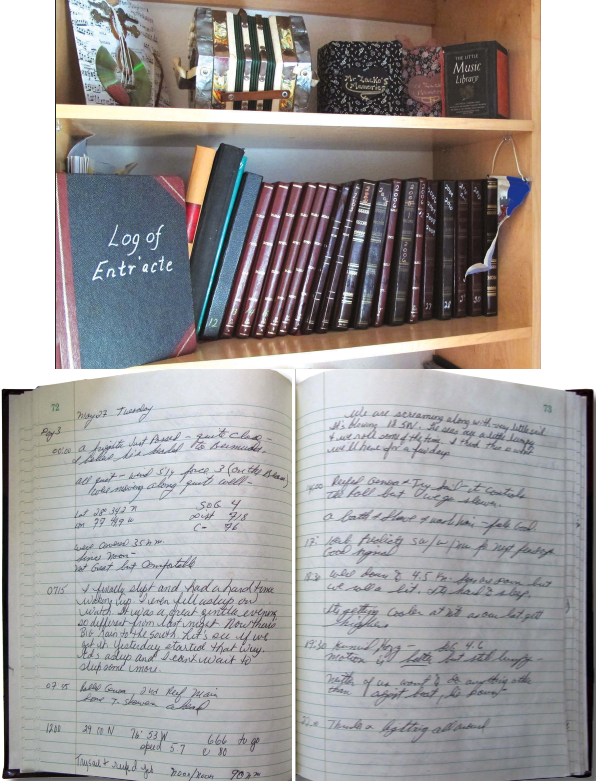
I am sitting in front of the fire doing research for an upcoming ocean passage. I like to study the passages of others. What routes did they take? Which months? Did they make good choices and, more important, did their planning result in a good passage? I am lost in this book . . . fascinated. I have made this passage several times, but the account I am reading bears little resemblance to what I remember. Yet it is our very own log of Entr’acte from 2005, our passage from Gibraltar to the Azores. It is our boat, our book, our writing, but these words seem to have been written by someone else. Seemingly innocuous entries trigger the memory. The blanks fill in and the past comes alive as the scenes become once again familiar. I look up to the bookshelf and smile. Entr’acte’s log, which began on her launch date April 1,1980, and has continued uninterrupted to the present day, now fills 37 beautifully bound volumes.
At first glance, these books seem to be a useless compilation by someone with an obsessive/compulsive disorder, or perhaps simply the affectation of a romantic. We were in our mid-20s when we began the Log of Entr’acte and we joked that these journals would be fun to read by the fire when we “got old.” Well, we’re approaching 70 now and we, along with Entr’acte, are still under way. I pause to think about logs. What are they really? What treasures do they hold? What should a log contain? Are they really necessary?
Modest beginnings
The log from our first 18-foot catboat, Drummer Buoy, was a simple all-in-one book, each page an identical form with columns for every conceivable phase of boat operation, maintenance, and navigation. Just fill in the blanks as you sail on. Included in this book was a guest log, basic piloting instructions, a Beaufort Scale to judge the wind, barometer instructions for predicting weather, and hurricane survival . . . advice, presumably, for when we failed to predict the weather properly. Our entries, when we made them, were simple and to the point but lacking in narrative. But Drummer Buoy was a very simple boat and our cruising in her was simple.
Thanks to Drummer Buoy, and inspired by the writings of Lin and Larry Pardey, the cruising bug bit hard. We built Entr’acte in our backyard, quit our jobs and, with very little money, set out to see the world in complete charge of our boat and our destiny.
A Nor’Sea 27, Entr’acte may have been a more sophisticated boat, and our goals were certainly more ambitious, but we still did not take log-keeping seriously.
I select volume one and open to 10 August 1981, departure day when we set out from Haverstraw, New York, to see the world: 0700 — “Left right on time!”
We have laughed a lot about that entry over the years. Just what were we on time for and why was it so important to leave “on time?”
One week and a hundred miles east on Long Island Sound, we made our next entry. In our defense, we were excited, completely exhausted from our preparations, and very familiar with Long Island Sound. Still, in retrospect, the lack of log-keeping was irresponsible.
Our first serious offshore passage from Block Island to Chesapeake Bay was chastening. Being a bit cavalier with our navigational entries, we mistook a lighted drilling ship for the New York City skyline and wasted hours in frustration and confusion. These were the salad days before GPS and all navigation was a combination of coastal piloting and celestial navigation using the sun, moon, stars, and planets. We learned in dramatic fashion the absolute necessity of maintaining a good, written DR (dead reckoning).
As we traveled farther, we met the serious cruisers, those “long-timers” with tens of thousands of miles under their keels. We were “the kids” who clearly needed some help and we absorbed all the advice that was offered. Foremost of their suggestions was the obligation to “keep a proper log.”
Inspecting the logs of these pros was impressive, not only for their regularity but for the detail. Hal Roth’s entries were those of a military vessel and the rest of the book a veritable time capsule.
I select volume three and begin a delightful walk through Entr’acte’s history and our life with her. I open to a random page and am reminded what it was like to cruise on a shoestring: a “night on the town” in Spain when we split one beer and one tapa (60 cents) between us. We stretched it out for three hours before drinking up and going home. The entry also mentioned how happy we were. In another volume, we are suddenly in Tonga playing with The Hausia Brothers Band before the King of Tonga. I move to another that details a particularly vile night beating up the coast of Panama and still another that, in one short paragraph, has captured the absolute wonder of our first celestial island landfall: “Perhaps this was not wasted energy after all!”
As we sailed on, we gradually matured into responsible sailors and our log evolved as well. It bears little resemblance to that all-in-one book from Drummer Buoy.
Logs for everything
Entr’acte’s log now comprises three separate books. The primary volume is the actual ship’s log. The second book is a dedicated engine log. The third is a maintenance log. At first, all of the information was in one book, but it proved far too difficult to find critical information when we needed it. Two years into our voyage, we met with a container ship officer and discovered the benefits of separate, dedicated logs. Now, finding critical information is a snap. Without fail, we make a log entry every single day that we are on board. Each entry represents a day in the life of Entr’acte.
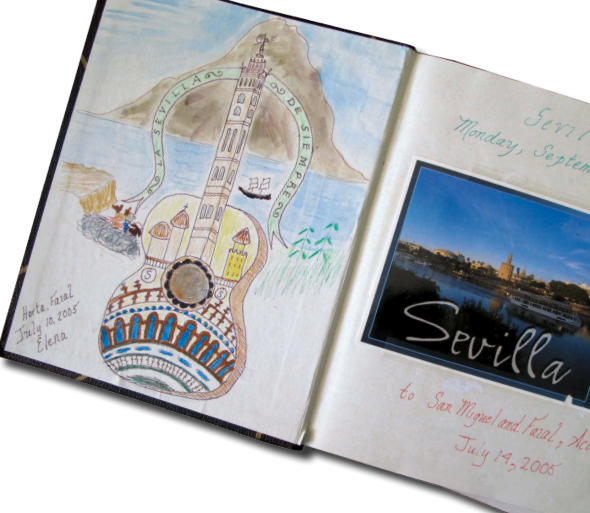
The morning entry begins with a weather synopsis, harbor conditions, and overnight events. The next entry usually outlines the plan for the day on board or ashore. The evening entry is made just before bedtime and summarizes the day on board as well as significant activities ashore such as social events, concerts, and sightseeing. If an official comes on board, we always request that he sign the log noting the date and time. This book also serves as our journal to record thoughts and impressions on where we are, how we got there, what we did that day, and locals we met and their contact information.
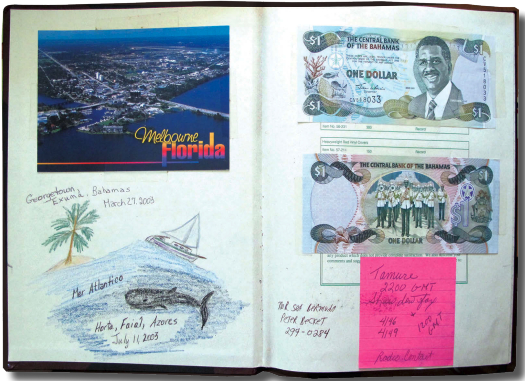
Several pages are reserved at the back of the book for “significant postings.” These could be theater tickets, bus or train schedules, program cover pages, restaurant receipts, menus, marina bills, and almost anything worthy of future reference, memories, or proof of payment.
Passage entries
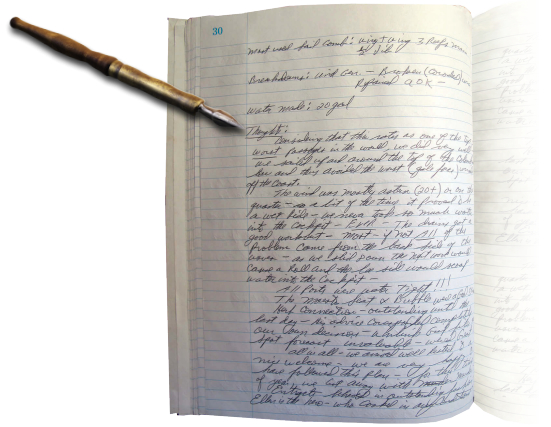
When under way, our navigation entries are regular and complete. For weather, we list barometer reading, sky, cloud cover, wind direction and speed, and sea state and direction. Navigation information includes position, destination, true course, speed, distance to next waypoint and distance to destination, sail combination, rpm if under power, hours accumulated while under power, estimated fuel consumption, and estimated hours of fuel remaining.
We keep proper watches and make log entries during the watch. These entries begin with our current position at the start of the watch and include true course, course to steer, barometer reading, weather, wind strength and direction, sea state and direction, and taffrail log reading. Headsail changes and reefing changes are also noted, as are sightings of ships, whales, or anything else of interest.
Our DR is constantly maintained, updated, and plotted on a paper chart. Every significant course change is logged and plotted along with the time of change. Despite the use of GPS, experience has taught us that electronics fail suddenly and without warning at very inopportune times, so it is vital to have written down the compass course you are trying to steer. We note changes in wind speed and direction as well as sea state and direction. If we take in or shake out a reef, we note it in the log along with the time.
At the conclusion of each watch, the watchkeeper writes a summary of the watch along with specific instructions for the new watch, such as cautions pertaining to events past and instructions for resolving present events like ships on the horizon or impending landfall. Verbal instructions are not remembered well by the new watch coming out of a sound sleep; written instructions are best.
Once the anchor is down and secure, we note the exact position along with bottom conditions and a brief description of the effectiveness of the anchorage in case we choose to visit it again someday.
At the conclusion of each passage we write a passage summary. What went well? What went wrong? Did our tactics work? What percentage of time did the wind blow from each direction and what point(s) of sail were we on? What percentage of the time was under power? How much fuel was used? How much remains? Which sail combinations did we use and which were most/least effective? What would we do differently? Anything of significance is noted while it is still fresh in our minds.
With the above data, we can reconstruct the entire passage, either while under way or years later. These pages have proven extremely valuable in planning future passages.
The engine log
The engine log is dedicated solely to the maintenance and operation of the engine. This has been the subject of good-natured ribbing over the years. (“You keep an engine log?”)
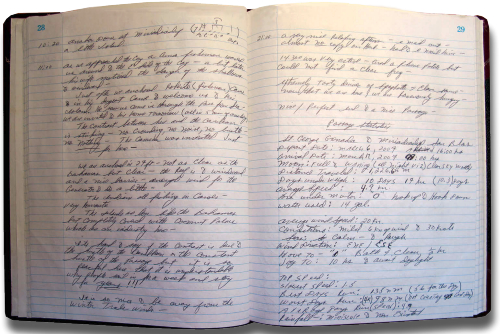
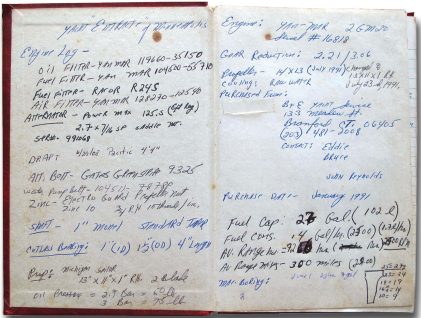
Yes, we have a small hardbound journal that documents the engine from its initial installation in 1994 to the present day. The inside front cover shows the engine’s make, model, and serial number along with the date and place of installation; the transmission brand, serial number, and gear ratio; the shaft size; propeller size (diameter and pitch) and brand; and the size and part number of the Cutless bearing.
The inside back cover lists various settings: valve clearance, torque settings and notes, specifications, and pages of the service manual most commonly referred to.
The final pages list commonly replaced parts by name along with their catalog number. These include fuel filter, oil filter, water-pump impeller, belts (brand, size, and number), thermostat, and so on. This format minimizes a lot of digging through the manuals when it’s time to do maintenance.
The body of the engine log details actual engine events. Every part installation, belt change, and repair is documented by date and hour-meter reading, and every part number with place of purchase, address, phone number, and cost.
Fuel is logged according to engine hours with hourly consumption noted and compared to past runs. Likewise with oil: the weight and brand are noted and consumption or lack thereof is compared to previous runs. We log how much battery water was added and how many hours elapsed between battery top-ups.
If any of the above figures show a marked change, that’s a reason to look into things to avoid surprises.
Thanks to these records, we know exactly how much fuel we use at various rpm settings and conditions. We can accurately gauge our consumption throughout a passage, reducing the chance of running out of fuel before we arrive in port.
Maintenance log
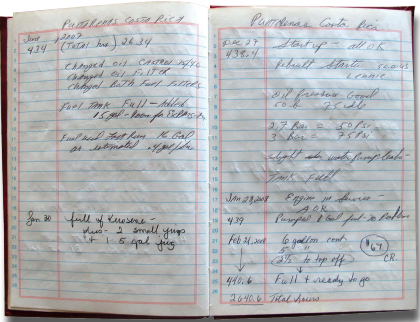
This book is a simple tabbed journal. Each section is dedicated to various items on board: watermaker and survival watermaker, galley, rig, dinghy and outboard, sails, winches and deck gear, charts (which are on board and which are needed), computer, life raft, and ditch bag. The maintenance log holds a record of repairs due to breakdown and also documents dates of preventive maintenance.
Our anchor windlass is an example. The aluminum warping drum is mounted onto a steel shaft. Dissimilar metals combined with endless saltwater dunking present a real danger that the drum could become permanently corroded to the shaft. With the drum seized to the shaft, I would be unable to dismantle the windlass for repair and it would become a total loss. After a few close calls, I concluded that to take 10 minutes each year to remove, grease, and remount the drum is good insurance. It helps to be reminded to do it.
The same goes for aluminum cleats fastened to the mast with stainless-steel machine screws. These screws should be removed and re-installed periodically to prevent them from becoming permanently welded to whatever they touch.
When was the emergency watermaker last serviced? What is the expiration date on the flares? When did we last fill the tank for our cooking fuel or end-for-end the anchor rode? The list seems endless. With hundreds of things to maintain, how does one keep track? Time passes swiftly, and the timing of events and routines gradually blends together. Without a written record, these small but vital jobs can be neglected.
Treasured memories
Thanks to our logs, all of our adventures are documented. Now, as we approach the golden years and can manage a little time to sit by the fire, we read the stories to each other. We are reminded of the wind in the sails, the landfalls, and the excitement of arriving in a new port and meeting locals who became dear, lifelong friends. These volumes are real books, not a virtual computer or tablet file. We tried to keep an electronic log, but as we made the same entries, they seemed to disappear. No, we prefer books we can see, touch, feel, and smell . . . complete with the occasional old saltwater stains. Or might they possibly be tears? Our logs remind us of what cruising should be. Each page is a day in the life of Entr’acte.
If you maintain a log for your good old boat, it will be a treasure.
Ed Zacko is a Good Old Boat contributing editor. He and Ellen met while playing in the orchestra of a Broadway musical. They built their Nor’Sea 27, Entr’acte, from a bare hull and since 1980 have made four transatlantic and one transpacific crossing. Entr’acte is now based in Seville, Spain, where Ellen and Ed are happily sailing in and around the Mediterranean and playing in the jazz clubs of Spain, France, and Morocco. When not on board Entr’acte, they heave-to in Phoenix, Arizona, where they maintain a busy concert schedule throughout the Southwest U.S. Follow them on www.enezacko.com.
Thank you to Sailrite Enterprises, Inc., for providing free access to back issues of Good Old Boat through intellectual property rights. Sailrite.com