Saying farewell to a first small boat
Issue 113: March/April 2017
In the two-page color advertisement, the million-dollar yacht was sailing briskly across blue water against a background of the white sand beach and palm trees of a generic tropical island. An attractive woman wearing sensible but sensuous summer wear gazed admiringly on a handsome middle-aged man at the helm. The image was extremely inviting and entirely out of reach. Then I saw, in the list of the boat’s features, the words, “self-tacking jib.”
“That,” I thought, “is the secret to it all.” If I had a self-tacking jib, it wouldn’t matter that my “tropical island” is the shoreline of White Rock Lake in Dallas, or that my 14-foot boat really doesn’t have room for a lounging admirer. Or, for that matter, that my sailing time is often curtailed by my role as commodore of the local boat club. (It is a grand title that means little in a club comprised of singlehanding sailors, none of whom, each being his own captain, is inclined to ask permission or to apologize.)
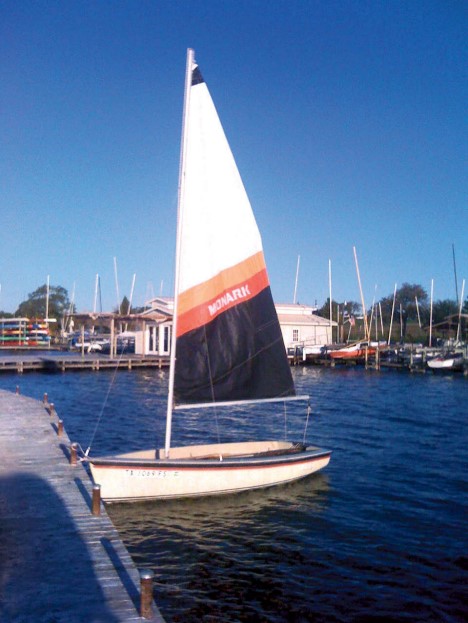
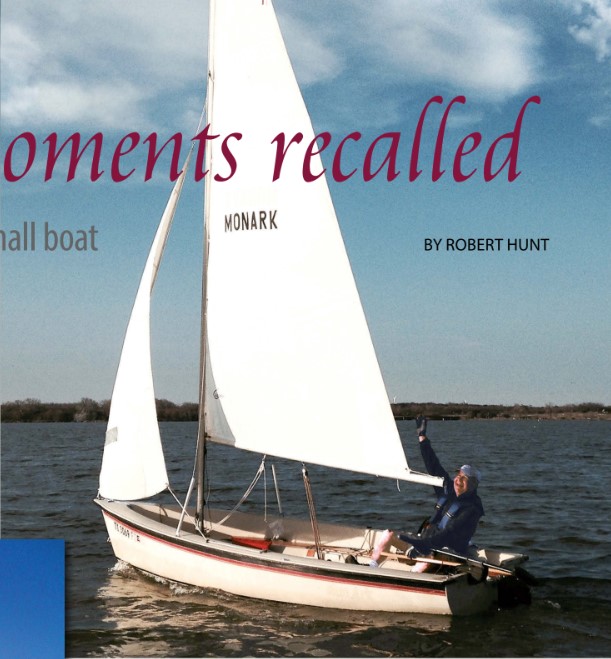
I’m ahead of myself. I’m writing to pay homage to a departing monarch, my first good old boat, a 14-footer named Anoesis. She was, more correctly, a MonArk, one of the many experiments in small fiberglass boats of the early 1980s. The design intent was a three-fer: a boat that could be motored (a small outboard can be mounted on the transom), rowed (built-in oarlocks and rowing seat), or sailed.
An experienced small-boat sailor recommended her to me as a boat that would be stable and easy to sail, and that she is. She has two drop-down bilgeboards under the seats and thus out of the cockpit. Together with the nearly identical rudder, they weigh 80 pounds. Supporting the cockpit from bow to stern is a heavy metal bar that, when sailing, is below the waterline and thus can be considered ballast.
To describe how she sails, let me just say that the few times I tried to race her in mixed classes of amateurs, I withdrew to avoid delaying the start of the next race. On the positive side, I could sail her singlehanded in 20 knots with no reef in the main and without serious danger of going over. Which is good. If she’d ever capsized, the eight unattached wooden pieces making up the seats and storage covers would have floated away while the miscellany stowed beneath them (including the anchor and battery for the trolling motor) would have gone straight into the muck.
Un-maidenly voyage
I bought her supposedly ready to sail, and I suppose she was as ready to sail as I was to sail her. So it was fortunate that the wind was light when I first eased Anoesis off the trailer into White Rock Lake. Although rigged for a jib, she didn’t have one, so there wasn’t much to tend to once I stepped the mast and raised the main.
There was a problem, of course. The ramp is at the north end of the lake and the wind was straight out of the south. With my extensive theoretical knowledge, gained from reading The Complete Sailor by David Seidman several times, I knew this would require tacking. This, in turn, I knew required headway. So as Anoesis tried to sail back up the ramp, I heaved her around the pier until I had 20 yards or so of water to the east. I pushed off hard, pulled in the sail, pushed the tiller to steer her more into the wind, and slid lightly into open water. It was great. For a moment. Then, even as I frantically tried to point her southeast, I slowly slid across the water into the reeds on the north bank.
Oh yes, now I remembered page 72. Without a keel, or in this case lowered bilgeboards, the boat slides to leeward and toward the dreaded lee shore. Actually, the reeds weren’t so bad. It was mid-autumn and the cottonmouth vipers that usually coil around them had long since retired for the winter. And, positively speaking, if I could turn the boat around, I had room to the west to build up speed. So, leaving the main to luff, I used the reeds and a paddle to slowly pull her around to face west to start again.
I lowered the bilgeboards, shoved off hard against the muddy bottom with the paddle, and managed enough forward motion to steer clear of the pier to my west by half a dozen inches and tack back east before I hit the docks of the boat club. I ignored a group of three spectators. Their shouted advice didn’t seem entirely sincere. Three more tacks and I was in open water and could begin learning about how the boat sailed and how to sail a boat.
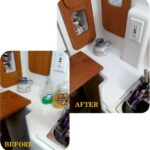
Two hours later, I knew there was work to do. I needed a cup holder — the coffee I had brought for my inaugural sail became a coffee stain as the wind picked up. I needed a new mainsheet — the line that came with the boat was so thick it barely ran through the blocks. (It would become my painter.) I needed a jib because, well, it just didn’t seem like a sailboat without one and, without a jib, you can’t heave-to and drink the coffee that should be safely in the cup holder.
The next day, I drove to the nearest boating store, where I got a quick lesson in the cost of upkeep. A new mainsheet cost nearly $80, or one-tenth of what I paid for the boat. Cup holders didn’t look like they’d fit and were priced as if made of gold. And when I inquired about a jib, I was referred to a company ready to create one with a 10-foot luff and 5-foot foot for a mere $350.
A reality budget
It was time to start finding out how it’s done in the real world. I started talking to every sailor I knew, looking at stuff online, and walking the docks to see how other boats were organized. I ultimately discovered five years’ of Good Old Boat magazines stashed in the boat club storeroom. I learned that you can buy used sails and that working on a boat isn’t something to fear. My first jib cost $35 and still works fine.
During my second time out I realized that the arrangement of the mainsheet blocks was a badly done kludge and that tying off the jibsheets on horn cleats was ridiculous.
Armed with a drill, a rivet gun, stainless-steel screws, and a growing supply of scavenged blocks, pad-eyes, and cleats, I began relentlessly rearranging the running rigging, leaving in my wake some cracked gelcoat (who knew it was so brittle?) as well as small holes along the coamings filled with either silicone caulking or extra pad-eyes. I cut my cup and bottle holders in the wooden seats with a hole saw. It all worked and it all helped.
I was addicted. If I saw it on another boat I had to have it — assuming I could get the parts for little or nothing. And that was surprisingly easy because derelict boats seemed to be abandoned on a regular basis at White Rock. Soon I had a vang, a downhaul, and a Cunningham.
An old friend abandoned his racing scow and left me a cardboard box of newer blocks, pad-eyes, fairleads, cleats, and other general sailboat stuff. In a couple of years I changed the mainsheet rigging three times. I finally settled for an arrangement I saw on a Nomad, off the stern and running up to mid-cockpit, but I retained the option of using the center-boom sheeting that’s more efficient for singlehanding.
A topping lift followed and, while the mast was down, a windvane. A small plastic trashcan fit perfectly under the mast to catch excess line from the halyards. And after a small outlay for pressure-treated furring strips, I had a wooden deck underfoot as well as under seat.
The decking was necessary because — unless I tilted the boat back more than 30 degrees to drain it — several gallons of water always accumulated in the stern bilge, water that inevitably came into the cockpit. Wet feet were inconsistent with my sailing fantasies.
Now that I had a boat with multiple attachment points and cleats on the coamings, stern, bow, mast, and boom, I could experiment and learn a lot about what affects sail shape (and how to correct it). I began to see how all that rigging works together: why it makes a difference if the jibsheets run inside or outside the shrouds, how the boom bends with different mainsheet arrangements, and how the vang and mainsheet interact. Who knew you should always loosen or remove the topping lift if you actually want to sail the boat in something other than circles? (And I sailed in a lot of circles.)
Fixing and fiddling
I learned how to repair fiberglass after I found a fine 5-foot-long crack along the center of the hull, the result of years of the boat being trailered badly. In a normal 14-foot boat this would have been easy to repair, but I knew from experience that the boat was so heavy that two strong men could barely turn her on her side, much less safely turn her over.
To reach the crack, I lay on my back on 12-foot 2 x 6s as the boat hung above me in its cradle at the club. Of course, this should have taken a few days, if I had gone so far as sanding and adding a new layer of gelcoat. And it would have cost a lot of money, what with the price of marine epoxy and so forth. I forewent these niceties and, after a thorough cleaning, layered on five strips of fiberglass with hardware-store epoxy. They were as smooth as I could make them with a brush, and the epoxy needed only 10 minutes to harden after I mixed it.
It worked. As did other hull repairs of a similar nature, although I did sand and finish the repair to a major hole at the bow after a novice I was teaching came into the dock pretty hard. I learned that, with a small belt sander, you can sand and shape 10 layers of fiberglass and epoxy.
Then I noticed a boat with running lights. How could I not install an electrical system? A 12-volt marine battery fit in the front compartment nicely, sharing it with the Danforth. I ran heavy-gauge wires from the battery under the seats to a series of devices mounted in the stern. (This required removing a tunnel of the foam with which the hull was filled.) Ultimately, I had an input for an extension cord to the battery charger, a 12-volt outlet, an outlet for a trolling motor, and a mount for a stern light. This allowed me a self-warming coffee mug and the dream of a voyage so long I would need to recharge my cellphone.
About that time, one of the lines on the starboard bilgeboard broke. The designers apparently never imagined replacing these lines, and I couldn’t get the boat out of my lowered cradle with the boards permanently down. Major surgery was required. With a cutoff saw in hand, and wearing a respirator, I cut through the cockpit, then the wall of the bilgeboard trunk, to reach the points where the lines were secured.
I thus learned about the anatomy of my boat and why it weighs so much. And that if I made 2-inch holes, I could fill them with caulking and door pulls from sliding closet doors more easily than by covering them with fiberglass. I learned that the peculiar guides through which the bilgeboard lines ran could be found at a sailing store in Vienna, Austria, (a city I once lived in and still visit regularly). And finally, that finished wooden covers over the holes in the cockpit look better than bad fiberglass and still allow access should lines ever need to be changed again.
Casual cosmetics
At this point in a Good Old Boat article there should be a paragraph about lovingly wet-sanding the oxidation off the gelcoat and polishing the hull, replacing or restoring wood, and so on. I didn’t do any of that. The wood on the boat, not original, was pine. It survived Texas sun only if I hit it with a belt sander twice a year then soaked it in marine varnish. And even then it looked, well, functional.
I did dream of getting the hull polished, or at least removing the stains from smashed spiders. (I call our boat club “Mirkwood on the Lake.”) That dream came to an end one quiet, moonlit night.
After I’d taken a colleague and her fiancé out for a quiet evening sail, Anoesis sat for three hours in the increasingly placid water while we joined several others celebrating the engagement, drinking wine, and enjoying the peace of the lake. It was after midnight when I put her away in the darkness. The next morning, I went to make sure everything was shipshape and saw long gooey strands of fertilized carp eggs hanging from stem to stern. Apparently it really had been a night for love.
I tried hosing them off, but they were tenacious. A broom finally removed them, but they left long stains that, even two years later I have not been able to remove short of sanding. And why bother? They are a story when visible, and they are invisible — below the waterline — when I sail.
A self-tacking jib
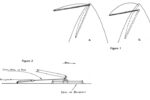
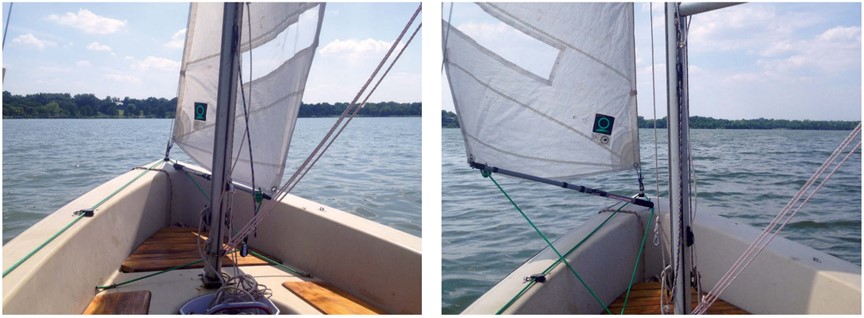
My last romantic fling with Anoesis involved a self-tacking jib. I could find little information on exactly how a self-tacking jib works, and I was unable to glean much from the pictures I could find. The physics demanded something that could draw the foot of the sail aft while allowing it to swing a full 180 degrees from port to starboard without my making any sheet adjustments. In an aha moment, I saw the reason for booms on jibs, typically on cutter rigs.
I didn’t want to invest time or money in shaping a boom from wood, and I really didn’t need anything fancy because it was only 4 1/2 feet from bow to mast. In the end, I used a small adjustable paint roller handle that could act as its own outhaul. Of course, the foot of my good jib was too long, but I’d acquired a rather limp spare that I had no shame in cutting down. An old friend with a robust sewing machine stitched the leech and I added a new grommet from the hardware store. We learned a lot about how incredibly tough even old sailcloth really is and why the cheap hand-stitching kit I’d picked up was worthless.
I ran a single line from the end of the boomlet to a block on the mast, then to the port side, through another block, and along the coaming through two pad-eyes to a cleat. I set sail. It didn’t work. Letting out the single sheet resulted in the boom rising up more than out, and pulling it in simply pulled the boom back to the mast. I should have foreseen this.
I installed a traveler (really just a taut line attached port and starboard) ahead of the mast. This held the boomlet down as it swung from port to starboard but it wouldn’t swing out beyond the traveler when running.
I tried two blocks attached to each other. One ran along the traveler. The jibsheet then ran from the end of the boomlet, through the other block, and through the block on the mast before going to the port-side block and down the coamings. I hoped I could ease the boomlet out beyond the traveler while the attached blocks kept it down. It still didn’t work.
Ultimately, I realized that the jibsheet needed to run forward to a block, then back around the coamings. At last a single setting gave me a well-shaped jib on either tack.
Put another way, I had arduously experimented my way into a jib that was really a mini-main, which, if I had given it some thought, is really all a self-tacking jib turns out to be. It was a realization that suggested further improvements, but I was ready to sail.
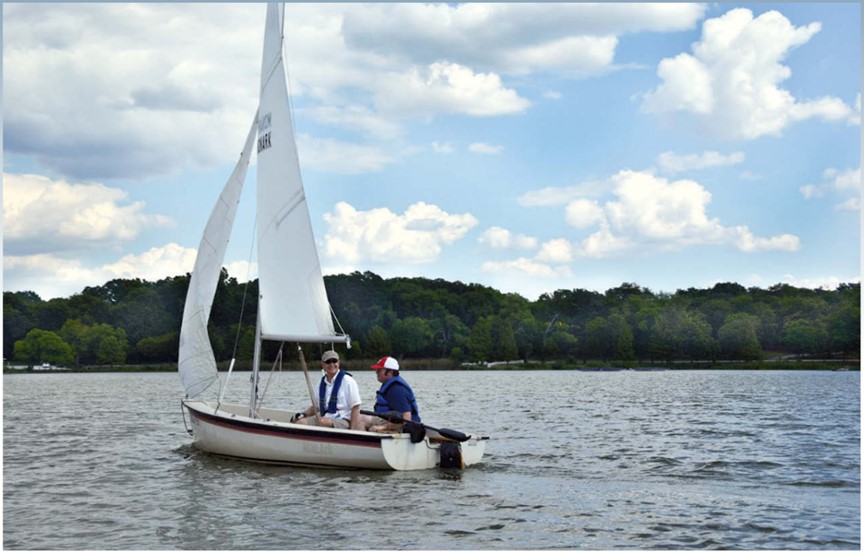
And so I did, although the lounging admirer never showed up. I sailed Anoesis up and down White Rock Lake hundreds of times, often alone, and usually more than once a week, in all kinds of weather . . . except rain. I’ve had some near capsizes, the closest being when a bilgeboard caught on a hidden log in a strong north wind, pulling its line so hard that it broke its guide and sliced through the fiberglass before I could blow the main and get the thing disentangled. And I’ve been stranded at dusk when the wind inevitably dies and have been thankful for the trolling motor.
A new romance
Then, a few months ago, I saw a 17-foot Harpoon 5.2 for sale at the club. I knew it was in great shape. When I found out the price I sensed that it was time for Anoesis and me to part. I was ready for a larger boat, one that could take on sailing in the bays along the Gulf Coast. Anoesis needed a new beginner for her very forgiving ways. I pulled her out of the water, cleaned her up, and removed all my experiments, except those useful for real sailing. The self-tacking jib went as well, because beginners need to learn to handle jibsheets. Now she sits under tarps, waiting for a young man with a trailer hitch to take her away. Should I tell him she doesn’t drain well? No . . . he’ll learn.
Robert Hunt learned to love the water while fishing as a boy in the 1960s, usually in one of his father’s homemade skiffs. But it wasn’t until 2012, after 20 years overseas as a teacher with the United Methodist Church in Asia and Austria, that he bought Anoesis, a 14-foot MonArk. In his work at Southern Methodist University, Robert teaches about cultural complexity. On the dock, he teaches people the joy of wind, water, and a boat with only a sail for power.
Thank you to Sailrite Enterprises, Inc., for providing free access to back issues of Good Old Boat through intellectual property rights. Sailrite.com