Issue 114: May/June 2017
While the first fiberglass auxiliary sailboats were introduced in the mid-1950s, and the 28-foot 6-inch Pearson Triton (1959) was widely considered the most successful series-produced model, it was Columbia yachts of Costa Mesa, California, that developed assembly-line production processes and made yachting affordable for the middle class.
Richard Valdes, a 1956 graduate of the university of California, and U.S. Navy submariner Maurice Thrienen, who in 1957 started a business selling fiberglass supplies, together founded a company called Glas Laminates, later Glass Marine Industries, to build boats, sail and power. That was 1960, and the business prospered, in part because Chicagoan Vince Lazzara bought the controlling interest in the company (after selling his casting foundry and cutting his teeth in fiberglass boatbuilding at AeroMarine in Sausalito). He helped finance tooling for new models and the development of a network of around 100 dealers.
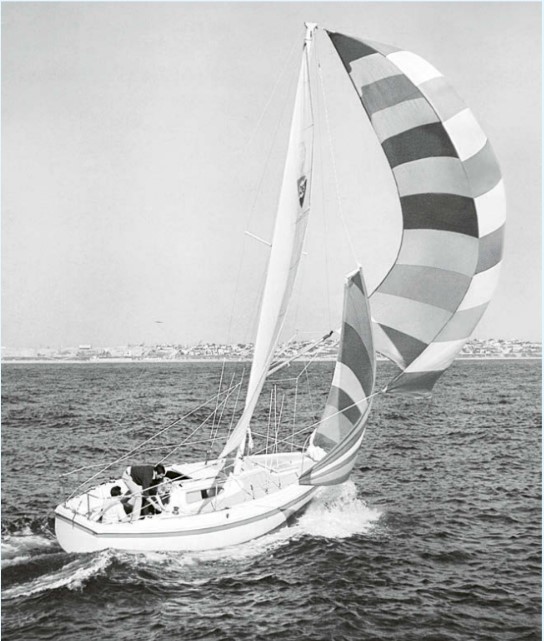
After their first model, the Islander 24, sold well at boat shows in Chicago and Los Angeles, the partners were ready to produce a larger boat. The company was by then renamed Columbia Yacht Corporation (after the America’s Cup 12-Meter), and early company literature says, “In 1962 the complete tooling was acquired for the Columbia 29, a highly successful model designed by Sparkman & Stephens.” This implies that the design was previously in production. It bears some resemblance to the S&S-designed Tartan 27 introduced two years earlier by the Ohio boatbuilder Douglass & McLeod Plastic Corporation.
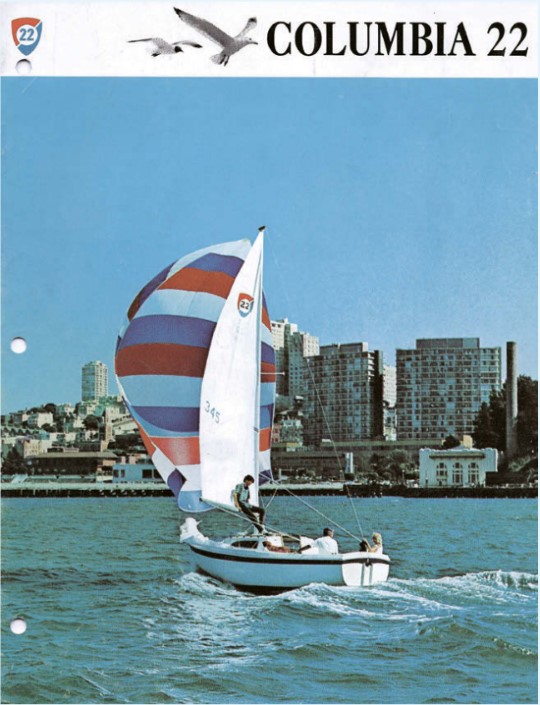
Lazzara purchased the molds of Charley Morgan’s 40-foot Sabre, a centerboarder that had nearly won the 1964 SORC (Southern Ocean Racing Conference), and successfully marketed it as the Columbia 40. Other models soon followed: ranging from the Challenger 24 and Columbia 22 all the way up to the Columbia 57. Most models at that time were designed by Bill Tripp and featured a flush deck with a bubble coach-roof over the saloon that gave the later 1960s and early ‘70s designs a very distinctive look.
In 1967, Columbia Yacht Corp. was bought by Whitaker Corp., making it the first fiberglass boatbuilder to draw the affection of a large conglomerate. (A year later, Morgan Yachts was bought by Beatrice Foods.) Headquarters and production facilities were located in an Irvine industrial park. Like Morgan Yachts, Columbia’s new owners initiated a kit program. Buyers could purchase just the basic hull and deck and as many additional components as they wished but, because so many were poorly finished by their amateur owners, Sailcrafter Yacht Kits were discontinued after a few years. In 1964, Pacific Marine in Göteburg, Sweden, was the first company to receive a foreign license to build Columbia’s designs. Later, companies in Japan, Australia, Spain, and Canada also received licenses.
Whitaker’s acquisition resulted in Lazzara divesting his interest in the company, and he had to sign a no-compete contract. He moved to Florida, where he began building houseboats and, in 1971, the Gulfstar line of cruising sailboats, motorsailers, and a few motor yachts.
In 1984, Whitaker unloaded some of the Columbia molds — the most recent Columbia 7.6, 8.7, 10.7, and a 35-footer designed by Alan Payne — to Aura, in Huron Park, Ontario, Canada. Other molds were sold, but no boats were produced in meaningful numbers. The economic downturn of the mid-1980s that doomed other large production sailboat builders like Pearson Yachts and O’Day Corp. also took down Columbia Yacht Corp. The industry has never been the same since.
Dan Spurr is Good Old Boat’s research editor. His book Heart of Glass is the first reference the editorial staff turns to when checking facts on the history of fiberglass boatbuilding.
Thank you to Sailrite Enterprises, Inc., for providing free access to back issues of Good Old Boat through intellectual property rights. Sailrite.com