Don’t leave anything to chance
Issue 115: July/Aug 2017
During the seasonal cruiser migration along the Atlantic Intracoastal Waterway (AICW), it is quite common to see boats bottle-necked before a drawbridge, circling like goldfish in a bowl. This is especially the case at drawbridges that open on restricted schedules. When transiting a series of bridges, these cruisers seem to race away from one bridge only to resume their restless circling maneuver at the next.
Thus, for many boaters, drawbridges are a nuisance. But others, who travel with a more sedate mind-set, do their best to accept, and even enjoy, the delays that drawbridges create. We’re among the latter group; we putter along, take in the sights, and find drawbridges, well . . . kinda cool. Rather than a hindrance, they are structures worthy of study — all that concrete and steel being moved by complex mechanisms.
Although many drawbridges are being replaced by high-span fixed bridges, there are still plenty of them around, and a good variety, some with quaint tender houses or quirky drawtenders that can make a drawbridge encounter rather interesting. An example is a bridge we traverse when we roam the lesser-traveled southern rim of Lake Okeechobee, Florida.
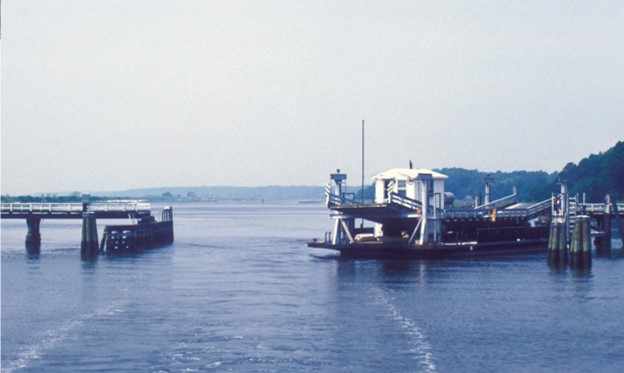
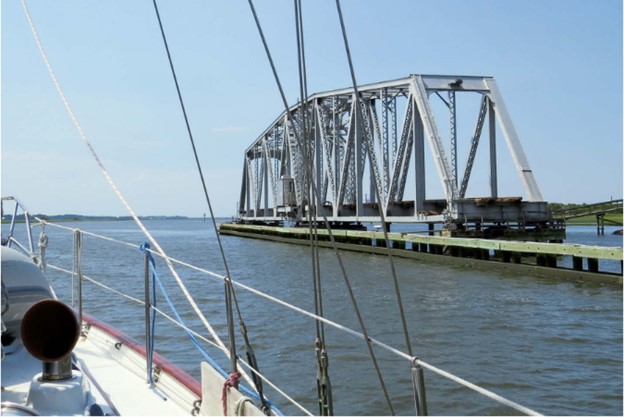
To request an opening for this swing bridge, we first put a call through to the adjacent fish camp to reach the drawtender. Eventually, the drawtender will mosey out and walk across the bridge, completing the preparatory bridge-opening chores as he goes. Then, sticking a long pole into a fitting, perhaps with a grunt from the effort, he’ll begin to push. Walking in a slow circle, he turns a small gear that drives a bigger gear that swings the bridge. As it nears the open position, he uses the same mechanism to slow the bridge’s motion until it comes to a halt. Once we’ve passed, he reverses the process to close the bridge . . . slow, simple and, for the most part, painless — at least for us.
Drawbridge variants
The swing bridge is only one of the types of drawbridges we come across. A drawbridge is any bridge that has a span that can be moved to allow or deny passage across or beneath it. Early examples were the bridges over castle moats that could be raised to provide a measure of protection for the castle’s inhabitants. Pontoon bridges are chronicled in ancient China, so it would appear that movable bridges are not a modern invention.
Swing bridge – A swing bridge rotates at its center so that, when open, the swinging span has turned 90 degrees from its closed position. Boats may pass through the opening on either side of the bridge’s center, though passage through some bridges is limited to one side only. Vertical clearance is never a problem, but horizontal clearance may be limited should the bridge not swing completely open.
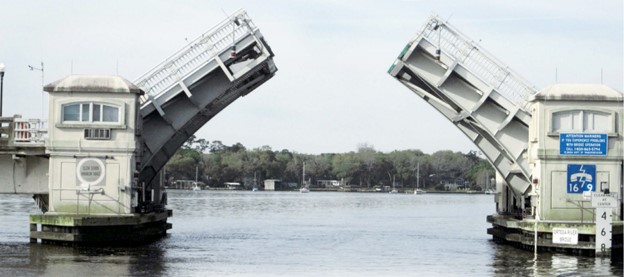
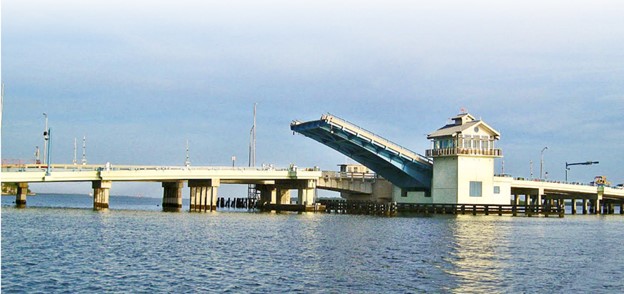
Bascule bridge – The type of drawbridge most commonly encountered on the AICW, the bascule bridge operates with a counterbalance. The bridge span (or spans — some bridges have two leaves that meet in the center) pivots upward until it stops at a near-vertical position. Not all bascule bridges are completely vertical when open, and sometimes only one leaf will open. In these situations, the vessel’s helmsman must be careful to direct the boat through the open portion that allows sufficient vertical clearance.
Lift bridge – On a lift bridge, the draw span remains horizontal and is raised vertically by cables in towers at each end. Vertical clearance under a lift bridge is limited, making it essential to determine ahead of time, from a chart or other source, whether that clearance is adequate for the vessel.
Pontoon bridge – In this less-common type of drawbridge, a floating span is moved between the open and closed positions with cables. Vessels should not attempt to pass through the bridge while it is opening or closing because the cables pose a hazard. When the floating span stops moving, the cables drop to the bottom. Pontoon bridges have unlimited vertical clearance.
Drawbridge regulations
There is no worldwide standard for drawbridge operations, so it is incumbent upon mariners to become familiar with the regulations that apply to drawbridges where they’re operating. Regulations govern the signals or methods to be used to request an opening and the lighting configurations each type of bridge is required to display in hours of darkness.
In the U.S., bridges operate under rules promulgated by the Department of Homeland Security under 33 Code of Federal Regulations 114-118, and 33 CFR 117 is specific to drawbridge operation (see “Extracts from 33 CFR 117,” below). While much of this information can also be found in the United States Coast Pilot (see “Resources,” page below), it is dispersed across various chapters and time-consuming to locate. To avoid problems, mariners should plan well ahead when making passages in areas where they will encounter bridges.
Requesting an opening
When in contact with a drawbridge, if you ask if the drawtender will “open on demand,” don’t be surprised if the response is “no, we open on request!”
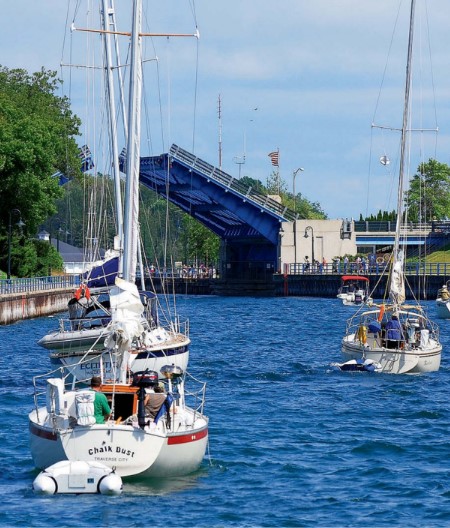
By far, the method most often used is to hail the drawtender via VHF channel 16. Many bridges are also assigned a working channel, usually VHF13, but it can vary from region to region and even from bridge to bridge. Both channels might be posted on the bridge (and, for some bridges, in Appendix A of 33 CFR 117).
Another way to request an opening is to make the approved sound signal.
Contact by phone is a possibility if a phone number for the drawtender is available — it is sometimes posted on the bridge. Phone numbers for some bridges are listed in the Coast Pilot or in cruising guides for the region.
Flag or light signals, while authorized under 33 CFR 117, are seldom used to request an opening.
Although drawbridges that open upon request (as opposed to drawbridges that open on a schedule) are generally required to open promptly upon receiving a proper signal from a vessel, there are exceptions to this rule. Some bridges remain closed during sustained winds of 34 knots or more, railroad bridges will not open when a train is due, and road bridges will remain closed to allow emergency vehicles to pass.
Adequate clearance
Maybe this is a good place to state the obvious: vessel operators should not try to pass through the navigable span unless they are sure that the clearance, both in height and breadth, is adequate.
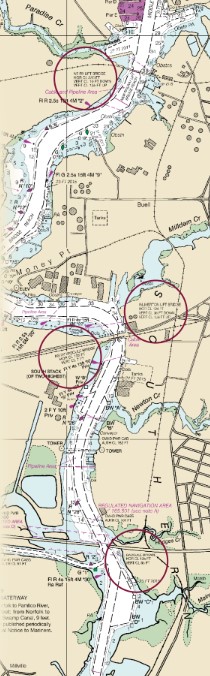
The clearances of navigable spans are printed on charts and in the Coast Pilot. In regions where water levels can vary, you should check the clearance gauge affixed to the bridge that indicates the actual distance between the water and the “lowest steel” in the bridge’s closed position. There may also be a notice affixed to the bridge indicating any additional height in the area of “higher steel” in the navigable span. However, no given clearances include any fixtures hanging below the “steel,” such as lights, signs, or items used during construction or maintenance.
If the bridge has a limited vertical clearance when open, this too will be posted on the bridge fender.
Hazards
Be alert to hazards around bridges. Watch for the effects of wind, current, and wakes and be prepared to react immediately to maneuvers by other boats or even the unexpected closing of a bridge.
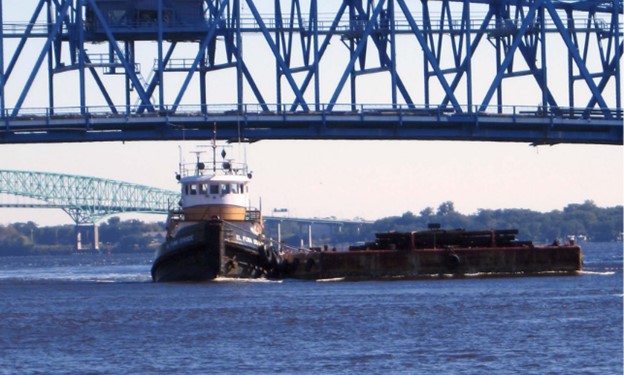
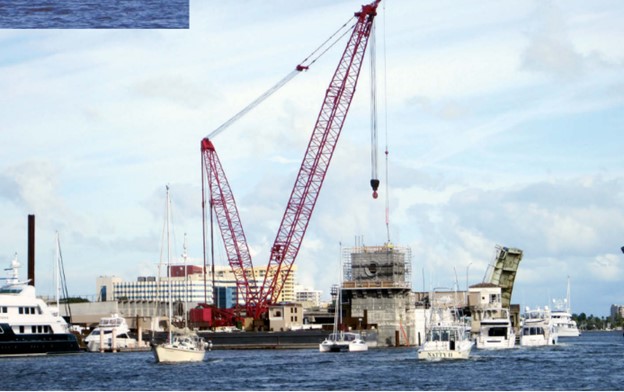
Maintain a sharp lookout when approaching a bridge that is undergoing construction or maintenance, as this is often performed with the help of workboats, tugs, and barges that might make unpredictable maneuvers or restrict the width of the navigable span. It’s good practice, when approaching such a situation, to slow down and signal one long blast to alert those in the area, just as you would when leaving a berth or when entering a blind bend. Don’t rely on a broadcast on the VHF radio.
Passage with a sail hoisted is prohibited at some drawbridges, and those specific bridges are noted in the Coast Pilot. Some drawtenders may choose to restrict passage by a boat under sail, even when it is not specifically disallowed.
Appropriate conduct
Be aware of other bridge protocols and courtesies in addition to the signals for requesting an opening.
While passing through a drawbridge, proceed at the slowest speed that allows you to maintain steerageway.
If a drawbridge displays lights to indicate when boats should (green) or should not (red) proceed through the draw, heed them. These lights are distinct from those that indicate whether the bridge is closed or fully opened, or indicate the bridge’s lateral and vertical margins.
Although it’s a requirement that drawtenders precede actions with appropriate signals, they do not always meet it. Be on the lookout in case a drawtender takes an action without preceding it with a signal.
Be especially alert in waters affected by current, whether river or tidal. Only on the Great Lakes, Western Rivers, and certain other rivers does a downbound vessel with a following current have the right of way over an upbound vessel. Elsewhere, if you are upbound, giving way to downbound vessels might be the more prudent or courteous action to take.
Advice from a drawtender
One of a drawtender’s biggest challenges is coordinating passage of a tug and barge combination while keeping pleasure craft at bay. Except for pleasure craft in extremis, priority for passage through a bridge span is given to government, military, commercial, and emergency vessels.
Drawbridges within metropolitan and tourist areas have significant foot traffic, and it can take time to clear pedestrians from the span so it can be opened. Motorists may become impatient, as may folks on waiting vessels. A drawtender’s ability to remain diplomatic on all fronts can be strained. Vessel operators are asked to be patient and understanding.
A vessel should make its intentions known to the drawbridge as early as possible and be ready to pass through the bridge when it opens. A vessel that remains too far back, or sets an anchor, could miss the opening.
Some drawbridges are located close to marinas or fuel docks, and a boat hovering in the vicinity can cause the drawtender to be uncertain as to whether the boat is waiting for a bridge opening or for a spot at the fuel dock. In such situations, vessel operators should inform the drawtender of their intentions.
Drawtenders are not traffic cops and do not determine the order in which waiting recreational craft pass through the open span. Operators of recreational vessels must work this out among themselves, either by radio or by positioning their vessels in such a manner that it is clear which one intends to let another vessel proceed.
Courtesy is valued on the waterways, and especially so at bridges. Patience and a thank-you wave to a drawtender and fellow boaters can often relieve tensions.
Extracts from 33 CFR 117
- 117.5 When the drawbridge must open.
Except as otherwise authorized or required by this part, drawbridges must open promptly and fully for the passage of vessels when a request or signal to open is given in accordance with this subpart. - 117.11 Unnecessary opening of the draw.
No vessel owner or operator shall –
(a) Signal a drawbridge to open if the vertical clearance is sufficient to allow the vessel, after all lowerable nonstructural vessel appurtenances that are not essential to navigation have been lowered, to safely pass under the drawbridge in the closed position; or
(b) Signal a drawbridge to open for any purpose other than to pass through the drawbridge opening. - 117.15 Signals.
(a)General.
(1) The operator of each vessel requesting a drawbridge open shall signal the drawtender and the drawtender shall acknowledge that signal. The signal shall be repeated until acknowledged in some manner by the drawtender before proceeding.
(2) The signals used to request the opening of the draw and to acknowledge that request shall be sound signals, visual signals, or radiotelephone communications described in this subpart.
(3) Any of the means of signaling described in this subpart sufficient to alert the party being signaled may be used.
(b)Sound signals.
(1) Sound signals shall be made by whistle, horn, megaphone, hailer, or other device capable of producing the described signals loud enough to be heard by the drawtender.
(2) As used in this section, “prolonged blast” means a blast of four to six seconds duration and “short blast” means a blast of approximately one second duration.
(3) The sound signal to request the opening of a draw is one prolonged blast followed by one short blast sounded not more than three seconds after the prolonged blast. For vessels required to be passed through a draw during a scheduled closure period, the sound signal to request the opening of the draw during that period is five short blasts sounded in rapid succession.
(4) When the draw can be opened immediately, the sound signal to acknowledge a request to open the draw is one prolonged blast followed by one short blast sounded not more than 30 seconds after the requesting signal.
(5) When the draw cannot be opened immediately, or is open and shall be closed promptly, the sound signal to acknowledge a request to open the draw is five short blasts sounded in rapid succession not more than 30 seconds after the vessel’s opening signal. The signal shall be repeated until acknowledged in some manner by the requesting vessel.
(d)Radiotelephone communications.
(1) Radiotelephones may be used to communicate the same information provided by sound and visual signals.
(2) The vessel and the drawtender shall monitor the frequency used until the vessel has cleared the draw.
(3) When radiotelephone contact cannot be initiated or maintained, sound or visual signals under this section shall be used. - 117.17 Signaling for contiguous drawbridges.
When a vessel must past two or more drawbridges close together, the opening signal is given for the first bridge. After acknowledgment from the first bridge that it will promptly open, the opening signal is given for the second bridge, and so on until all bridges that the vessel must pass have been given the opening signal and have acknowledged that they will open promptly. - 117.19 Signaling when two or more vessels are approaching a drawbridge.
When two or more vessels are approaching the same drawbridge at the same time, or nearly the same time, whether from the same or opposite directions, each vessel shall signal independently for the opening of the draw and the drawtender shall reply in turn to the signal of each vessel. The drawtender need not reply to signals by vessels accumulated at the bridge for passage during a scheduled open period. - 117.21 Signaling for an opened drawbridge.
When a vessel approaches a drawbridge with the draw in the open position, the vessel shall give the opening signal. If no acknowledgment is received within 30 seconds, the vessel may proceed, with caution, through the open draw. - 117.31 Drawbridge operations for emergency vehicles and emergency vessels.
(a) Upon receiving notification that an emergency vehicle is responding to an emergency situation, a drawtender must make all reasonable efforts to have the drawspan closed at the time the emergency vehicle arrives.
(b) When a drawtender receives notice, or a proper signal as provided in §117.15 of this part, the drawtender shall take all reasonable measures to have the draw opened, regardless of the operating schedule of the draw, for passage of the following, provided this opening does not conflict with local emergency management procedures which have been approved by the cognizant Coast Guard Captain of the Port:
(1) Federal, State, and local government vessels used for public safety;
(2) Vessels in distress where a delay would endanger life or property;
(3) Commercial vessels engaged in rescue or emergency salvage operations; and
(4) Vessels seeking shelter from severe weather.
Resources
United States Coast Pilot covers the entire U.S. coast from Maine to Alaska in nine volumes, each of which can be downloaded in its entirety or by chapter.
Coast Pilot 4 – 48th Edition, 2016, covers the Atlantic coast from Cape Henry, Virginia, to Key West, Florida. Chapter 12 covers the AICW from Norfolk, Virginia, to Key West and includes details of bridges along the route: www.nauticalcharts.noaa.gov
Waterway Guide publishes editions covering regions from the Great Lakes via the Northeast to Texas. Navigation updates by region can be found under the Waterway Explorer tab: www.waterwayguide.com
The ICW Planning Guide lists bridges along with contact numbers and opening schedules: www.icwplanningguide.com/Pages/ACICW-Bridges.aspx
33 CFR 117, Drawbridge Operation Regulations, can be read or downloaded at the Cornell University Law School site: www.law.cornell.edu/cfr/text/33/part-117
Jill and Rudy Sechez have cruised for 20 years and still enjoy using paper charts, lead line, compass, and oil lighting. They have built seven of the nine boats they’ve owned, including their current 34-foot sail-assisted trawler, Briney Bug, and its 8-foot rowing dinghy, one of five they’ve designed. They have written numerous articles on various topics for several boating magazines and their book, Anchoring—A Ground Tackler’s Apprentice, was published by Waterway Guide Media, LLC. Rudy and Jill are available for speaking engagements. Contact them at rudyandjill@yahoo.com.
Thank you to Sailrite Enterprises, Inc., for providing free access to back issues of Good Old Boat through intellectual property rights. Sailrite.com