A rakish C&C design that races and cruises equally well
Issue 116: Sept/Oct 2017
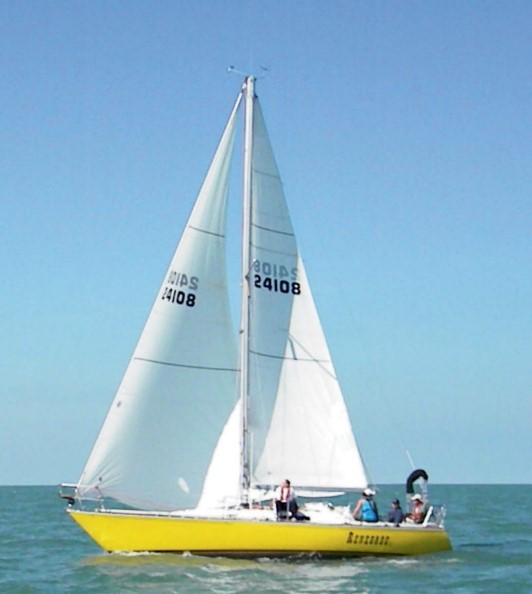
Restoring an old boat is much like falling in love. Not much about it is logical or rational, but when we fall for the right girl — or the right boat — we are all in. Such was the case for John and Jo Vandereerden when they bought their Viking 33. They could see the boat would sail well enough to race competitively, and the well-designed and nicely appointed cabin would ensure they could pursue their love of cruising the Great Lakes in comfort. Given those qualities and the boat’s attractive profile with its long overhangs and classic good looks, John and Jo were hooked.
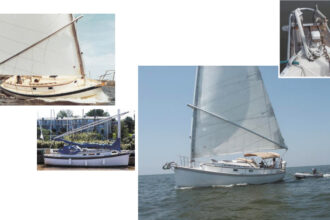
The canary-yellow 1974 Viking 33 was named Renegade II when they bought her. She was originally purchased from Ontario Yachts by boatbuilder Haydn Gozzard, who apparently sold her in the 1980s to help fund his Scorpio Yachts business. John and Jo have had some fantastic cruising adventures and participate in weekly club racing. It’s obvious that their honeymoon with Renegade II continues, given the long list of improvements John has made to the boat since taking ownership in 2009. Jon and Jo keep Renegade II in LaSalle, Ontario, at the LaSalle Mariner’s Yacht Club, a small, friendly organization of 75 members located on the Detroit River.
History
Building on the reputation of the Viking 28, which had gained some success in the Great Lakes region as a one-design and club racer, the builder, Ontario Yachts of Burlington, Ontario, offered the Cuthbertson & Cassian-designed Viking 33 to the market as an IOR (International Offshore Rule) racer with a reasonably well-appointed cruising interior. The same company also built the Ontario 28 and 32 models, as well as being well known for building the Etchells one-design sailboats. Ontario Yachts survived the collapse of the boatbuilding industry in Ontario in the early to mid-1980s and is still in business, but it no longer manufactures keelboats or supplies parts for any of the keelboat models it built. It still builds the Etchells and makes some other small boats and boat parts like tillers and trailer storage boxes — and it made the fiberglass tray for the pitcher’s mound at the SkyDome in Toronto.
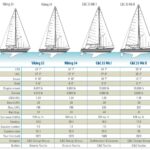
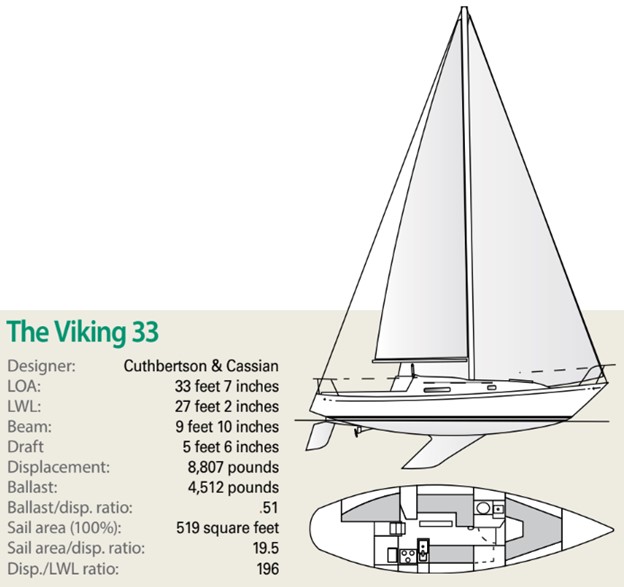
The Viking 33 entered production in 1972. After some changes made in late 1974, it continued in production as the Viking 34 but with the same hull and an updated interior. The rig was heightened by almost 2 feet, adding 21 square feet to the sail area, the keel was reconfigured, and the rudder design was tweaked. Ontario Yachts built a combined total of about 93 Viking 33s and 34s over a 10-year production run that ended in 1982.
Design and construction
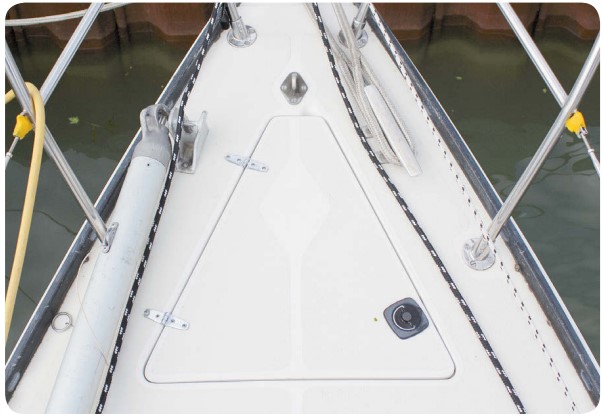
The Viking 33/34 has the look of a modern classic, and to the trained eye it’s obviously a C&C design with its raked bow, counter transom, and strongly cambered coachroof. It has a swept-back fin keel and a semi-balanced spade rudder on a stainless-steel rudder stock. John says the swept-back keel is excellent for shedding weeds, which can be an issue on the Detroit River.
Using the conventional construction methods of the day, Ontario Yachts made the hull with a solid laminate of hand-laid fiberglass mat and woven roving, laying additional glass in high-stress areas. The deck is a sandwich of fiberglass and balsa, so is subject to the usual core issues if hardware has been fastened to the deck without due care being paid to properly sealing the balsa core to prevent water intrusion. Bulkheads are marine-grade teak-faced plywood and are tabbed (taped and bonded with resin) to both the hull and the deck to give the entire structure strength and rigidity.
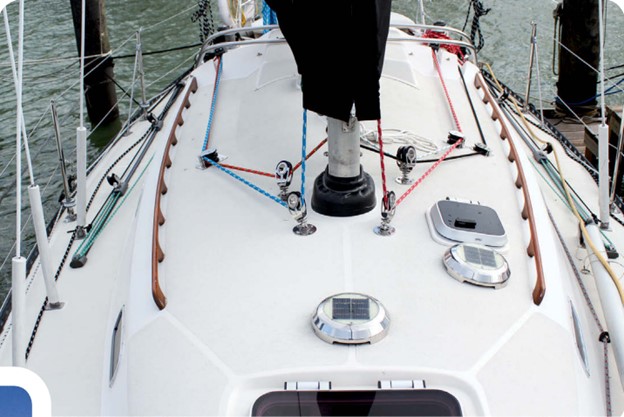
The hull-to-deck joint is bonded and mechanically fastened with bolts and the rail is capped by an aluminum slotted toerail (an easy place to attach snatch blocks). Eight stainless-steel bolts secure the lead keel to the hull. The bilge is shallow, and the wooden stringers that support the cabin sole can get wet, so this area warrants close inspection for rot. The stringers are relatively easy to access. The Yahoo owners group has information on this repair.
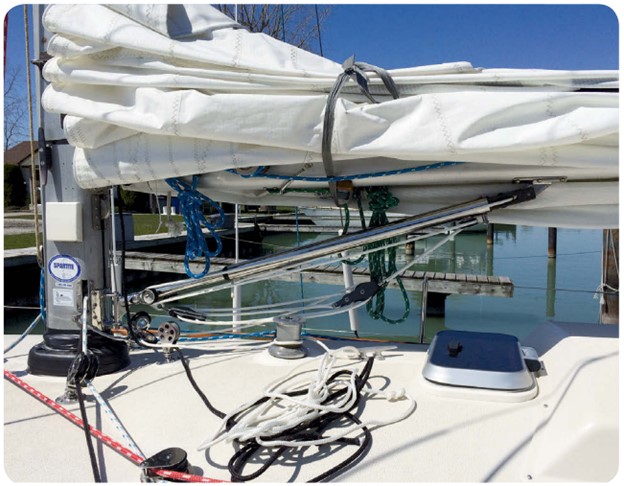
The V33/34 is a masthead sloop with a keel-stepped single-spreader mast supported by forward and aft lower shrouds. Later in the production run, the mast was changed and rigged with double spreaders. Some owners have reported on the Yahoo forum that they had to reinforce or replace the chainplates.
On deck
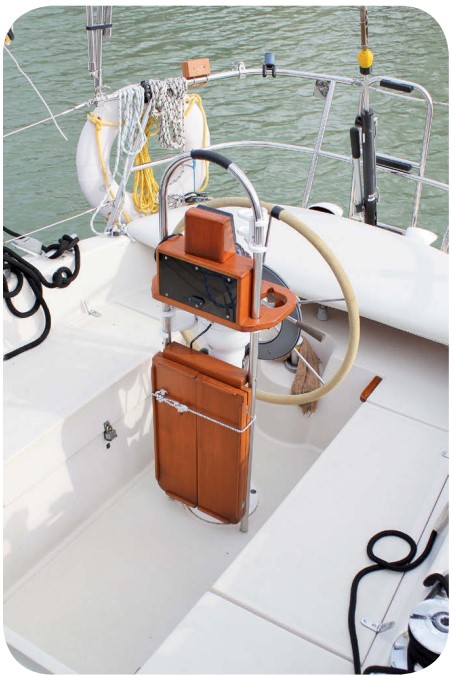
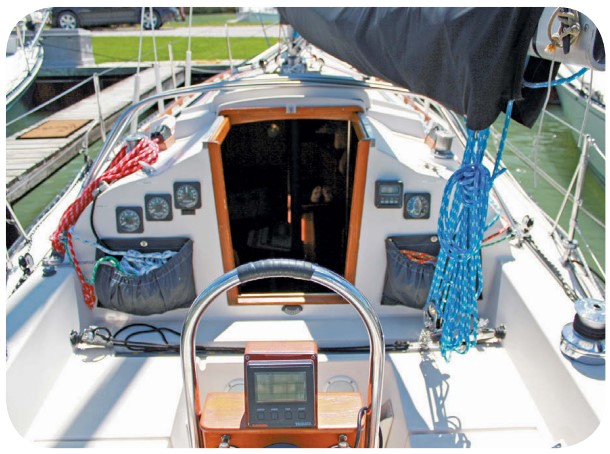
The V33/34 is a relatively narrow boat with a maximum beam of less than 10 feet and has the fine entry and pinched stern typical of IOR designs of the 1970s. The cockpit is on the smaller side for a 33-foot boat. Most of the boats were delivered with a tiller, but Renegade II has since been fitted with Cinkel pedestal steering that allowed John to custom-build a high padded helm seat across the stern. Sheltered under the bimini, the seat is a comfort- able spot when cruising.
Like most boats designed to the IOR, the Viking has a large J measurement (15 feet), which means big headsails. Trimming them is relatively easy with the large primary winches on the cockpit coamings. Renegade II has a pair of self-tailing spinnaker winches.
When John and Jo bought the boat, the stern pulpit had been damaged, so John ordered a custom split pulpit with an opening that allows easy access to the swim ladder. He also replaced the double lifelines along with the stan- chions and their bases.
The deck gelcoat has been redone because the nonskid was worn to the point that footing was a concern. There is enough exterior woodwork to match the Viking’s classic lines without making maintenance a full-time job.
Belowdecks
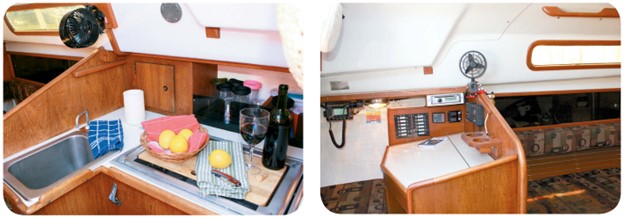
A well-laid-out, finely appointed cabin with some beautiful joinery awaits belowdecks. Headroom in the saloon is about 6 feet and diminishes slightly forward under the slope of the coach-roof. Fixed portlights in the saloon admit light while the companionway, a hatch above the forward cabin, and added hatches in the main cabin and the head provide ventilation throughout the boat.
A fully enclosed head is to port, forward of the main bulkhead and, facing it, a proper hanging locker. At 6 feet 4 inches long, the V-berth is surprisingly large. A very large storage locker forward of it accommodates a lot of cruising provisions.

Under way
Our test sail was competing in the River Rat, a late-fall regatta on the Detroit River. Conditions were blustery with a steady 15 to 20 knots of wind and occasional gusts to 25. Our crew for the race was a mix of regulars and some first-timers to the boat.
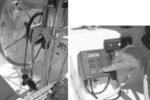
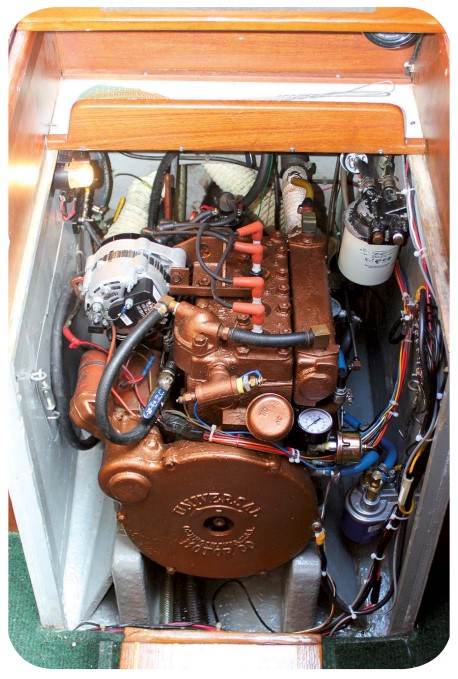
As we eased out of the north boat basin, we headed into the rollers and steered downriver toward the start line. The original 30-horsepower Atomic 4 gas engine is in great shape and, paired with a folding two-blade propeller, pushes the boat well. John says parts are easy to find. He is diligent about maintenance, and has moved all the engine gauges from the engine panel low in the cockpit to a custom panel on the binnacle, putting the all-important engine information front and center. The shifter and throttle control are also on the pedestal.
As we neared the starting area, we rolled out the large roller-furling headsail and shut down the engine. Renegade II came alive, and it was apparent why John and Jo love her so much. She has the feel of a large solid, well-built boat while still being lively and responsive to the helm and sail trim. She felt very manageable even in the gusty conditions.
The V33/34 is a headsail-driven boat with the mainsail acting more like a trim tab, especially in heavy conditions. It likes to be sailed upwind with some heel, which most owners report adds speed by lengthening the waterline.
We likely sailed the boat with more sail area than was ideal, so the rail was wet for a good majority of the upwind portion of the race, but the boat handled it well. Perhaps more important, this sort of sailing is fun and put a smile on every- one’s face. Tacking the large headsail up the narrow river was a chore even with the self-tailing winches. The boat won’t outpoint a more modern design but it will come very close.
Downwind, Renegade II is lively, owing to her large foretriangle and very large spinnaker. Given her design and her narrow stern she obviously won’t rocket off on a plane, but she holds her own downwind with just about any boat of the same vintage, as her record of successful racing shows. Owners report that the boat can be a handful downwind in high winds because it tends to wander. As do most IOR boats with pinched ends and similar hull shapes, the V33/34 tends to roll downwind, but does not seem overly prone to this issue. The use of tweakers (lines set up amidships to pull down on the spinnaker sheets and create better sail shape) and sailing on a broad reach instead of dead downwind help the helmsman steer a steadier course.
Once we crossed the finish line, John and the crew instantly switched into cruise mode. They shortened sail, turned up the stereo, broke out ice-cold libations, and stretched out in the cockpit to enjoy the sun of a fading fall afternoon. John and Jo, fresh from three and a half weeks of cruising the North Channel and Georgian Bay, recounted some great stories of their adventures. Again it became clear to me why they love this boat so much.
Conclusion
The Viking 33/34 is truly a sailor’s boat that will bring a smile to any sailor’s face whether on a spirited chase around the buoys or a leisurely daysail. While it is an IOR design, it is not an extreme example and does not suffer terribly from some of the stability flaws and idiosyncrasies of its contemporaries.
Athough now 35- to 45-years old, these boats have the advantage of being well constructed, and most seem to be well cared for. Anyone interested in a V33/34 would do well to have the boat surveyed, with emphasis on a careful inspection of the cored deck for water intrusion and delamination and an examination of the wood stringers beneath the cabin sole.
A survey of the market revealed prices ranging from as low as $6,000 for a project boat to about $28,000 for a well-restored example. Many of the boats seem to be in the Great Lakes region, although there is a report of a small fleet on the west coast of Canada, outside Vancouver.
A review of the Yahoo owners group for the boat reveals that John and Jo are by no means the only ones enjoying a love affair with the Viking 33/34. Numerous posts by owners convey their great affection and pride of ownership.
Robb Lovell grew up sailing on Lake Huron aboard his family’s Endeavor 40, where he caught the sailing bug. That was about 20 boats ago. Robb enjoys buying and restoring boats and is an avid racer and cruiser based out of LaSalle Mariner’s Yacht Club (LMYC) in Ontario. He currently races on a Cal 9.2 named Jade, but owns three other sailboats and a tugboat . . . yes, he has a problem!
Thank you to Sailrite Enterprises, Inc., for providing free access to back issues of Good Old Boat through intellectual property rights. Sailrite.com