Its master commands it by radio
Issue 117: Nov/Dec 2017
Shortly after becoming a sailboat owner, I became intrigued by the idea of building a radio-controlled model sailboat that performed like the real thing. After all, what father doesn’t want to sail a little boat on the local pond with his children?
I’d built plenty of models before, from the time I joined my school’s flying club, and always found model making therapeutic. I wasn’t discouraged even when the rubber-band-powered Spitfire I’d spent hours perfecting smashed itself to pieces against the gym wall. I later switched my attention from planes to boats, and built showcase models of Cook’s Endeavour and the sail-training ship Sir Winston Churchill, on which I’d sailed as a trainer.
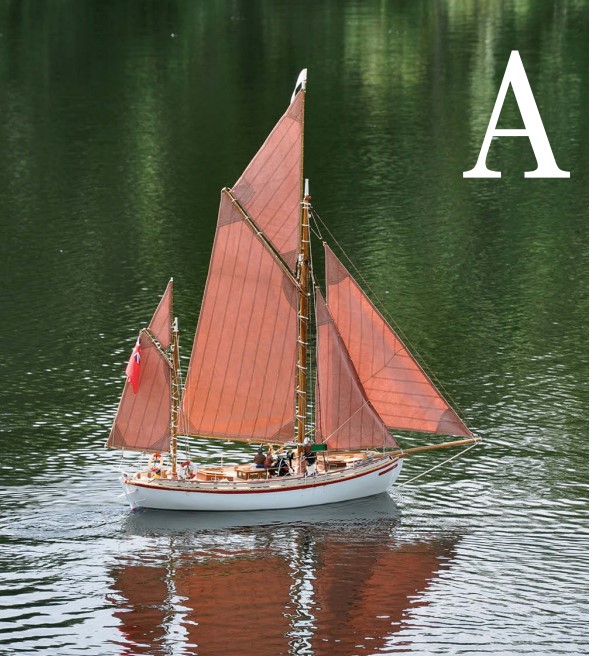
Even so, the thought of building from scratch a boat big enough to accommodate all the multi-channel radio-control equipment I envisioned was a bit daunting. So, when I found a large-scale (1:15) kit for a Colin Archer ketch, with a ready-made ABS plastic hull and all the fittings, I bought it. At $550 it wasn’t cheap.
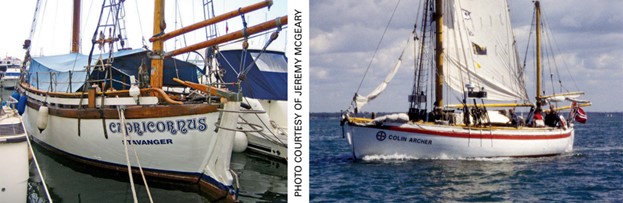
Colin Archer was a Norwegian of Scottish descent who became famous for his designs for pilot boats and lifeboats, most of which were double-enders. This model is of RS1, the first in a long series of sailing lifeboats built to Colin Archer designs. RS1, launched in 1893 and named Colin Archer after its designer, is owned by the Norwegian Maritime Museum, in Oslo, Norway, and is still sailing.
Assembly
Before even beginning to assemble the model, I spent a lot of time at my local model shop picking the staff’s brains about the radio-control equipment I would need. Nobody there had built a sailboat with the sophistication I was planning. They were more interested in speedboats.
I walked out of the store with an eight-channel transmitter and receiver, three winches, an electric motor, a heavy 12-volt battery (similar to a motorcycle battery), and a wallet lighter by another $500.

The term “kit” is a bit misleading for this model because, apart from certain pre-shaped items, including the hull and bulkheads, it consists of a pile of wood and instructions that are not very informative. I began by gluing the main bulkheads to the hull with epoxy and installing the motor mount and stern tube. I then bolted the motor to its mount and connected the prop shaft with a universal coupling.
As on a full-size boat, the next step was to install the ballast — but how much? The model was one fifteenth the length of the original, but ballast ratios don’t scale down linearly and there was nothing useful in the instructions. I could think of only one way to ballast it properly. I bought a 5-pound coil of lead sheet from a local surplus store and cut it into 2 x 12-inch strips, laid them in the bottom of the hull, and placed the 3-pound battery on top. I then filled our bathtub with water and lowered the hull in to see how it floated — it was hopelessly high.
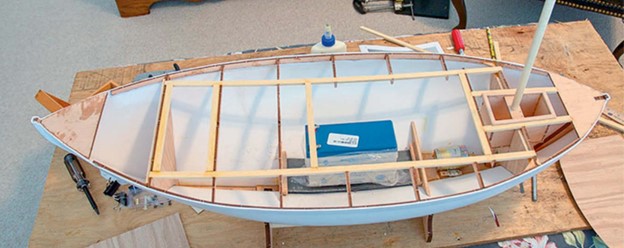
I bought another 15 pounds of lead and added it until the hull floated a little above its waterline. I then placed all the radio-control equipment on top along with other bits and pieces, including deck timbers, masts, and even the sailcloth. When I reached the correct waterline, I sealed the ballast with epoxy resin and built a floor for the battery to sit on. The model draws 6 inches, equivalent to 7 feet 6 inches. The real Colin Archer draws 7 feet 3 inches.
It was easier to position all the radio-control equipment, principally the steering servo, the receiver, and the three winches that would control the jib, staysail, mainsail, and mizzen, before laying the deck beams. I placed the continuous-coil drum winches forward. As the jib winch rotates, it pulls in the sheet on one side while letting out the other, hauling the jib from one tack to the other.
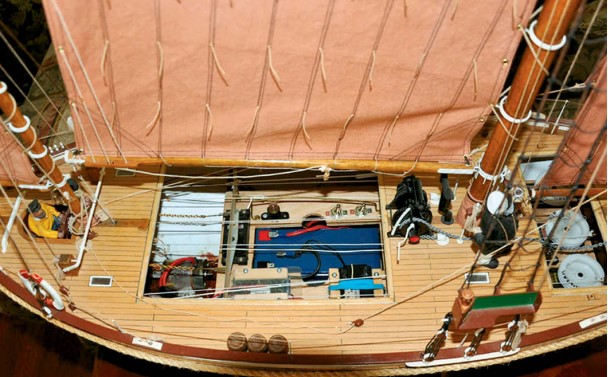
When I’d installed and connected all the controls, I decided it might be a good idea to test the boat “at sea” before laying down the deck. The lake behind my house in South Orlando, Florida, is ideal for testing model boats except for one problem: I had no idea how the resident alligator might react to an intruder in its domain. However, the test went without interruption, and the motor drove the boat along at a brisk walking pace.
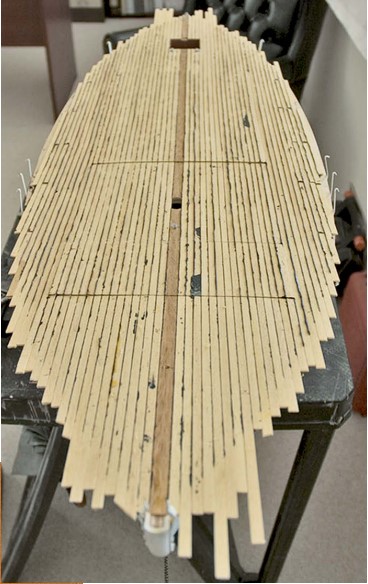
Back in dry dock I fitted the deck beams, then glued individual planks over the plywood deck, caulking each one with Life Caulk.
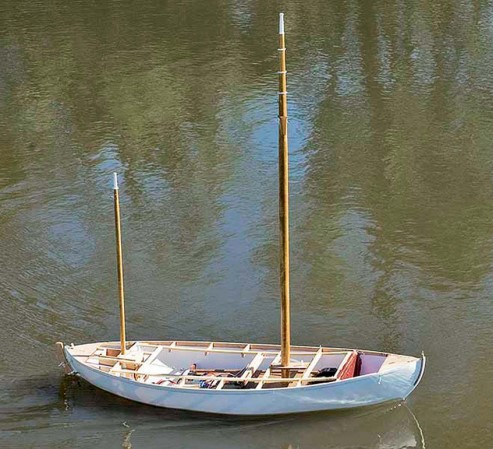
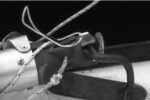
If the model was to be transportable, I would have to be able to remove the masts and sails. I stepped both masts on the keel and connected the rigging to the deadeyes with hooks. By unhooking the rigging, I can lift the masts out of the deck.
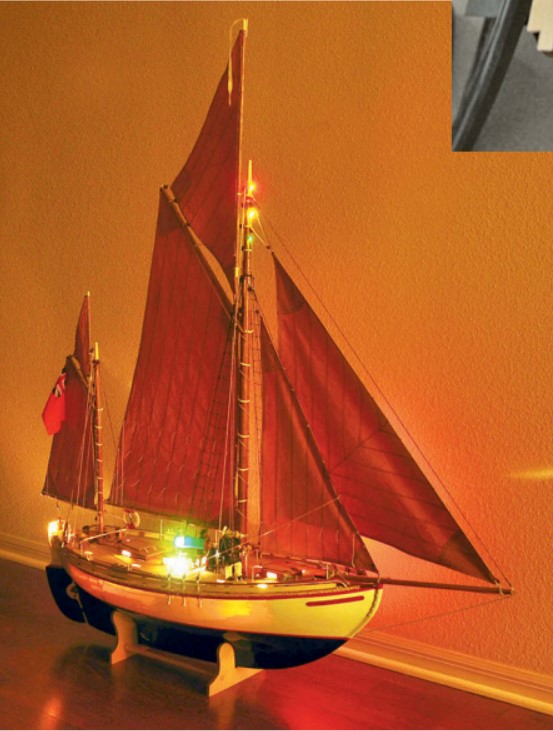
The supplied sailcloth was white, but I wanted tanbark sails, so I boiled the cloth in water with 10 teabags, which stained the cloth perfectly. I delivered the cloth and patterns to a seamstress who worked in the Disney World costume department near where I live. She did a superb job of double-stitching on the sails to simulate cloth panels. The sails are hanked on and halyards run over sheaves (which actually turn) down to belaying pins. The tops’l yards are attached to the masts with pintles and can be removed if the wind is too strong.
As a final touch, I fitted working cabin lights, which shine through the cabin windows, and navigation lights.
Watchkeepers
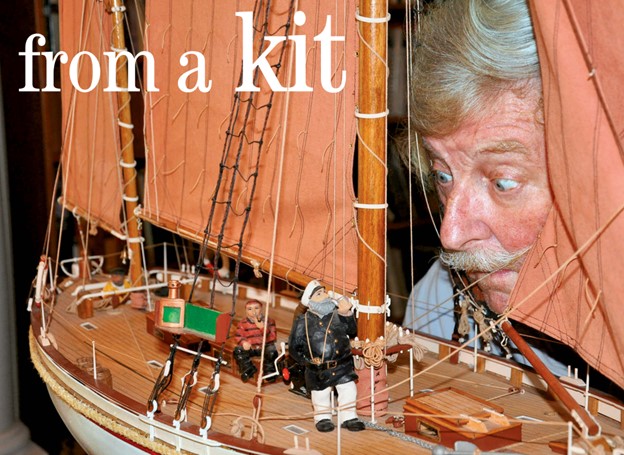
As my model neared completion, someone suggested that it should have crew. That sent me on a fruitless search for sailor figurines. I could easily have crewed her with American Civil War soldiers, cowboys on horseback, or World War II soldiers, but not sailors. I worried the boat would remain crewless, until I followed a suggestion that I try Ron’s Miniature Shop in Orlando. On entering this amazing magical emporium of dollhouse furniture I was not hopeful. But when a salesperson slid open a drawer full of sailing figurines of all shapes and sizes, I could hardly believe my eyes. There were naval officers, pirates, and even ships’ cats. I left with a skipper, three crew, and two cats, all very close to scale size. My crew does add a certain something, especially the captain, as he studies the set of his jib.
Sailing trials
As it does with all vessels, the time arrived for the maiden launch.
After pre-testing all the electronics, steering, sheet winches, and motor, I gently lowered The Old Gaffer, as I had christened her, into the water. The breeze, perhaps an actual force 3, created slight ripples on the surface, and I had no idea if this would be too little wind or too much.
I eased the sheets until the sails shook, and started the motor to power Gaffer away from the shore on a broad reach. I then shut down the motor and slowly hauled in the sails until she heeled, ever so slightly, and began to actually sail.
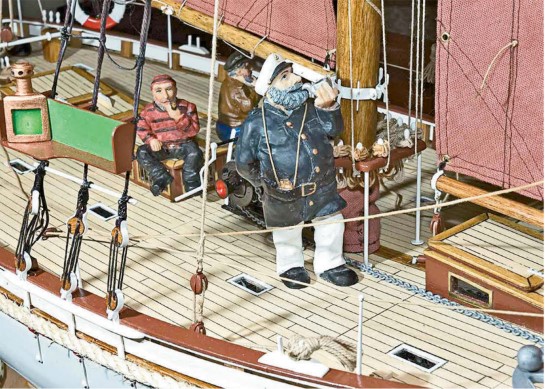
It was an emotional moment, seeing her sail away on her own for the first time. As I slowly sheeted the sails home, she heeled more and started to move quickly away from me. That’s when it struck me: I had no idea what the range of the radio control was! I eased the tiller control to starboard and, as her bow swung through the wind, I tacked the jib. Within seconds, having made a flawless tack, she was on the opposite course and sailing back toward me.
Since that first intrepid trial, I have learned to handle the boat on any point of sail, including goose-winged and hard on the wind, in quite big seas — well, at least three inches!
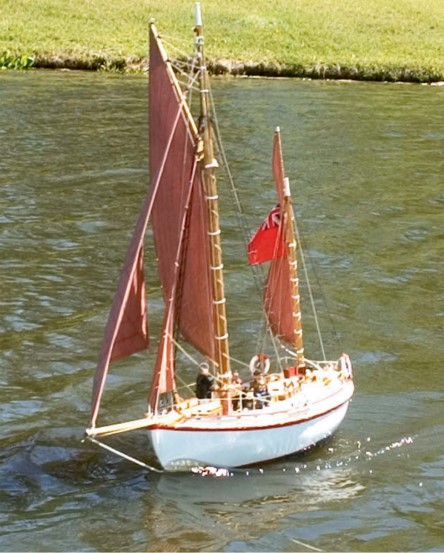
The Old Gaffer is a delight to handle, and I have not had to make any adjustments to the ballast or sails. When the wind gets up, I ship the tops’l and she behaves handily under gaff main, mizzen, and jib. I hardly ever use the motor, but it might be needed if our resident alligator ever shows his annoyance.
A few years ago, when on a delivery to the Mediterranean, I called in at Gibraltar and in the marina was a real RS called Capricornus from Stavanger, Norway. I would have loved to have met the owner, but he wasn’t aboard and the boat was obviously laid up.
Resources
Billing Boats offers dozens of model kits – http://billingboats-direct.com
For historical background on RS1 Colin Archer, visit the boat’s website: www.colinarcher.no
Roger Hughes has been sailing for nearly half a century as a professional captain, charterer, restorer, and happy imbiber on a lot of boats. His present project, the restoration of Britannia, a once run-down Down East 45, is nearing completion after five years (he thought it would take two at the most). Roger and his wife, Kati, were planning to go cruising in late 2017 and using all the innovations he has incorporated in the boat. Many of Roger’s projects have been featured in Good Old Boat. Find more on his website: www.schooner-britannia.com.
Thank you to Sailrite Enterprises, Inc., for providing free access to back issues of Good Old Boat through intellectual property rights. Sailrite.com