Here’s how to put a quick, easy stop to a free-spinning prop and shaft.
Issue 130: Jan/Feb 2020
Under sail aboard Soggy Paws, our CSY 44, the flow of water past our hull makes our fixed-blade prop spin. And, because our engine is attached to a BorgWarner 71C hydraulic transmission, there is no way to lock the shaft by placing it in gear.
Of course, a spinning shaft creates drag, affecting boat speed, but more importantly it causes wear. And not just wear on the packing gland and Cutless bearing, but wear on the transmission. Our BorgWarner manual says it’s okay to trail the prop and shaft while sailing, but only for up to four hours. At that point, it recommends starting the engine and running it in gear for about 10 minutes before shutting down (and re-starting the four-hour clock).
This seemed a bit much, especially as we were preparing for longer ocean passages. On a 20-day Pacific passage to French Polynesia, I calculated that we’d have to start the engine 120 times! That would extend the wear from a freewheeling prop to include the engine starter and the engine itself. I began looking into installing a shaft lock.
My research revealed two options: spend $400 on a commercially made shaft lock or make one myself. The first option did not seem like an efficient use of boat dollars. The second option did not seem like a quick or easy project.
When I discussed the problem with my engineer wife, Sherry, she came up with a brilliantly simple approach, modeled after something her father had done 30 years before. Being engineer-oriented even as a teen, she remembered his method.
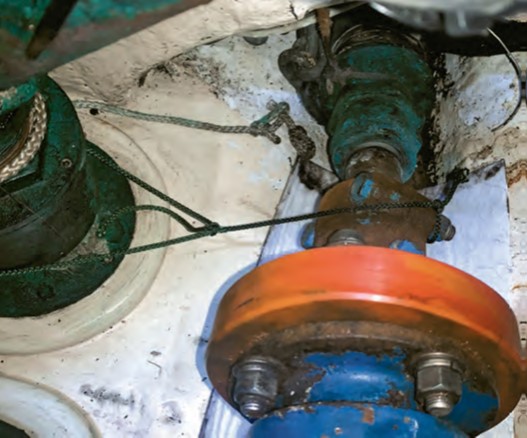
Sherry’s solution involves just a single small line. After securing it around something solid near and opposite (port or starboard) the transmission-to-shaft flanged coupling, I make a small loop in the bitter end, at a length that allows me to drop it over a bolt head or nut on the flange. (Bolts that run perpendicular to the shaft are best.) The idea is that the line is strong enough to keep the shaft from spinning when under sail, but weak enough to break instantly and easily if it’s in place when the engine is started and put into gear.
To set the shaft lock on our boat, our speed must be below about 3 knots and the transmission out of gear. Even with full sails on, we can achieve this state quickly by heading up, nearly into irons. As soon as the shaft stops freewheeling, I drop the loop over a bolt head and rotate the shaft by hand so that the line is taut. Then we resume course, and the shaft doesn’t spin.
To use the engine again, all we do is put it in reverse for a few seconds. Magically, this throws the loop off the bolt head and away we go. If we ever forget that the lock is on and put the engine in forward, the line simply breaks. Then we grab a spare piece of line and make another shaft lock!
For reference, I use a 1⁄8-inch line (not low-stretch or high-tech) for our 24-inch-diameter, fixed-blade prop. Err on the side of too small, and if it breaks while working as a shaft lock, up-size. Remember too that a bowline weakens the line at that point. A properly installed through-hull and flanged seacock works well as an anchor point. Consider which way your shaft rotates; it’s important that the line fetches up over the top of the flange, not underneath.
This shaft lock possesses most of the attributes that define a great piece of boat equipment: it does its job well, I can make and fix it myself, no maintenance is required, it is light weight, it requires little space, I can carry multiple spares, and it is reasonably priced.
And if you can’t easily reach your shaft coupling, either spend the money on a commercial solution or dream up a different fix. You might also consider marrying an engineer.
Dave McCampbell is a retired U.S. Navy diving and salvage officer with almost 50 years of sailing experience and eight sailboats’ worth of maintenance experience. He and his wife, Sherry, currently in the Philippines, recently spent eight years crossing the Pacific aboard Soggy Paws, a CSY 44. They recently sold her and now cruise and live aboard Soggy Paws, a St Francis 44 catamaran.
Thank you to Sailrite Enterprises, Inc., for providing free access to back issues of Good Old Boat through intellectual property rights. Sailrite.com