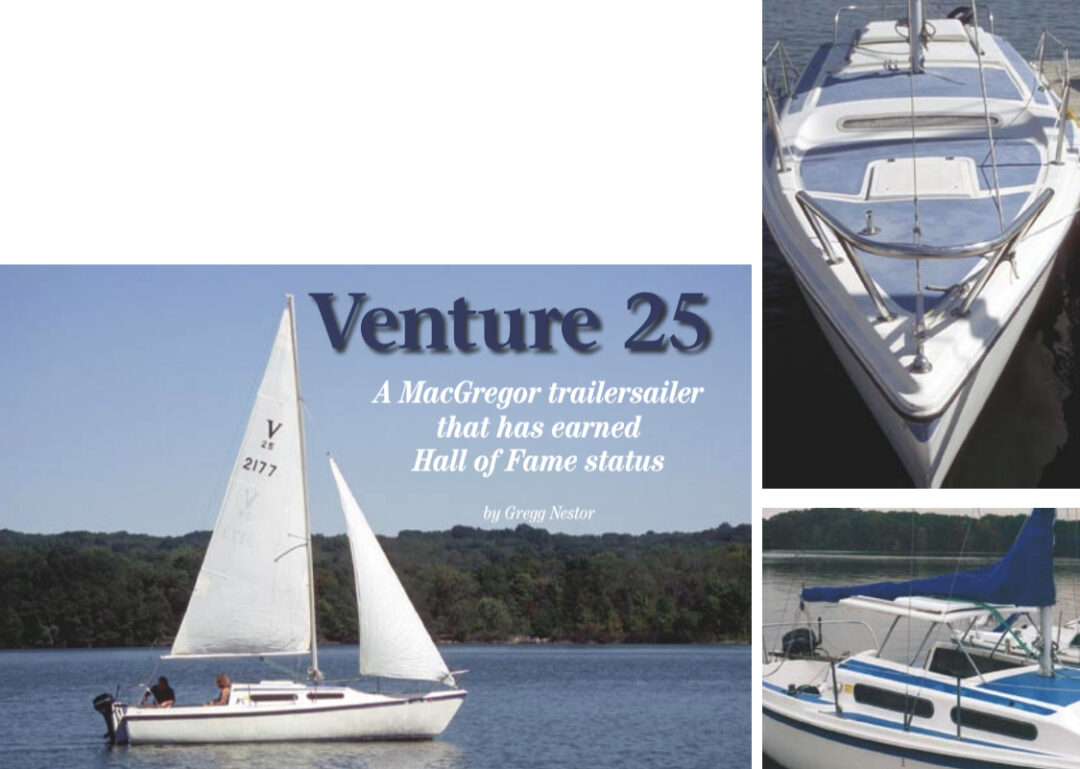
A MacGregor trailersailer that has earned Hall of Fame status
Issue 39 : Nov/Dec 2004
In 1967, as a final requirement for earning his MBA at Stanford Business School, Roger MacGregor wrote his thesis on automating sailboat manufacturing. Not too many years after that, Roger was credited with exposing the pastime of sailing to countless thousands of people.
Roger and his wife, MaryLou, started MacGregor Yacht Corporation in their garage. In 1968, they introduced the Venture 21. As their business rapidly developed, production soon outgrew their garage and they relocated to a new facility they built in Costa Mesa, California.
In 1973, the Venture 25 debuted. With its swing keel, lightweight design, and one-person easy rigging, this boat soon became the flagship of the line and remained so for 14 years. It was extremely popular with first-time sailboat owners, especially since it cost about the same amount as a new car. After 7,000 boats, production of the Venture 25 ended in 1987 with the introduction of the water-ballasted MacGregor 26.
MacGregor’s Venture 25 earned lasting recognition by fostering new enjoyment and growth in sailing as a recreational activity. In January of 2000, the Venture 25 was one of two boats inducted into the American Sailboat Hall of Fame in Newport, Rhode Island.
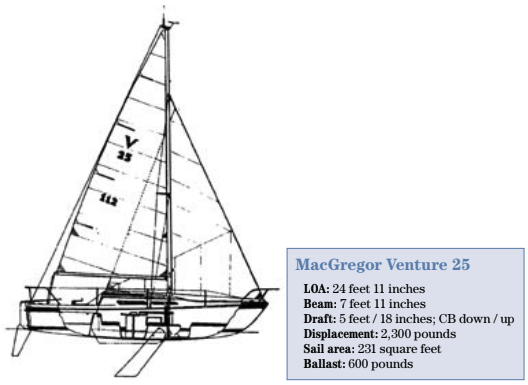
The MacGregor Yacht Corporation is still located in Costa Mesa, is still family run, and is still manufacturing sailboats the Roger MacGregor way. The company is one of America’s most successful boatbuilders. The Venture 25, has an overall length of 24 feet 11 inches, a beam of 7 feet 11 inches, and displaces 2,300 pounds with 600 pounds of ballast.
Design and construction
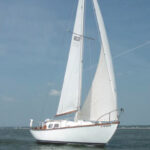
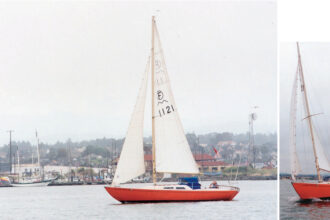
The Venture 25 displays functional lines with just a hint of sheer, a slight spoon-shaped bow, and an almost plumb stern. The boat is of uncored fiberglass construction, albeit a bit on the thin side. The construction is stiffened up by the combination of a fiberglass pan and glassed-in deck-support stringers. The forward and aft portions of the hull are filled with foam blocks, giving the boat positive flotation. The hull-to-deck joint is sealed with adhesive, mechanically fastened, and covered with an aluminum-and-vinyl rubrail.
The Venture 25 features a retractable keel, providing 600 pounds of ballast in the form of cast iron. With the keel retracted into its trunk, the boat draws only 18 inches, as compared to 5 feet when fully extended. The keel is raised and lowered with a winch that has a friction clutch. The winch is just inside the cabin, beneath the companionway. When the winch handle is released, the friction clutch automatically brakes and locks the keel in any position. Once the keel has been fully lowered, a 3⁄8-inch by 3 1⁄2-inch locking bolt can be inserted through the keel trunk and keel, locking the keel down.
On deck
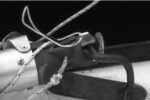
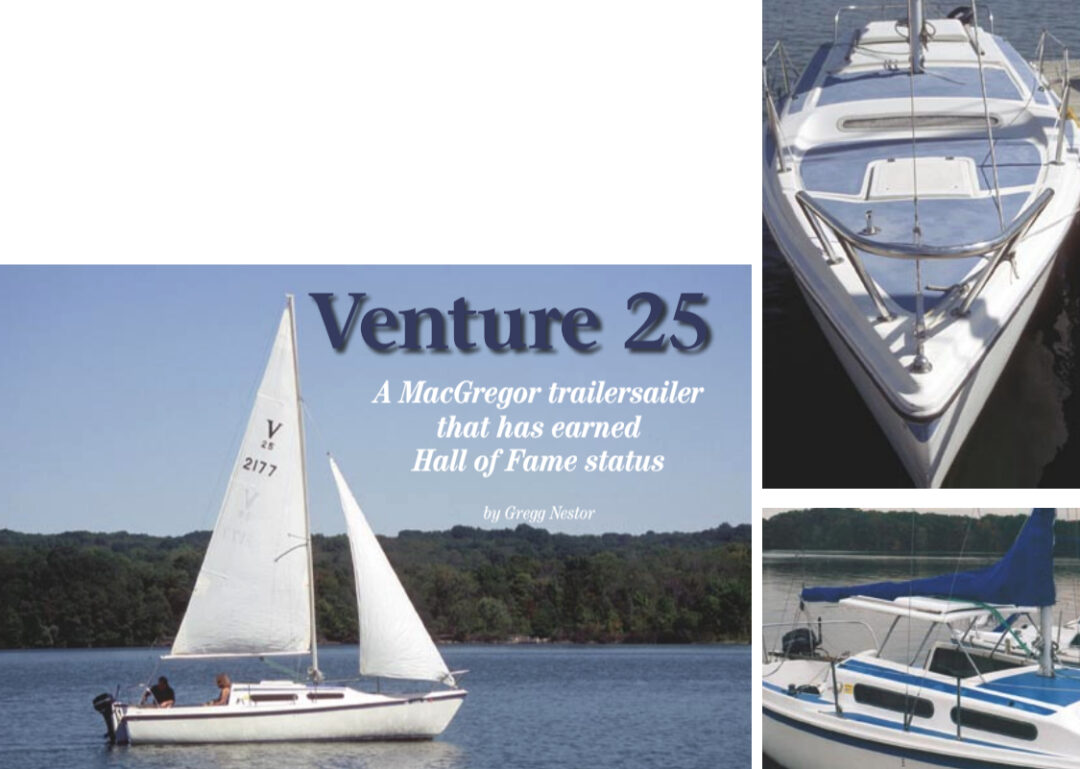
The foredeck of the Venture 25 is relatively long and narrow. Almost directly in its center is a flush, opaque, forward hatch. A few inches forward and slightly to starboard of the hatch is a 4-inch-high stainless-steel pipe flange (see photo at right). This item was an option on early models. For trailering, a Y-bracket is inserted into this fitting, allowing the forward portion of the unstepped mast to be secured at this location. When not trailering, the fitting makes an exceptionally good tripping hazard. This unique item, like most of the deck hardware, is through-bolted. Some of the deck hardware even has plywood backing plates.
From stem to stern, all horizontal surfaces are non-skid. There are bow and stern pulpits and 18-inch-high stanchions with single lifelines that terminate at the start of the cockpit. The shrouds are outboard of 6-inch-wide sidedecks (on later models the sidedecks were eliminated in favor of a raised deck), and there are no handrails on the cabintop. The Venture 25 is minimalist when it comes to the use of wood. Topside brightwork is limited to just six pieces: five around the companionway, including the sliding track and the tiller.
The cockpit is 6 feet 6 inches long with 10-inch-high coamings that afford reasonable back support. While the cockpit lacks a bridge deck, it is self-bailing. There is a locker to starboard, which gives access to the lazarette. However, there is neither a locker nor a designated place for an outboard motor’s gas tank. Owners must choose between stowing the tank beneath the tiller on the cockpit sole or using an outboard with a self-contained gas tank. On the stern is a transom-mounted, fiberglass, kick-up rudder and an adjustable outboard-motor bracket.
Belowdecks
Entering the cabin of a Venture 25 is a three-step affair. The first step is onto the keel winch housing, step two is the keel trunk, and step three the cabin’s non-skid sole.
In the bow, and a half step up, is the 6-foot long by 5-foot 2-inch wide V-berth, with the forward hatch opening directly overhead. Just aft of the hatch is a deck support stringer that extends downward about 2 inches. If you’re not paying attention when you’re in the V-berth, the low-hanging support will get your attention.
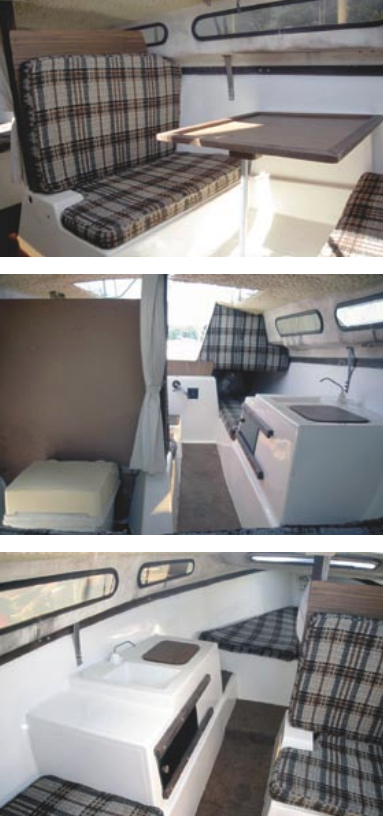
Aft and to starboard is a head area (with a Porta Potti) that measures a generous 38 inches by 32 inches. Good knee room! Since the Porta Potti is not secured to the cabin sole, its use while underway could prove to be challenging, especially if conditions become a little rough. For privacy, this area is separated from the main cabin by a wood-grained plastic laminate bulkhead and a curtain running up the centerline from bulkhead to V-berth.
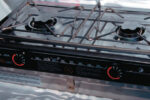
On the port side and amidships is the one-piece fiberglass galley unit that is molded into the pan. This consists of a top-loading icebox with a plastic laminate cutting board cover, a single sink with hand pump, and an area for a stove-top cooking surface. Beneath the galley and behind a sliding door is stowage space for cooking gear and the 3-gallon water tank.
Directly across from the galley, on the starboard side, is a dinette with seating for four and sitting headroom of 38 inches. By lowering the plastic laminate table and using the backrest cushions as a filler, the dinette converts to a 42-inch-wide double berth. Directly aft of the dinette/double berth is the starboard access to the cockpit locker.
Diagonally across from the dinette is the 2-foot by 6-foot 2-inch port quarterberth, bringing the total number of berths to five. Aft of the quarterberth is the port access to the lazarette and the boat’s battery. There is stowage beneath all berths/settees.
The textured pan gives the lower portion of the cabin (from deck down) a finished appearance, but overhead the raw fiberglass detracts from the boat’s interior looks. There is a keel trunk that runs from beneath the cockpit forward to the bulkhead that separates the main cabin from the head and V-berth area. Molded into the pan and to port of the keel trunk is a walkway that allows for free movement fore and aft. To use the dinette, one needs to step over the trunk or risk bruised shins. Cabin illumination is good and is provided by five (on later models, four) long oval, non-opening portlights.
The cabin’s standing headroom is easily expanded to 6 feet 1 inch by means of a large “pop-top.” This is especially nice when you’re using the galley. With the addition of optional side curtains, the pop-top frame can be converted into a dodger of sorts.
The rig
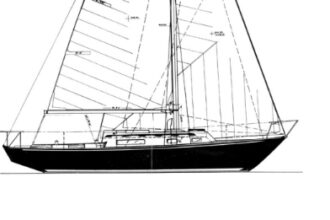
The Venture 25 is a sloop with a deck-stepped mast that rises to 28 feet above the cabintop. The mast and the boom are constructed of anodized aluminum. The rig is simple, with a single spreader, upper and lower shrouds, and a single backstay. The external halyards are double-braid polyester, cleated at the base of the mast. The total sail area for this fractional rig is 231 square feet, comprised of a mainsail and a working jib. A 130-percent genoa, sporting 175 square feet of sail area, was also available as an option.
Fixed jib fairleads are located forward on the cabin-top with corresponding jam cleats placed on the cabin’s aft edge. Short genoa tracks (17 inches) and cars are situated at the forward portion of the cockpit on each sidedeck. Adjacent to these on the cockpit coamings are Arco #6 single-speed sheet winches and jam cleats. End-boom sheeting is a triangular affair (Crosby rig) that runs back and forth from boom to the port and starboard corners where the coaming and transom meet. Cleating is on the port side. The mainsail comes without reef points. However, the standard gooseneck fitting serves as a simple roller-reefing system. By removing the retaining and pivot pins, the mainsail can be “roller reefed” around the boom.
Under way
The Venture 25’s light construction makes it a tender craft. The retractable keel expands its sailing grounds to include shoal-water areas. With the keel fully extended, and using the working jib, the boat points well. Employing the 130-percent genoa increases the boat’s performance. The Venture 25 has a history of being a competitive racer.
When the wind picks up, the boat develops weather helm, and in heavy weather it will round up before you realize what’s happening. Reducing sail area helps in heavy weather. Downwind control isn’t the best. It’s often difficult to steer a straight course on a run. When sailing “in the groove” the keel cable may hum. This can be annoying or even alarming. To eliminate this vibration and the associated humming, slacken the cable.
Points to check
When surveying a Venture 25, there are three areas to pay particular attention to: the swing keel, the hull, and the standing rigging.
Like all boats that use exposed cast iron as ballast, the Venture’s keel is prone to corrosion. Add age and salt water to this rusting potential, and the condition may be significant. In addition to the keel itself, there have been reports of corrosion of the keel cable and terminal. Also check for leaks around the keel’s lower pivot bolt, as well as electrolysis and wear of the keel at this pivot point.
MacGregor boats, the Venture 25 included, have the reputation for being lightly built. The hulls are a bit thin, and they do flex, so check for cracks. The standing rigging is lightweight and, over the years, may have been stressed. Carefully examine the rigging and plan to replace much of the stainless-steel wire.
Summing up
The Venture 25 is a good first big boat. Keep in mind that its overall construction and rigging are on the light side. The swing keel offers shallow-water sailing; and the boat is best sailed in protected waters.
Many after-market upgrade and repair parts are available but while MacGregor Yacht Corporation can offer replacement parts and technical support, they are concentrating all their energy on the MacGregor 26, their water-ballasted “powersailer.” Some of the best support and information is available from independent sources, such as www.macgregorowners.com
Availability of Venture 25s is good. And on the used-boat market, typical pricing for a Venture 25 in sail-away condition is in the range of $4,000 to $6,000, with condition and upgrades being everything.
Thank you to Sailrite Enterprises, Inc., for providing free access to back issues of Good Old Boat through intellectual property rights. Sailrite.com