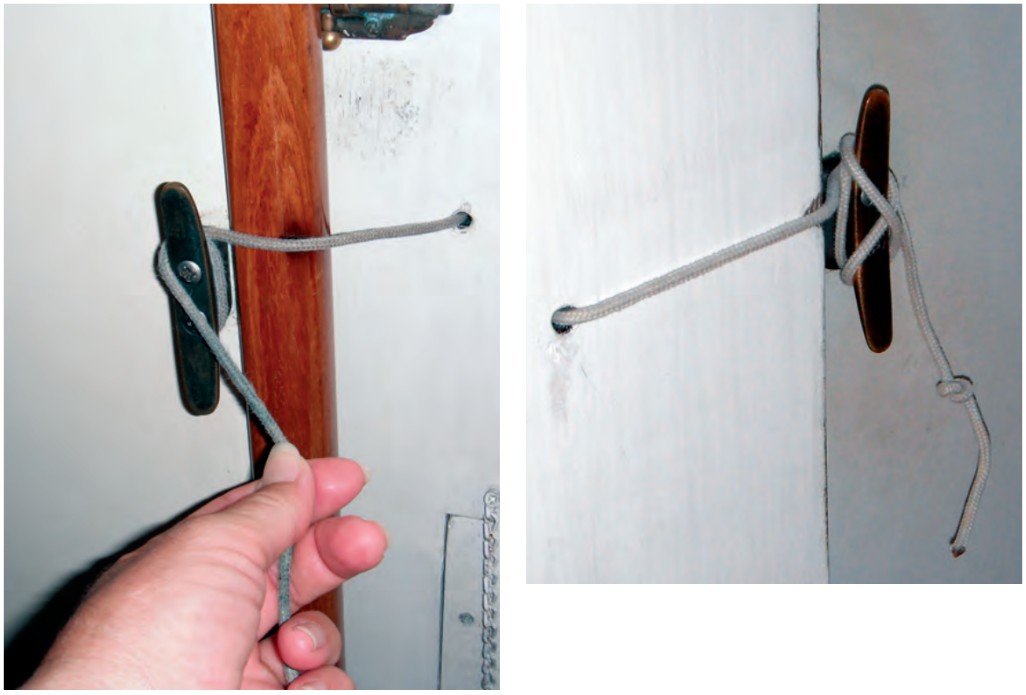
Close it with a cord and a cleat hitch
Issue 86: Sept/Oct 2012
In situations where more-normal people ask, “How can I fix this?” we on board Eurisko tend to think, “How can I use string to fix this?” This habit took form years ago after we had struggled for ages to find an appropriate latch for our head door.
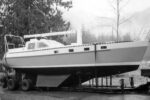
The door swings athwartships to provide privacy for the V-berth or it can be used fore and aft to close off the head. In an attempt to economize on space and multipurpose as much as possible, we attached the trash can to the inside of the door and hinged it to be accessible from either side. But as well-planned and beautifully constructed as it is, the door did not have a latch when we bought our 34-foot Creekmore.
The Velcro a previous owner had installed on the bulkhead was sufficient until we sailed her hard, and then the door swung to the beat of the heeling boat. We wanted to latch the door from either inside or outside the head but we couldn’t find a method for securing it without using awkward contraptions that didn’t fit with our simple lifestyle . . . until we thought to use string.
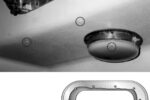
We drilled a small hole near the opening edge of the door, big enough to thread through it a 2-foot length of small line (we used starter cord). By tying a stopper knot near each end, we now had a line we could pull most of the way through the door into one side or the other. My husband, Dave, installed a 2-inch brass horn cleat on either side of the bulkhead that encloses the head. All we have to do is pull the line through the hole and cleat it on either the inside or the outside to secure the door. When we’re offshore, we put a locking turn on the cleat to prevent the line from loosening and the door from banging in big seas.
When we first installed our new “latches,” a friend pointed out that the line chafes on the edge of the door. In spite of her assurance that “that won’t last very long,” it was nearly 10 years before we replaced the original line. She was correct about the chafe, however, and the paint has worn off the door where the line touches. What’s more, I occasionally smack my elbow on the corner of the cleat and swear at the person who thought that was a good idea . . . until I remember I have only myself to blame.
Despite the few disadvantages, we would not trade our unusual door closure. Inexpensive, unobtrusive, and simple, our “latch” is yet another problem solved by string.
Connie McBride and her husband, Dave, faced an empty nest when their third son, David, left home, their 34-foot cutter, Eurisko. Part of their therapy was to buy a Bolger sharpie in which to explore shallow waters where Eurisko couldn’t take them. See Connie’s blog at http://simplysailingonline.com.
Thank you to Sailrite Enterprises, Inc., for providing free access to back issues of Good Old Boat through intellectual property rights. Sailrite.com