Famous mini-cruiser’s lines updated for home builders
Issue 61: July/Aug 2008
Some years ago, when I was building boats on Orcas Island in the San Juan Archipelago north of Seattle, I considered the possibility of producing fiberglass hulls based on the lines of Trekka. She’s the 20-foot 6-inch yawl I built in Victoria, British Columbia, and solo-sailed around the world between 1955 and 1959.
I contacted the heirs to the Laurent Giles yacht design office in England, where the original plans were drawn in 1953. Would they be interested in updating the design from wooden plank-on-frame to fiberglass, based on my experience and the changing nature of yacht construction since 1953? Although correspondence ensued, I quickly became aware that this was a venture that would require a considerable financial outlay for an uncertain market. As I already had work in hand, the idea languished into obscurity.
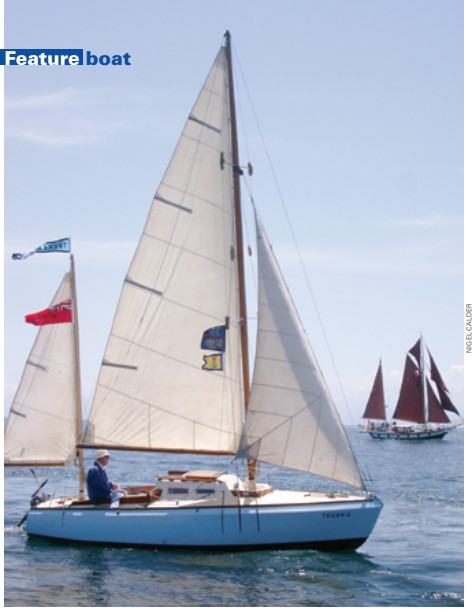
Although I still considered Trekka’s original design well-thought-out and certainly adequate for her intended purpose of solo offshore voyaging, there were several design features that I felt could be improved in a way that would not increase the cost and would, perhaps, simplify the building. As you will appreciate, the amount of space in a 20-footer is somewhat limited.
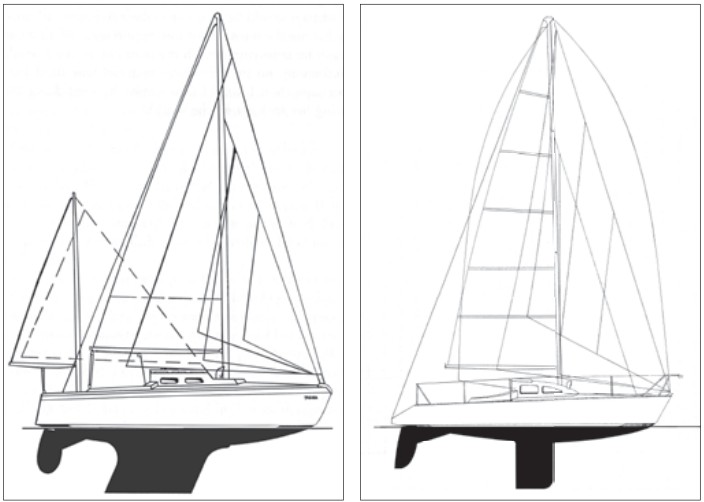
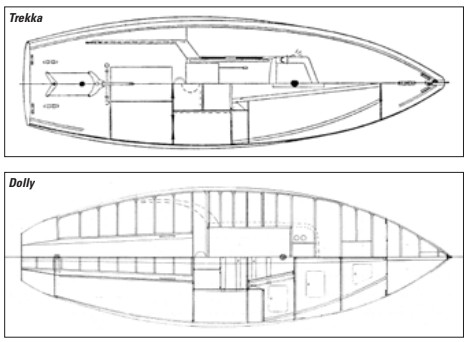
So my first alteration was to increase the beam at the midsection by 12 inches, which not only created more space inside the hull but also provided additional stability. I lofted the original Trekka lines quarter-sized on a sheet of particleboard using a 6-inch curved centerline so that the bow and stern still matched the original lines. This swelled the middle of the boat like a woman in early pregnancy. I liked what the lines revealed.
That sheet of particleboard with the lofted lines survived for several years through many moves. When I was offered a small workshop at Nautical Landing on Seattle’s Lake Union waterfront, the place and time finally allowed me to develop and build the little boat that became Dolly, which is my wife’s childhood name.
Rough-sawn cutoffs
By chance I met a man who had acquired two trailer loads of top-quality spruce cutoffs from a sawmill. It was rough-sawn, but after I planed it to 1⁄8-inch finished thickness, the old-growth vertical-grain spruce could have graced the finest of guitars. My construction preference is the cold-molding method: several thin skins of planking or veneer laid up double-diagonal style over a mold or interior framing that is usually longitudinal. The original Trekka scantling was 9 ⁄16-inch western red cedar supported on 1⁄2-inch x 1-inch oak bent frames set at 4-inch centers. I figured that three layers of the spruce, with a final skin of 1⁄16-inch mahogany veneer, would provide sufficient stiffness without additional framing, other than interior bulkheads and partitions such as bunk fronts and cabinetry. This would save weight and increase interior space.
I became aware of the cold-molded form of construction when I got to New Zealand in the mid-1950s. Max Carter, one of the premier builders in Auckland, pioneered the modern method of using World War II-developed adhesives to bond layers of planking together to form hull shells in much the same way that plywood sheets are produced, with the grain of one layer at about 90 degrees to the adjacent one. Max built many yachts using this method and is largely responsible for raising the bar for the Kiwi yacht-building industry.
Having built several cold-molded boats myself, I knew how to go about building light and strong hulls in suitable wood. The early aircraft builders chose Sitka spruce for similar characteristics, and I was fortunate to find enough material for the project.
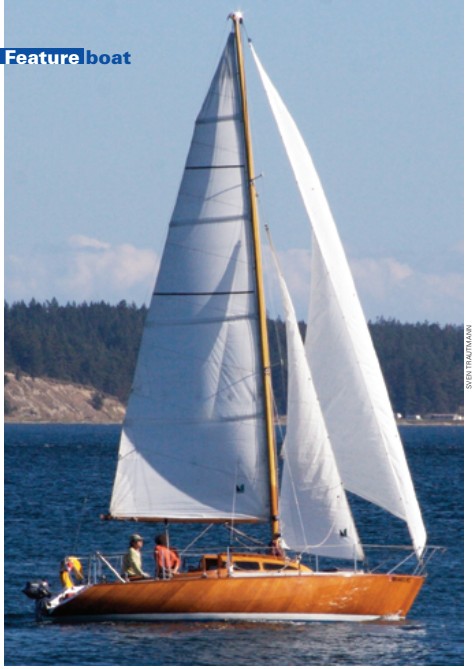
In addition to adding beam to the hull form, I shortened the fin keel and increased the draft 6 inches for greater stability, the better to carry more sail. Instead of the little yawl rig on Trekka — chosen for its ability to balance the rig for better self-steering — I chose to rig Dolly with an efficient cutter rig that was well-stayed for offshore sailing. Self-steering, if required, could be accomplished with the use of a modern windvane unit.
Similar down below
The accommodations in Dolly are arranged much as they are in Trekka, with a couple of full-length berths forward and two small cabinet lockers on each side, each with shelves for galley supplies. Aft of the lockers is space for a two-burner stove to port, with navigation space to starboard. Under the bridge deck is a small sink and, under that, storage for a Porta Potti. Aft of a bulkhead are two large storage compartments that can be used as sleeping berths alongside the cockpit sides. (One needs to be nimble to get into these!) Under the cockpit is a water tank and more storage.
Dolly is capable of extended offshore cruising for those not influenced by glossy yacht ads showing all the modern conveniences. As with Trekka, she is capable of delivering her crew safely to far-off destinations at a fraction of the cost of her much larger rivals. A small boat like this offers minimal maintenance costs, allows easy handling, and provides adequate shelter and living space in a tiny package. Possibly her best feature is that she is an enjoyable boat to sail, with a variety of sail combinations for cruising or racing.
The Dolly design is one that can be built in a relatively small shop like a garage or shed, as the keel assembly can be attached toward the end of the project. The cold-molded method allows small members to be glued into a very strong one-piece structure without excess weight or expense. Yet this is no quick stitch-and-tape method using sheet plywood tortured into position. Cold-molding is real yacht building, suitable for dinghies or mega-yachts.
Dolly is based in Seattle, where she receives exquisite care from her owner. At the 2006 wooden boat festival in Port Townsend, Washington, Trekka and Dolly received a lot of attention. I like to think that the two boats had a chance to get to know each other in the quiet of a summer’s evening after the crowds had left.
John Guzzwell built Trekka at age 24 and completed his world circumnavigation with her before he reached 30. He and his wife, Dorothy, live on Washington’s Olympic Peninsula. He is active in the marine industry as a sailor and boatbuilder.
Thank you to Sailrite Enterprises, Inc., for providing free access to back issues of Good Old Boat through intellectual property rights. Sailrite.com