A tale of human fallibility and 500-hour alternator brackets
Issue 38 : Sept/Oct 2004
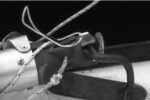
The brackets connecting the bottom of the alternator to our engine failed in benign conditions miles from the nearest land. Not quite a crisis but a problem. We had started the engine because the wind was too light to make much progress under sail. Like most freshwater-cooled engines, when you lose the alternator mounts or bearings, you lose belt tension and the ability to drive the water pump, so we could not charge, and we could not motor. A search for raw materials for a jury rig did not yield much. Finally, I bent up some 1⁄8-inch aluminum wire I figured would last a couple of minutes at most; just enough to make the last few moves in a marina at idle.
We were in the wilderness of Lake Superior a few miles north of Isle Royale’s Passage Island. I had made the brackets myself when I installed the engine five years ago. Nothing on a shelf anywhere would solve the problem. Now we needed another set of custom-made brackets. Isle Royale’s Mott Island was maybe 10 miles away and had repair facilities for National Park Service boats, but I was not sure what kind of help they would be inclined to give. The NPS has never demonstrated any real understanding of boaters or their problems even though they use boats to manage Isle Royale National Park. Thunder Bay, in Canada, was 30 miles away as the crow flies . . . farther away but with more options.
A merciful light breeze returned dead down the rhumb line from Thunder Bay. Crows don’t have to tack. While there was daylight and open water, we shut down all electrical systems. The late afternoon was followed by a long night; dark as the inside of a boot. We ran the running lights, GPS, chart plotter, and radar as we wove our way through the islands along the shore outside the entrance to the bay. At 0100 the wind died, and we ran two and a half miles to an anchorage on the jury-rigged brackets, with the alternator fi eld current interrupted so there would be no charging load. The brackets were good for exactly that distance and nothing more.
On a lee shore
In the morning a brisk sea was rolling into the anchorage. We were close to the beach on a lee shore. We practice sailing off the anchor whenever we can. Still, the odds did not look good for that one. I started another scrounge for the raw materials for a jury rig. The wire would not take the power I’d have to use to get off the shore. I considered a batten, a plastic sliding locker door . . . and then I saw it. I had been looking at the old brackets as the “broken parts.” They were extruded aluminum angles with 1-inch flanges. They had lasted, by rough calculation, about five years and maybe 500 hours of engine time. A bad design, they needed to be good for maybe 20,000 hours to outlive the engine and several failed alternators. The flanges that stiffened the parts also introduced a stress riser that caused the failure. But those flanges did not, themselves, fail; they were intact. Bingo. I drilled new holes in the remaining flanges, carved the holes larger with a jackknife, and installed “Design No. 3.” They looked so good I told Karen they might actually allow us to charge. Still, we sailed from Ontario’s Tee Harbor across Thunder Bay to the town of the same name, using the engine only to get us off the lee shore and then again at the marina in Thunder Bay.
Canadian hospitality is amazing. We called Rod and Debbie Ellard, whom we’d met a few days before. Rod is a machinist. He made some 20,000-hour brackets for us, and he and Debbie extended many other kindnesses during our stay. Nice place, Thunder Bay. Good people.
Lessons learned:
- Alternator brackets are very critical parts; carry spares.
You can’t predict what you will need to jury rig; carry a
good collection of materials and the tools to work them. - When it is crunch time try to think outside of the box.
- All humans are fallible; they may design things that break.
- Some humans are very kind.
Thanks, Rod and Debbie.
Thank you to Sailrite Enterprises, Inc., for providing free access to back issues of Good Old Boat through intellectual property rights. Sailrite.com