An extra hand for short-handed cruising sailors
Issue 68 : Sept/Oct 2009
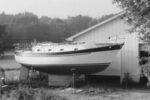
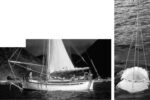
Lazy-jacks provide a simple way to control a sail when you lower it. By holding the sail above the boom and preventing it from falling on the deck, they also make it easier to furl the sail. They can be used on Marconi rigs, gaff rigs, and even on club-footed jibs. There is no one definitive way to rig lazy-jacks; almost as many variations exist as there are installations.
Lazy-jack installation
A basic component of any lazy-jack system is a pair of upper support lines, one on the port side of the mast and one on the starboard side. These hold up a lower set of lines that actually contain the sail, which is raised and lowered between them.
The upper support lines are usually attached to eye straps about half to two-thirds the way up the mast. With this type of installation, the tension in the lazy-jacks can be controlled by adjusting the lower lazy-jack lines at the forward end of the boom. Alternatively, instead of being fixed to eye straps, the upper support lines can lead over small blocks and down to the base of the mast, where they can be adjusted to tension or loosen the lazy-jacks.
Regardless of which system you use, the lower ends of the upper support lines terminate in an eye-splice around a thimble. When making this eye-splice, be careful to ensure no sharp ends of melted strands protrude from the eye-splice as they will chafe the sail.
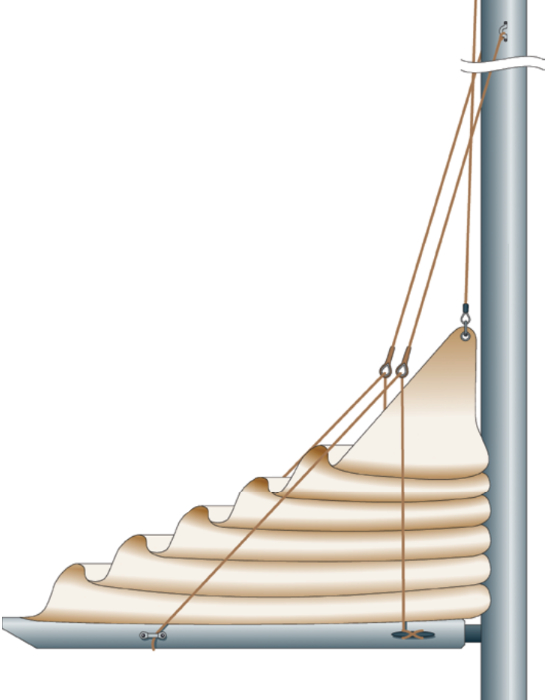
Two-leg lazy-jacks
In a two-leg lazy-jack, the lower lazy-jack line is one continuous line. One end is fastened to an eye strap on one side of the forward end of the boom. It leads up to and through the thimble eye of the upper support line on the same side of the boom, down around the boom through an eye strap, back up to the other upper support-line thimble eye, then down to a cleat at the forward end of the boom, where its tension can be adjusted.
Normally, lazy-jacks on boats up to about 30 to 35 feet are made of 1⁄4 -inch polyester line; those on larger boats are made of 3⁄8-inch polyester line.
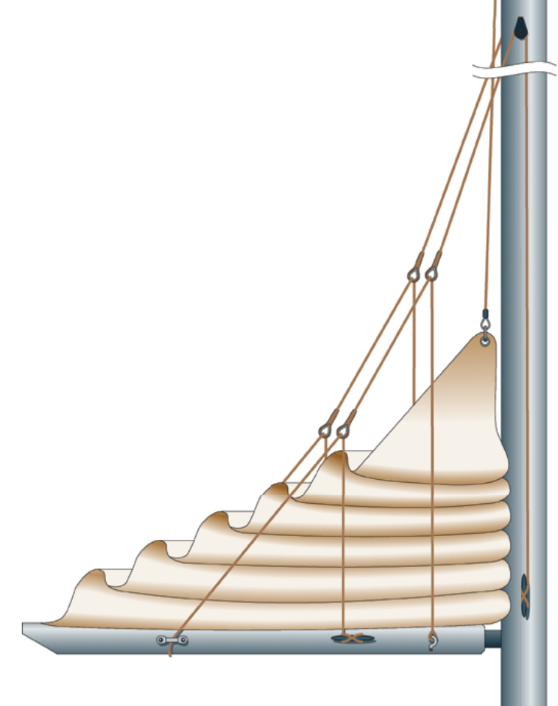
A three-leg lazy-jack system can hold a larger sail more securely and, just like the two-leg, can be as simple or elaborate as the situation demands. Someone who often sails singlehanded might even lead the upper-leg control lines to the cockpit.
Three-leg lazy-jacks
Three-leg lazy-jacks have similar upper support lines but their lower lines enclose the boom at three places. The three-leg lazy-jack system is usually seen only on very large boats. Because they include yet a third area of the lazy-jack net, these systems contain large lowered sails a bit better than two-part systems are able to do.
Tensioning lazy-jacks
Tension on lazy-jacks is correct when, after the sail has been lowered and the boom is being supported by the topping lift or boom gallows, they are reasonably taut but have enough slack so they don’t abrade the sail. They should be slack enough so you have room to install the sail covers easily. As a matter of fact, it’s somewhat easier to install a sail cover when the lazy-jacks are properly tensioned, because the sail cover can be laid out along the boom and will stay in place.
Batten fouling
The most common complaint sailors make about lazy-jacks is that the boat must be pointed directly into the wind when the crew raises the sail. On a boat with a Marconi main, raising sail off the wind will cause the aft ends of the sail battens to be blown outside the lazy-jack lines and catch there. Boats with full battens usually don’t have this problem. One way to solve the dilemma is to slack off the lazy-jacks before hoisting the sail; another is to make sure the boom is directly downwind. Once the mainsail is part-way up, and the battens are clear of the lazy-jacks, there is no further problem.
A way to prevent the battens from snagging the lazy-jacks is to slack off both lazy-jacks, or even just the leeward one, and bring them forward to the mast when hoisting sail. Once the sail is raised, the lazy-jacks can remain in the forward position or be moved back to their normal position in readiness for the next time the sail will be lowered. For many, this extra maneuver may negate the inherent advantage of using lazy-jacks: making things simple.
One side benefit of fitting lazy-jacks is that they provide an emergency backup for the topping lift, since the lazy-jacks will prevent the boom from crashing down on the craniums of the crew if the topping lift fails. It’s tempting, if you have lazy-jacks, to do away with the topping lift entirely, but this makes it more difficult to reef or furl the sail when the lazy-jacks are supporting the weight of the boom at the same time.
Naturally, lazy-jacks add a bit more windage and a small amount of weight aloft, so they’re not often seen on racing sailboats, where every hundredth of a knot is important. But for the cruising sailor they are a great asset, especially when sailing solo or short-handed.
Don Launer, a Good Old Boat contributing editor, has held a USCG captain’s license for more than 20 years and has sailed the East Coast from Canada to the Caribbean. He built his two-masted schooner, Delphinus, from a bare hull. His new book, Navigation Through the Ages, was published by Sheridan House last June.
Thank you to Sailrite Enterprises, Inc., for providing free access to back issues of Good Old Boat through intellectual property rights. Sailrite.com