A raised-deck Crocker design that still receives admiring glances
Issue 22 : Jan/Feb 2002
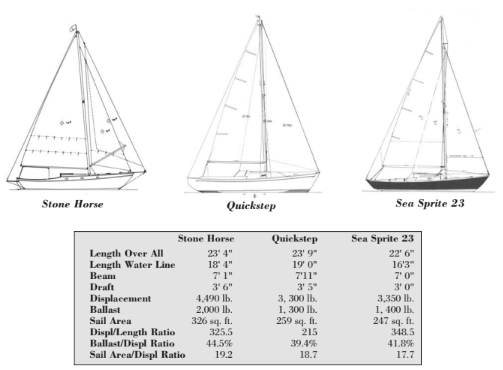
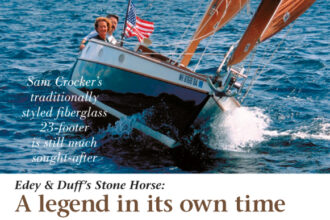
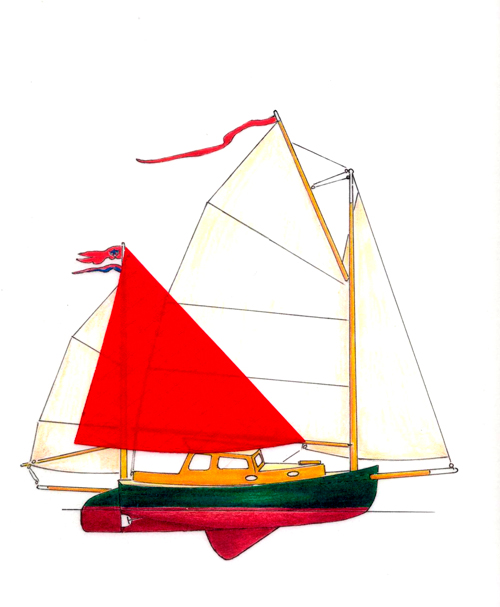
The Stone Horse is a vessel I’ve long admired. Her design was based on a wood yacht from the board of S. S. Crocker, a master at drawing up the raised-foredeck type of yacht, and I’ve respected both the beauty and practicality of his creations, in particular the lovely gaff-rigged ketches Macaw and Gardaloo.
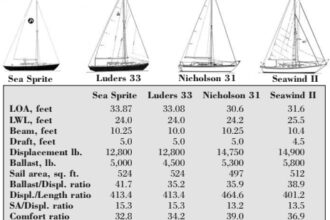
Two small yachts that fit into the general daysailer/ overnighter category with the Stone Horse are my own mid-1970s Quickstep design and the popular Carl Alberg-designed Sea Sprite 23.
The Stone Horse and Sea Sprite are similar in many ways. Both are fairly husky little boats with displacement/length ratios well over 300, both have modest beam, and both have fairly high ballast ratios in order to obtain the stability to carry a decent sail area. The 326 square feet sail area of the Stone Horse, by the way, is based on 100 percent foretriangle (as scaled by me off a small drawing) and is not the advertised sail area of 339, which includes the areas of both the jib and the staysail.
Quickstep’s 1977 design, while a long way from new, is still far enough removed from that of the Stone Horse to have been created in an era when we designers were learning to utilize lighter displacement in order to improve performance and, at the same time, obtain the necessary stability by more generous beam. It’s interesting to note that the Sea Sprite has roughly the same displacement and ballast as the Quickstep but also the narrower beam of the Stone Horse. As a result, it seems unlikely that she would stand up to a stiff breeze as well as the others. Also, her six-inch-shallower draft does not allow her generous ballast to be carried as low or as effectively as it might be.
If I were a betting man, which I’m not, I’d have to say that I’d bet the Quickstep, with her much more cut-away keel, would be the choice in light-medium air, and the Stone Horse would shine when it blew up a bit, say in small-craft-warning conditions. Then her very long keel, husky displacement, and high-ballast ratio would give her the edge, certainly in steadiness and motion comfort, if not in speed.
None of these little craft can offer the epitome of comfortable weekend accommodations, of course, but the Stone Horse has the edge with a very well thought out arrangement, and the Sea Sprite is third on the list. The short waterline, traditional long and pretty ends, low freeboard, narrow beam, and short trunk cabin of the classically styled Sea Sprite simply do not add up to a great deal of usable space, either in the cabin or in the cockpit.
Still, all three of these craft are viable daysailers and will give the budding sailor or the small family a lot of fun for the dollars invested. The skipper interested in racing might well pick the Sea Sprite, as there are club fleets active in several areas. But if I had my choice? Well, as I said, I’ve always admired S. S. Crocker’s raised foredeck designs so I’d love to spend a month cruising the islands of the Northwest in his beautiful little Stone Horse. I know she’d be a lot of fun, and she would certainly receive a lot of admiring glances wherever we sailed.
Thank you to Sailrite Enterprises, Inc., for providing free access to back issues of Good Old Boat through intellectual property rights. Sailrite.com