The equipment you hope you never have to use
Issue 67: July/Aug 2009
Among the most important pieces of equipment on board our boats are some we’ve spent good money for but hope we never have to use. Fire extinguishers are one example and the ditch bag is another.
If your boat is foundering and you’re forced to take to the life raft, you’ll need to take with you several items to assure your comfort and aid in your rescue. These should be stored in a ditch bag that’s easy to find and retrieve in an emergency.
The ditch bag is sometimes referred to as a rapid-ditch bag, a ditch kit, a grab bag, a flee bag, or an abandon-ship bag. What you stow in the ditch bag depends on the kind of sailing you do and where you sail. A ditch bag suitable for bluewater cruising with a large crew in cold climates is very different from one needed when sailing in coastal or intracoastal waters.
The container
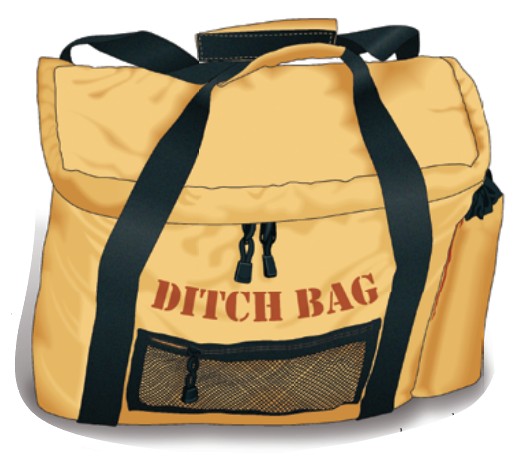
No matter what its contents, the ditch bag should be able to float when packed and should be designed so items inside the bag can be fastened to it with individual lanyards. The bag itself should be brightly colored and sport reflective strips. It should also be identified with a large label stating “Ditch Bag,” or something similar, so there will be no mistake as to which bag to grab amid the stress and confusion of abandoning ship.
Boating supply stores sell a great variety of ditch bags. Some bags have a Velcro bulkhead mount so they can be located in plain sight and easily removed in an emergency. Many bags claim high flotation loads, but unless the bag is completely waterproof (and most are not), the weight of the equipment inside can send the bag to the bottom. The shoreside weight of the contents can be misleading. If the bag contains a number of heavy water bottles, for example, they will provide their own flotation when the bag is submerged in salt water, since fresh water is less dense than salt water. Metal objects are an entirely different matter. The only real way to know if your bag will float is to immerse it when it’s loaded with all the requisite gear and see for yourself.
You can supplement flotation by storing many of the items in the bag — medications, first-aid gear, and so on — in sealable plastic bags that trap a substantial amount of air. A completely waterproof bag is another solution, but they are not easy to find. If you locate one, it should be able to keep your heavy contents dry while staying afloat.
The contents
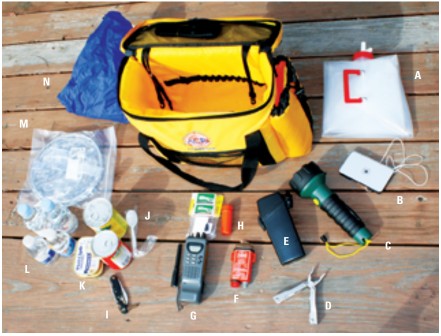
Whatever else you decide to put in the bag, the most important items are those that can alert rescuers to your status as soon as possible. These include electronic systems such as an EPIRB and PLB (see “EPIRBs, PLBs, and SARTs 101” in the January 2008 issue) as well as a VHF radio that is either waterproof or in a waterproof bag. Your kit should also contain visual distress signals. These could include a strobe light, hand-held and rocket flares, and smoke signals. Although they are stored out of sight in the ditch bag, don’t forget to check the expiration dates of pyrotechnic devices and replace them when appropriate. A signaling mirror can also be very effective in attracting attention but requires a sunny day (see “Reflect on This” in the January 2005 issue and “Signaling for Help 101” in the January 2009 issue).
Solar blankets can protect you from the sun or cold and can be used to catch rainwater. Include bottled water and some form of nourishment. If that nourishment is in cans, you’ll need a can opener unless the cans have pull-tab tops. If you’re making a long ocean crossing, a solar still or hand-operated reverse-osmosis desalinator should be part of your emergency equipment, as should simple fishing gear. A basic medical kit is important too. Don’t forget any medication that you or a crewmember can’t live without, and sunscreen. Spare glasses and a pencil and pad of paper could be helpful; a knife is essential. Inflatable life rafts should have patch kits and a supply of short lanyards to make sure nothing is lost overboard, such as the bailer or the knife.
There are no hard-and-fast rules about the contents of a ditch bag. Sailors must evaluate their own requirements. Think about things you’ll need to keep you warm and dry, protect your skin from exposure to the sun, keep you hydrated and nourished, maintain your health, signal for help, and navigate toward land.
If your sailing lifestyle will never put you in a situation where a ditch bag would be necessary, assembling one will not be a high priority. But if there is a chance, however remote, you might need it, the ditch bag should be one of those items you spend time and money on and then hope you never have the occasion to use.
Don Launer, a Good Old Boat contributing editor, has held a USCG captain’s license for more than 20 years and has sailed the East Coast from Canada to the Caribbean. He built his two-masted schooner, Delphinus, from a bare hull. He keeps her on Barnegat Bay, New Jersey.
Thank you to Sailrite Enterprises, Inc., for providing free access to back issues of Good Old Boat through intellectual property rights. Sailrite.com