
Ten things you could take off the “must-have” list
Issue 67: July/Aug 2009
In today’s economic climate, many of us are looking for ways to scale back our budgets without giving up our dreams. For anyone who has been planning an extended family cruise — whether for two weeks or four months — leaving off as much of the “must-have, can’t-leave-without” equipment as possible can make the difference between a family sailing experience to be cherished and a might-have-been that will always be regretted. Many articles have been written about the minimum requirements for equipping a boat for an extended coastal voyage but very few help you figure out what you can leave behind without compromising your voyaging lifestyle.
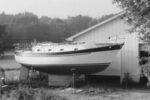
My husband, Evans Starzinger, and I have spent the last decade cruising aboard our 47-foot aluminum Van de Stadt Samoa, Hawk, and before that, on our Shannon 37, Silk. When we fitted out Hawk after completing a circumnavigation aboard Silk, we chose to keep the boat simple to minimize maintenance when cruising in the high latitudes, where boatyards and chandleries are few and far between and where we must be able to fi x anything that breaks. If we had put aboard all the things we “couldn’t leave without” before setting sail, we’d have spent another two years ashore earning the money to buy the equipment, and at least twice as much of our time on maintenance once we left. We weren’t willing to make those trade-offs.
For 15 years, and more than 100,000 nautical miles, we lived without many of the things others consider to be necessities. We have gained first-hand experience with the real trade-offs inherent in outfitting a boat.
If we were to fi t out a coastal boat on a very limited budget for cruising for several months at a time in the Great Lakes, between the Northeast and the Caribbean, or between the Pacific Northwest and Mexico, our choices would be quite different. Those choices and the reasoning behind them may help you avoid unnecessary expenditures so you can realize your cruising dreams. What follows are 10 things we would leave off when fitting out a coastal-cruising boat on a minimal budget.
1. Refrigerator/freezer
Of the equipment we left off Hawk, refrigeration comes as the biggest surprise to most people. But refrigeration costs a great deal to install and then requires more energy to run than just about anything else aboard. Having it aboard means running the engine for several hours a day in the tropics or totally reconfiguring the electrical system. We have gotten along very well for more than a decade without refrigeration and have learned many alternative ways to preserve everything from fresh produce to meat.
If we planned to cruise north to Maine, the Great Lakes, or Puget Sound, we would definitely not install refrigeration; we know from experience that we would never miss it. If heading south to the Caribbean or to Mexico, we would carry several large, insulated freezer bags. We have used these on Hawk to keep things cold between the store and the boat. With a block of ice, these work well to keep meat, milk, yogurt, and a few other foodstuffs cool for two to three days at a time.
2. Watermaker
Silk carried 100 gallons of water, and we were never down by more than 50 gallons. We often caught rainwater between dockside refills. On Hawk, we preferred the simplicity of extra tankage to the cost, complexity, and energy requirements of a watermaker. Hawk carries 200 gallons of water in two tanks, and we have gone two months between refills without making any real effort to conserve water. On strict passage rations, we have gone three months without refilling the tanks. We have always been able to catch rainwater before our tanks got too low except in a few places like the Sea of Cortez in Mexico, where water was readily available in marinas.
We would definitely not install a watermaker as long as we could find a way to carry at least 25 gallons of fresh water for each regular crewmember and we could set the boat up to catch rainwater efficiently.
3. Hot water/pressure water
On Silk, we had pressure water and a water heater that worked off 110-volt power or the engine heat, but we rarely used either. We installed foot pumps in the galley and head and used those so we could control our water usage. We still had to maintain the pressure-water system, however, and we spent more time rebuilding the pumps and looking for leaks than we did using it. Aboard Hawk, we did not install pressure water or a water heater; instead we put foot pumps in the head and galley. Those have met most of our needs more than adequately.
While we never miss hot-water showers while cruising the tropics or when summer cruising in temperate latitudes, we have occasionally wished for that luxury when cruising in cold climates where there were no facilities ashore. But for coastal cruising, we would buy a solar shower for use when the sun’s out and a large teakettle for when it isn’t — and make use of the shower facilities ashore at yacht clubs or marinas when we felt the need for a “real” shower.
4. SSB/ham radio
An SSB or ham short-wave radio keeps most cruisers in touch with the mobile cruising community and provides social life on passage. With a Pactor modem, it can also serve to send and receive email. We did not have a high-frequency radio for most of our circumnavigation on Silk and, when we installed one near the end of our voyage, found we didn’t like being tied to “scheds” and having people panic if we couldn’t come up at the appointed time. On Hawk, we have relied on an Iridium satellite phone for voice and email communications and for weather.
But since we left on Hawk in 1999, communications have undergone a total revolution, and the options available to cruisers have increased dramatically. Cell-phone coverage has improved, WiFi has become common, and Skype has brought low-cost international calling to anyone with a computer. As a result, if we expected to limit our cruising to U.S. waters, we would not install an SSB or rely on the Iridium phone. Instead, we would buy a cell phone with a country-wide plan and we would use WiFi wherever it was available (most marinas, some larger harbors, and ashore at coffee shops or restaurants). We would use Skype to make most of our long-distance phone calls and use the cell phone sparingly.
For cruising Canada and Mexico, we would purchase one of the North America plans for the cell phone that extends coverage to these other countries. If cruising in the Caribbean, we would buy an unlocked GSM phone and purchase a new SIM card for each group of islands. We would make do without modern communications for the few weeks we might be cruising in places without cell-phone coverage or WiFi, such as the west coast of the Baja Peninsula or the unpopulated areas along the north coast of Newfoundland.
5. EPIRB
We have carried a 406-MHz Emergency Position-Indicating Radio Beacon (EPIRB) on both of our boats, but we would not buy one if we were fitting out a coastal boat, even if we planned to make short offshore hops of from one to three days. The U.S. Coast Guard reports that 94 percent of EPIRB signals are false, so it is reluctant to launch a search-and-rescue mission without confirmation that the vessel involved is in an emergency situation.
The high percentage of false signals has forced long-distance offshore race organizers to require two emergency signals from the same vessel before they will launch a search-and-rescue attempt. Today, making contact with the Coast Guard through the VHF radio or a cell phone is far likelier to result in a rescue than setting off an EPIRB. Rather than spend the money on a 406-MHz EPIRB, we would invest in a high-quality VHF radio with Digital Selective Calling (DSC) that provides coverage up to 20 miles offshore, and we would use that in an emergency.
6. Radar
We carried radar on both boats but have used it in earnest only about a dozen times in 15 years of cruising. Since the accuracy of GPS has increased to the point where you can pinpoint your position to within a few feet anywhere in the United States, Canada, or the Caribbean, the GPS has supplanted the radar in its primary use — locating the boat in conditions of poor visibility.
The second use of radar — avoiding collisions with other traffic in poor visibility — is necessary only where there is heavy fog. In areas like Maine and British Columbia, the fog tends to burn off by midday, so sailing in the afternoon instead of the morning all but eliminates the need for radar.
In areas with heavy shipping traffic, such as the Strait of Juan de Fuca or the entrance to Chesapeake Bay, an Automated Information System (AIS) receiver plugged in to our chart plotter would provide us with the location, course, and speed of any shipping in our vicinity and give us an added margin of safety. As long as we were not trying to cruise to a fixed schedule in an area known for heavy fog, we would not spend the money on radar.
7. Integrated instruments
A full set of instruments — anemometer, depth sounder, and knotmeter — costs a great deal to purchase and install and even more to fix. We have sailed with integrated instrument systems on both boats, and we have had to replace some component of them about every six months. The only piece of information the instruments provide that is absolutely critical is depth. Today, high-end chart plotters have a feed for a fishfinder that can be used to determine depth.
The GPS also provides speed over the ground, eliminating the need for a knotmeter. Though the GPS cannot provide speed through the water when in areas with strong currents, it can tell you how much the current is affecting your course, which is what is really important. Many people have circum- navigated without wind instruments and tend to be better sailors for it, knowing exactly where the wind is and how strong it is at all times.
When equipping a boat for coastal cruising, we would fit a Windex to the top of the mast and install a fishfinder that worked through our chart plotter, rather than invest in a full system of integrated instruments.
8. Diesel heating
For anyone planning to cruise in cooler climates, a reliable heater means the difference between cold-weather camping and civilized comfort. We were very disappointed with the reliability of the Webasto forced-air system on Silk, and most people we know with forced- air heaters have had trouble with them unless they were in use regularly. Aboard Hawk, we installed a drip diesel heater that kept us warm in temperatures below 50°F but is overkill otherwise.
If we were outfitting a coastal boat for summer cruising in Maine, Nova Scotia, Newfoundland, the Great Lakes, or British Columbia, we would install a marinized bus heater that uses the engine hot water to heat the boat. If we turned this on when we were approaching an anchorage and getting the anchor down, the boat should be toasty warm when we went below. A kerosene lantern would then keep the chill off overnight.
9. Mainsail furling
Good sail control means one crewmember taking no more than a few minutes to reduce canvas from full sail to reefed or furled. For headsails, roller furling offers a solution tested over hundreds of thousands of offshore miles aboard racing and cruising boats. Mainsail furling systems have so far not proven to be nearly as robust. But handling the 750-square-foot mainsail is the most formidable task we face reguarly aboard Hawk.
We eventually followed the lead of the singlehanded ocean racers and installed full battens and lazy-jacks. For reefing, we use a two-line, slab-reefing system led back to the cockpit with separate lines for the tack and clew at each reef point. We have had only one failure in 75,000 nautical miles and consider the system to be just about bulletproof.
However, we often dream of being able to handle the mainsail as easily as we handle the jib, so we continue to follow advances in mainsail furling, stack packs, and other mainsail-handling systems. So far, we haven’t found any solution as reliable as the full battens and lazy-jacks. If we were fitting out a boat for coastal cruising, we would install a lazy-jack system with the existing mainsail and try to find a way to retrofit a two-line reefing system led back to the cockpit.
10. Generator
We hate running the engine but have no desire to substitute a separate diesel generator as the way to recharge our batteries. The choices we made above for coastal cruising add up to an energy-efficient boat with minimal electrical demand. However, laptop computers today draw much more than they did when we got our first one in New Zealand in 1993. At that time, the black-and-white (well, green- and-gray) screen and the simple programs meant that the computer drew less than 1 amp and hardly changed our electrical balance.
Today’s laptops with their big color screens and behemoth programs draw 4 to 5 amps. Because they’re doing digital photography and surfing the Internet, cruisers spend much more time on the computer today than a decade ago. For those who choose to have a laptop aboard, the peak electrical demand when on the computer all day will be 50 amp hours and, with two computers aboard, it can be twice as much. Our single 75-watt solar panel can almost keep up with one computer in tropical sunshine, but not two.
If we were outfitting a coastal boat, we would install as many solar panels as possible without compromising the boat’s sailing performance. That, in conjunction with motoring into and out of anchorages, would probably take care of our electrical demands. But if we had a big gap between what we were using and what we were generating, we would turn to the solution that has worked well aboard Hawk to provide power for our increasingly energy-hungry computers.
On this boat, we have supplemented the solar panel with a 4-stroke, gasoline- driven, “super quiet” Honda generator that produces 900 watts and weighs only 29 pounds. If we put it on our swim platform when it’s running, we don’t hear it at all from inside the boat. It uses approximately a tenth of a gallon of gasoline per hour and generates a steady 40 amps at 12 volts. In conjunction with our single 75-watt solar panel, we need to run it about an hour a day on the few occasions when we’re using both of our computers all day at anchor.
Everything ties together
The decisions about what we would leave off a coastal boat tie in to one another — if, for example, we decided to add refrigeration, we would have to revisit the electrical generation question. The members of every boat’s crew have to find their own balance between comfort, convenience, maintenance, money, time, and electrical consumption that best meets their particular cruising needs.
We’re not purists, nor are we Luddites. We don’t have any deep philosophical opposition to the majority of the items on this list, but we have found that we most enjoy our comforts when we can have them for a minimum of cash, care, and complexity. By not equipping our boat with the equipment listed above, we would save at least $20,000, which for us would be enough money for a year to a year-and-a-half of coastal cruising. We would also spend a lot less time worrying about getting things fixed and a lot more time enjoying the places we visited. We’d save dollars and reduce stress, and that makes sense.
What we wouldn’t leave without
Given the list of things we would leave off a coastal cruiser, what equipment wouldn’t we leave without? Beyond the basic boat — which includes mast and sails — the following are items we would consider the bare essentials for a three- to four-month coastal cruise.
Oversized ground tackle
We would opt for an oversized anchor and at least 75 feet of chain. In order to sleep well at night, we prefer to have an anchor one size larger than the manufacturer recommends. Anchoring instead of staying in marinas is the best way to minimize expenditures when cruising.
Autopilot
We almost always sail short-handed, so having aboard a third “person” to take the helm while we’re managing things on deck is critical to our safety. On most coastal boats, a wheel-mounted autopilot is sufficient, but we would want to make sure that the autopilot was capable of handling the boat even in strong winds and big waves offshore.
High-end chart plotter
A chart plotter minimizes the mistakes inherent in moving from chart to GPS. It also offers fishfinding and AIS capabilities. We prefer the waterproof, marinized chart plotters with a fixed installation to the possibility of having our laptop computer tossed across the boat or doused by a wave.
Depth sounder or fishfinder
The only instrument we absolutely must have aboard is a way to determine depth. A lead line works, but we don’t have the patience or the skill to use it quickly enough in an emergency situation.
Dinghy
Anything from an inflatable kayak to a sailing dinghy will do, but we need some way to travel between the boat and the shore when at anchor.
VHF with DSC
While a handheld is cheaper, a fixed-mount VHF transceiver with an antenna at the top of the mast offers much better reception and provides much greater range. A VHF is necessary for everything from talking to harbormasters and arranging slips in marinas to calling for help in an emergency. DSC gives you emergency coverage a minimum of 20 miles offshore.
Compass
We would carry a binnacle-mounted compass and a handheld compass or a compass in a binocular. When coastal cruising, you depend upon being able to take bearings on landmarks to plot your position on a chart. Having the tools and the skills to do this is essential to safety in coastal waters, even with accurate charting and GPS.
Laptop computer
We are at the point where we can’t do many of the things that are most important to us without a laptop: weather information, email, photography, and calling home. We would choose to cruise with at least one computer aboard. We would also choose to have a cell phone because it has become very difficult to arrange anything, from a rendezvous with friends to an appointment with a mechanic, without one. But we do not consider a cell phone a necessity, especially given that we do most of our long-distance calling using Skype over the Internet.
Beth Leonard and Evans Starzinger circumnavigated in Silk from 1992 to 1995. They spent three years rebuilding their cruising kitty and building a boat capable of sailing in higher latitudes. In May 1998 they left aboard Hawk. Their itinerary consists simply of a list of places they’d like to visit.
Thank you to Sailrite Enterprises, Inc., for providing free access to back issues of Good Old Boat through intellectual property rights. Sailrite.com