A good old author recalls the fun of the good old days
Issue 68 : Sept/Oct 2009
Everything about sailing was very different then. The America’s Cup was challenged for and defended by syndicates of privately funded amateurs sailing beautiful boats like Intrepid and Gretel that were built to Lloyd’s scantling rules. Those boats did not break in half. Now it’s sailed by groups of stateless itinerant professionals in boats built to the modern scantling rule: what’s the least we can do and get away with it? Those boats do break in half. The boats in the 1960 Bermuda race were caught by a 90-knotter. A few withdrew but none sank, and no one was lost or seriously hurt. Compare that to the succession of disasters that began with the 1979 Fastnet Race and continues to this day whenever an offshore fleet is caught and given a good shaking by Poseidon who feels, as I do, that he is not being shown the proper respect.
Yup, everything was different then . . . even at the Long Island Sound club-racing level. In 1971, for about $6,000 you could buy a brand-new Ranger 26, Yankee Dolphin, Cal 25, or one of Bill Tripp’s Columbia 26s, and if you weren’t competitive it certainly wasn’t the boat’s fault. For less than $18,000 you could have a 30-foot Tartan, Pearson, or Cal 2-30. A Cal 40 listed for $33,851. To be competitive today, you have to be able to spend that kind of money on sails alone.
Those new mass-produced fiberglass boats brought cruising and racing to young families with mortgages and kids who could never have afforded the cost and mainte- nance of the one-off proper wooden yachts of previous generations. Without those vessels — that were once hot new boats and are now our good old boats — if those families had been able to sail at all, it would have been in small, open daysailers.
In 1973 the hot boat was the Gary Mull-designed Ranger 26. Bill Lapworth’s Cal 25s, which had held that title a few years before, had been out-designed, as always happens. A small local Connecticut builder was producing the Kramer 25. It was also very competitive, but it was barred from overnight races because, as hard as this is to believe in today’s safety-obsessed culture, Kramer refused to put lifelines on his boats. As it turned out, keeping the Kramers out of the 1973 Falkner Island Race was one of the most fortunate decisions ever made by a race committee. More about this later.
The A-Dock social club
A few years before, I had built a sailing dory that I kept alongside A-Dock at the Milford Boat Works. On the other side of the dock were the slips where a half-dozen Ranger 26s lived when they weren’t racing or off on family cruises. That’s another thing that was different then: the small hot racer was also a reasonably comfortable cruiser for a young family of four . . . something today’s hot racers definitely are not. As it happens when people keep their boats on the same docks, they meet and become friends. I was invited to race on one of the 26s called Sea Owl. The friendships my wife, Heide, and I made on A-Dock and with the others who crewed on Sea Owl are still close, warm, and important 35 years later.
By the beginning of the 1973 season, we had raced the Owl for a couple of years with results rather like my golf game: middling with frequent debacles and very occasional brilliance. But it was always fun, a great deal more fun than my golf game is. The company I worked for was next door to a sail loft, and when I didn’t show up with a sail needing repairs for several Monday mornings, the loft boss called me to ask if I was all right.
Specialty recovery
The under-the-boat spinnaker recovery was one of our specialties. Once, when we were all lined up on the lee side of the cockpit hauling the damned thing aboard as the other boats were passing us and rounding the mark, Paul, the owner and skipper, turned to me and said, “Aye Disko, we catch lots of halibut this trip, no?” This is not to say we were not serious about racing. We were deadly serious, but not so serious that we ever forgot that we raced as a team and it was far better to lose a race than to endanger a friendship.
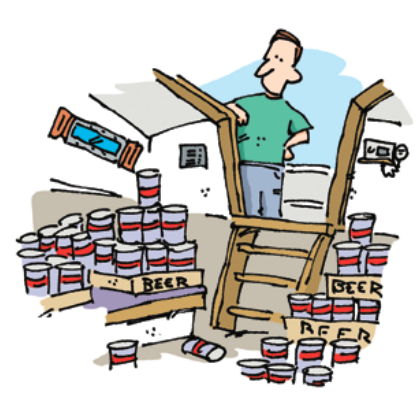
In those pre-Gatorade days, sailboats ran on beer, and the crew would bring some along for every race. No one ever drank anywhere near what they had estimated we might need; just in case, what was left over was then left on board. One day, after a race in which the Owl had seemed particularly logy compared to the other Ranger 26s that lived in the slips on either side of her, I noticed that she was sitting lower in the water than they were. If memory serves, we had accumulated 11 cases of beer in the bilges and under the bunks. Their removal significantly helped her performance.
Club-to-club deliveries
We raced in the Eastern Long Island Yacht Racing Association. Each weekend, one or the other of the clubs along the Connecticut and Rhode Island coast that belonged to the association would sponsor a day race and some of them would also sponsor a longer overnight race.
At the end of the season, performance in all of these races would be tallied by a complicated point system and prizes were awarded by classes based on size. We usually did fairly well because we sailed a lot of races.
After a race, or during the following week, a couple of guys would move the boat to the next club, usually accompanied by one or more of our kids, who were all preteens then. The wives would drive up together for the cocktail party after the next race and we’d all go out to dinner together. The cocktail parties were always splendid, both for the comradery and for the hors d’oeuvres. To this day I cannot eat a deviled egg without thinking of the Ram Island Yacht Club.
The wives and some of the crew would then go home to the New Haven area, leaving the guys and the kids who were going to sail the next delivery leg. The only problem was how to get a car to the next stop so the delivery crew could get home. The carpool arrangements could become wildly complicated at times. The standard joke was that everything was set for the next delivery, race, and cocktail party except that we’d have to sell a car in Branford and buy one in Noank. It was a grand way to live and a wonderful way to raise children, who, as they grew older, graduated from delivery to racing crews. All the kids turned out pretty well.
Falkner Island Race of 1973
The Falkner Island Race was sponsored annually by the Windjammer’s Sailing Club and the Milford Yacht Club. In 1973, the start of the first class was scheduled for 1700 on Saturday, June 16. Sunset would be at 2026 and the moon would rise at 2113. Sunrise on the 17th would be at 0515, but that hardly concerned us because the predicted weather conditions would make this one of the quickest Falkner Island races in history. The forecast was for haze and light west-to-southwest winds, changing to easterly at 10 to 20 knots with occasional showers sometime during the evening. I got this forecast on Saturday morning from the meteorologist at the Sikorsky Airport in Stratford. He said a cold front was expected, but not until sometime late on Sunday.
The rhumb-line distance was only 50 miles, so we’d be finished long before the front arrived. We always hoped for conditions in this race that would make it possible to finish and get a drink in the yacht club bar before it closed at 2 a.m. This year we might make it. We were supposed to have a light-air beat into a smoky sou’wester to the first turning mark, Middle Ground Light. This was called Stratford Shoals Light on charts but was always Middle Ground to us. Once we had rounded it, we’d have a spinnaker run followed by a close reach or beat to Falkner as the wind backed into the east. That is, if the weather behaved as the forecaster had said it would. Then, if everything went as predicted, this would be followed with a rollicking spinnaker run home. In those conditions, we were sure to cover a mere 50 miles in less than the nine hours between the first gun and the closing of the yacht club bar. No problem.
A strong crew
The crew for this race was, as Adlard Coles would say, a strong one. Paul Scholder, the owner and master, was a lawyer, as was Jack McGrail, one of the deck apes. The other two apes were Tim Foley, a saloon keeper, and Bill Kelly, a welder who worked at the same company where I was an engineer. I was the navigator, which is why I still have the logbook. We were all fairly experienced sailors, having grown up on the sound and raced in our youth.
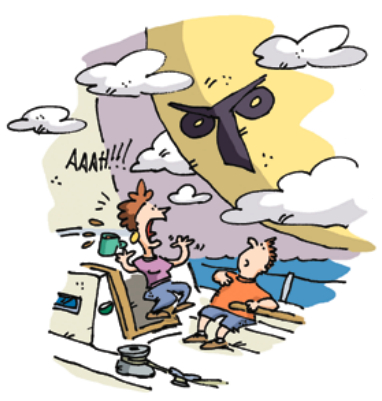
The start was off Milford with the usual 50 or 60 boats going off in classes based on size and rating under the old Off Soundings Rule. We started at 1705 under the 150 percent jib and full main, Owl’s maximum upwind rig. The wind was light and from the southwest as predicted, and we were making a bit better than 5 knots through the water. The last two hours of the ebb was against us, so at 1723 we tacked when clear of Charles Island to stay inshore out of the worst of it. We tacked a couple of times more and by 2000 were around Middle Ground Light. The southwester had not only held but picked up enough so that on a broad reach Owl’s spinnaker dragged her along at close to 6 knots. This kite was rather spectacular; bright yellow with a black owl’s face on it. Yacht club bar, here we come.
As always happens on a beat against a foul tide, the boats had spread out on the way to Middle Ground as the various skippers made different tactical decisions on how best to play the wind and the tidal current. Downwind, the boats tend to come back together because there is generally only one way to go. After the kite was up and Paul had brought us up-to-date on all the latest courthouse jokes, we settled down for a long, easy 21-mile broad reach to Falkner, the next turning mark.
Weird visibility
The haze did not lift. If anything, it became thicker down on the surface and, with the moonlight penetrating and being reflected by it, visibility became weird. We became aware of this when we came silently up behind a Pearson 26 and heard a woman scream. It seemed that the owner’s wife, coming up from below, had seen that huge owl’s face hovering in the haze right behind them and been frightened half out of her wits. In the confusion this caused aboard the Pearson, we got by them without the expected luffing contest as everyone on both boats, including the woman we’d frightened, laughed about it.
As we came up on Falkner Island, it looked as if the southwester was going to hold. Instead of the expected spinnaker run, it would be a close fetch on the port tack along the Connecticut coast for the 20 miles back to Milford. At worst, we would need to make one or two short starboard-tack hitches to move away from the shore. We could see no one in our class in front of us; we knew just about all of them were behind us. It looked like we were winning at least our class and perhaps the whole race on corrected time.
After a short mutual pep talk about just this once let’s jibe and get the hell machine aboard without any catastrophes, we prepared to round the island. Jack, who had been napping below, came up barefoot and in his underwear to join Paul on the foredeck. Kelly was at the mast to handle the halyards, Tim was steering, and I was below writing up the log. They hoisted the Number One and were about to jibe as Kelly started the spinnaker halyard. They had decided to gather and repack the kite on the foredeck and had just pulled the foot aboard when the weather changed dramatically.
Now what?
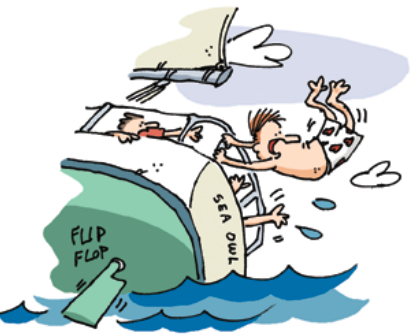
One second I was standing on the cabin sole writing up the log. The next I was standing on the face of the galley furniture wondering what the hell the deck apes had done now. That cold front that hadn’t been expected until the next afternoon had come blasting through, clearing the air, dropping the temperature 20 degrees, and replacing that light southwester with a roaring northerly blowing at 25-plus knots. This filled that big jib that was already sheeted. When Kelly let the spinnaker halyard run, it fouled, so the sail Jack had been gathering in his arms also filled. All that sail and all that wind laid the Owl on her side and effortlessly tossed Jack overboard. He grabbed the aft stanchion as it flashed by. If he hadn’t, we would probably never have seen him again. With both the kite and the jib pulling like locomotives, the boat was going as fast sideways as she had ever gone frontward in her whole life. Tim and I wrestled Jack aboard. It was easy because waves were breaking over the cockpit coaming. Then Tim asked me, “Which way should I go if the rudder ever goes back in the water?”
We freed the sheets so the boat came back on her feet, then ran off with the kite streaming out in front like a huge yellow quarantine flag. Eventually we got the spinnaker and the Number One down and stowed the pole after running off a couple of miles in exactly the wrong direction. We were the only boat caught by the weather change with both headsails up in mid-jibe, so none of the others had quite the number of disasters piled one on the other that we had had. As we turned to chase the rest of the fleet, we reefed the main and got the heavy Number Three jib up to discover that the spinnaker pole had been stowed by hooking it to a stanchion on top of the leeward jibsheet. This was discovered just as the quarter-inch bolts with small washers that held the stanchion were being winched up through the deck.
It could have been worse. A whole lot worse. Somewhere there is a Ranger 26 with an aft lifeline stanchion that carries five deep dents from the thumb and fingers of Jack McGrail’s right hand. The next day, the stanchion we had winched out of the deck, along with all the others, was refastened with large washers and backing boards of half-inch mahogany plywood. We had all acquired a lifelong paranoia about lifeline stanchions.
Regaining lost ground
The wind stayed strong and, like all nor’westers blowing off the Connecticut shore, it was gusty and shifted back and forth as much as 30 degrees. We were now bombing along on a sparkling clear, cold, moonlit night chasing the rest of the fleet. Careful teamwork by the helmsman, the guy playing the mainsheet traveler, and the jibsheet trimmer allowed us to pass a few boats. The tail-end Charlies are always the easiest to catch, but we carefully ignored this fact as we worked our way back into an almost respectable position toward the middle of the fleet.
But Sea Owl’s travails were not yet over. About a mile or so from the finish line, the knotmeter registered zero. Someone said we must have picked up some eel grass in the impeller again. The boat was trimmed perfectly and the sails were drawing nicely. Then someone else looked over the side and said, “Eel grass, hell. We aren’t moving.” Paul decided to settle the argument. He went below to do the quick shift between the knotmeter impeller and the plug that sealed the hole. When he pulled the impeller, ready to stop the gusher with the plug he held in his other hand, nothing happened. No eel grass, but no water either from a 2-inch hole through the bottom of the boat.
Snared in plastic
He stuck his fingers into the hole and pulled up a piece of sheet plastic. He kept pulling, and it kept coming until the cabin was half filled by about 50 square feet of a 1-mil dropcloth. Meanwhile, the rest of the crew was trying to hook it with the boathook and untangle it from the fin and rudder.
We finished far back in the fleet at 0454:13, exactly 2 hours, 54 minutes, and 13 seconds after the yacht club bar had closed. Time does fly when you’re having fun. And it was fun sailing on a good boat with a group of guys who took racing seriously but never too seriously. In all the races I sailed in Sea Owl, I cannot recall a single harsh word being uttered no matter what disasters we and the fates, working together, brought down upon us.
Jule Miller grew up in Milford, Connecticut, was educated and worked as an engineer, and sailed for many years on Long Island Sound. In 1991, he moved to Nevis where he lives with his wife, Heide, writes, and sails on the Caribbean Sea. He is the author of a number of books, both fiction and non-fiction, including the Good Old Boat audiobook, A Voyage Toward Vengeance. His most recent is Slippery Places: How the Delusions of Modern Management Destroyed an American Manufacturing Firm.
Thank you to Sailrite Enterprises, Inc., for providing free access to back issues of Good Old Boat through intellectual property rights. Sailrite.com