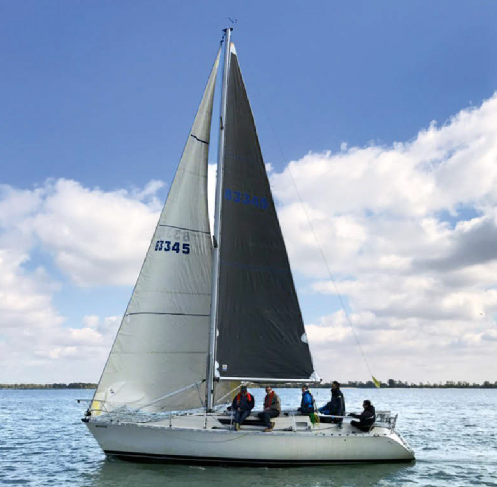
A true racer/cruiser from the world’s largest boatbuilder
Issue 128: Sept/Oct 2019
Beneteau is arguably one of the oldest and most successful boatbuilders in the world. The French company traces its roots back to 1884 when its founder, Benjamin Beneteau, a shipwright, started building wooden fishing vessels. Fast forward to the 1960s and the decline in commercial fishing when the company found itself in tough times and began building small recreational fishing boats and cruisers out of a new material — fiberglass. By the mid-1960s, at the insistence of Annette Roux, Benjamin’s granddaughter, Beneteau dove headlong into designing and building recreational sailboats.
The company gained market share in the sailing industry, both in France and other parts of Europe. Leveraging a strong U.S. dollar and an even stronger U.S. market, Beneteau began importing boats to the U.S. through a dealership network and, in 1986, established a factory in Marion, South Carolina. As of mid-2017, this U.S. production facility had built more than 8,700 boats.
The Beneteau First 345 was designed by Jean Baret of Beret-Recoupeau, a French design firm specializing in performance sailboats. Production of the First 345 started in 1985 and ceased in 1988 with about 500 hulls, the majority built in France and an estimated 80 hulls built in the U.S.
Design
Since the dawn of leisure sailing and recreational sailboat racing, some designers have striven to create the perfect performance cruiser, a boat that is a joy to sail around the buoys and possesses the creature comforts for extended days aboard.
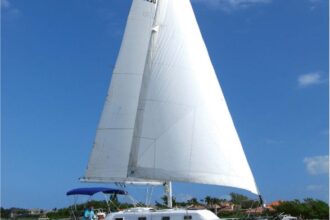
The Beneteau First 345 effectively blends these two traits in a production boat of decent quality from a well-known manufacturer. In our local fleet in Windsor, Ontario, there are two Beneteau 345s. One has been used principally for club racing and some longer-distance racing and the occasional week or two of regional cruising. The other First 345 has carried its owner from Lake St Clair, Ontario, and down the Intracoastal Waterway, where he cruised the boat extensively for a year around the Caribbean. Ask either of these two owners about their boat and they both rave about its attributes as a great racer and a great cruiser.
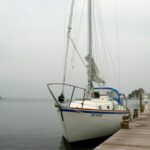
The 345 has a European look, with crisp lines that Beneteau is known for. A high freeboard and large cabin trunk (with generous windows and hatches) give the First 345 the look of a cruiser, but upon closer examination, the boat’s powerful double-spreader masthead rig, deep fin keel, spade rudder, firm bilges, and flat bottom leave no doubt that the boat was designed with performance as a priority.
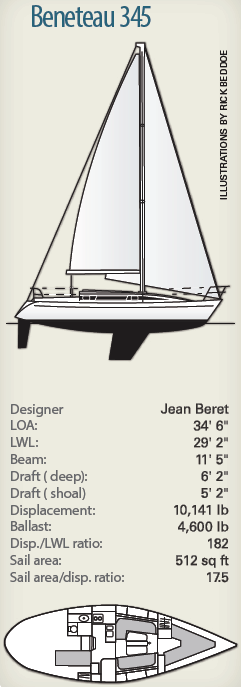
The First 345 has a fine and flat entry leading to a long 29-foot 2-inch waterline. The maximum beam is just shy of 11 feet 5 inches, with the beam carried well aft.
The iron external keel was available with either standard 6-foot 2-inch draft or a shoal draft of 5 feet 2 inches. Our test boat, Bliss, is equipped with the standard-draft keel.
Total listed displacement of 11,244 pounds (including ballast of about 4,600 pounds) gives the 345 a displacement/LOA ratio of 182 and a ballast/displacement ratio of 45. Coupled with a sail area/displacement ratio of 17.5, this is a fairly speedy boat, until compared to a J/34 which has a PHRF rating of 117 — or the J/35 at 72. Fleet PHRF ratings for the Beneteau range from 120 to 135 seconds per mile.
Construction
The 345 features a hand-laid solid-fiberglass hull with a balsa-cored deck. Some owners report that plywood was used for core in high-stress areas, such as under winches.
The hull-to-deck joint is an inward-facing flange bonded with 3M 5200 adhesive and mechanically fastened with rivets through an aluminum toerail that runs the entire length of the hull and is slotted to accommodate snatch blocks and save weight.
The First 345 is powered by a raw-water-cooled Volvo 22-hp diesel. Our test boat, Bliss, is driven by a Martel folding prop for reduced drag.
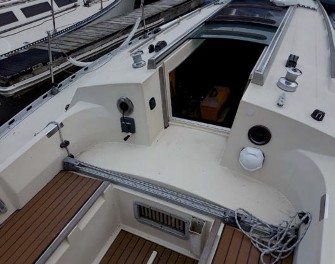
Large self-tailing winches adorn the sides of the cockpit coaming on molded-in bases. Cabintop winches provide effective leverage for the halyards and other control lines, all of which lead back to the cockpit.
The Isomat mast is keel-stepped with double spreaders and is configured as a masthead sloop supporting a large 431-square-foot genoa and a 258-square-foot mainsail. The matching Isomat boom is relatively short, leaving the aft end of the cockpit clear to accommodate a small bimini for sun protection or davits for carrying a dinghy.
The First 345 is rated for offshore work by the French international certification agency Bureau Veritas (the French equivalent to Lloyds of London).
On deck
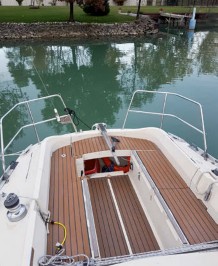
Another indication of the dual-purpose nature Beneteau intended for this boat are the two configurations they offered: a racing package and a cruising package. Bliss is equipped with the racing package, which means she features a tiller, a taller rig, and a traveler-and-mainsheet system situated on the bridge deck in front of the companionway. The cruising package boats feature wheel steering and a mainsheet system on the cabintop, allowing for a clear cockpit and unobstructed companionway access.
Bliss’ cockpit is commodious and comfortable, with seats long enough to stretch out for a nap. Underway, the cockpit easily accommodates both a skipper and a racing crew of two or three to handle the sails without running into one another’s elbows. The cockpit sole is accented in a faux-teak veneer, and a deep cockpit locker provides an adequate catchall for fenders and cleaning gear. The coamings make for adequate backrests.
A bridge deck leads to a small recessed companionway with a large glass sliding hatch that runs forward nearly to the mast step, providing both headroom and ample light below.
The sidedecks are wide and uncluttered; access to the bow is hampered only slightly by the shrouds and chainplates located well inboard to accommodate better sheeting angles for improved pointing.
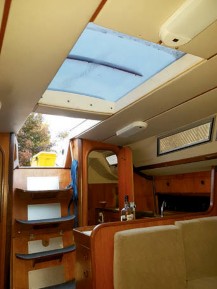
Twin hatches provide ventilation for the main cabin, while a larger centered forward hatch provides light and ventilation in the forward cabin.
At the bow there is an anchor locker and a set of small anchor rollers integrated into the stem fitting, where a Harken furler handles the large genoa.
Accommodations
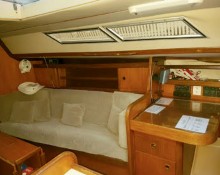
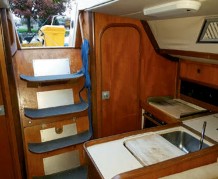
The overall feeling of the cabin is bright and airy, owing to the substantial light coming from both the portlights and the large companionway slide, which can best be described as a giant skylight. All this glass and light makes for a pleasant open interior that effectively eliminates that underwater feeling of some sailboat cabins.
The cabin is clad in light wood veneer, which is nicely offset with a teak-and-holly sole. Overall, the finish grade of the cabin is excellent and attractive.
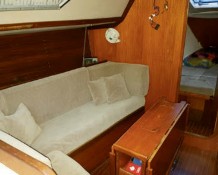
The interior was available in two configurations, one with a matching pair of quarter cabins aft under the cockpit and coamings and a walk-through head on the way to the forward cabin, or in the case of Bliss, a single aft cabin with a larger owner’s forward cabin with the head situated to the rear adjacent the aft cabin.
Coming down the companionway into the main cabin, Bliss features an L-shaped galley with double sinks near the boat’s centerline and a large icebox with an integrated cold plate (that kept our beers cold for post-race celebrations). There’s an LPG gimballed stove/ oven combination with storage for plates and associated sundries above the stove and the counter.
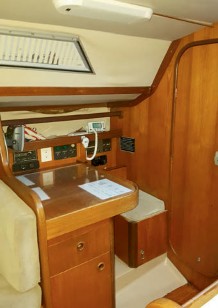
The rounded door to the aft cabin is directly aft of the nav station and inside is a large berth that is mostly under the cockpit; headroom is limited.
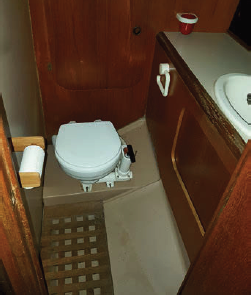
Adjacent the aft cabin is the head with access via an identical door situated aft of the galley, and while the head is a respectable size for a 35-foot boat, it lacks headroom, much like the aft cabin.
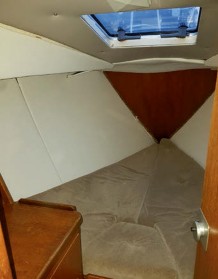
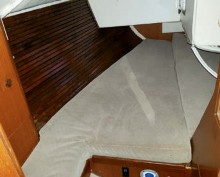
Rounding out the interior is the master cabin forward, where a large hatch for ventilation and star gazing dominates. At 5-feet 11-inches, I was able to fit on all bunks; taller sailors might wish the designers worried less about large built-in cabinets and used those precious inches for slightly longer bunks.
Underway
On a brisk fall day with variable winds, our test sail was a club regatta at the LaSalle Mariners Yacht Club located on the Detroit River. Racing is a great way to get a feel for a boat as most races run the boat through basically all points of sail. Bliss did well both upwind and downwind. In gusts on our downwind leg, she made a little over 7 knots. The spinnaker was impressively large and kept Bliss moving well and her crew on its toes.
The helm felt well balanced and the boat tacked quickly, no doubt owing to its modern underbody combined with good crew work. The boat felt substantial yet nimble and responsive, and was manageable when reacting to gusts. The freeboard and wide beam makes for a reasonably dry ride in all but the worst conditions.
Sitting on the coaming with one’s back to the lifelines affords a better view of the course while putting crew weight on the high side where it belongs. The wide tops of the coamings and wide sidedecks in relation to the lifelines make it a fantastic boat for racing as well as cruising.
The Volvo diesel pushed the boat well and is surprisingly quiet. However, on Bliss the ignition switch used to start the diesel is below, at the nav station, which is fine when sailing with crew, but could present a challenge for a singlehander.
Known issues
While the First 345 is generally regarded as a decent-quality production boat, every example is over 30 years old and should be evaluated carefully before purchase. In particular, the decks of the First 345 are balsa-cored, and a surveyor should be retained to check for soft spots and delamination.
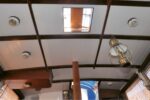
On virtually all First 345s, the adhesive holding the vinyl headliner fails and the liner falls down. While this is strictly a cosmetic issue, there are pages of online forums dedicated to creative solutions to address this problem.
Likewise, the 345’s iron keel seems to require ongoing maintenance, which is why lead is preferred. An inspection of the bilge should hopefully reveal bright and shiny stainless steel keel bolts; keep a close eye on them.
Many production boats in the mid-1980s had issues with hull blisters and Beneteau models of this era are no exception. Checking the hull for blisters is a good idea and applying a barrier coat before they appear is good insurance.
Pricing and availability
Because the vast majority of the First 345s were built in France, it’s not surprising there are far more for sale in Europe. Prices range from $28,000 to $52,000. We found eight for sale, seven in Europe and just one in the U.S., on the East Coast.
Can one boat be all things? While every boat is a compromise, the Beneteau First 345 seems to be an excellent choice for the sailor looking for a respectable club racer that also can be cruised in relative comfort.
Robb Lovell grew up sailing on Lake Huron aboard his family’s Endeavor 40, where he caught the sailing bug. That was about 20 boats ago. Robb enjoys buying and restoring boats, and is an avid racer and cruiser based out of Lasalle Mariner’s Yacht Club (LMYC) in Ontario. He currently races on a Cal 9.2 named Jade, but owns three other sailboats and a tugboat!
Thank you to Sailrite Enterprises, Inc., for providing free access to back issues of Good Old Boat through intellectual property rights. Sailrite.com