Five ideas that flunked; five that made the grade
Issue 92 : Sept/Oct 2013
In the years since we launched her, our home-finished 31-foot Cape George cutter has been subjected to perhaps the most rigorous form of testing: being cruised and lived aboard by a family of five. That three of those five are very young children has probably placed more strain on everything than if they were adults — at least, it has placed more strain on those of us who are.
Building the boat with limited funds had required some inventiveness and we put to sea not knowing whether some of our improvised systems would work or not. Some proved patently useless and didn’t survive the shakedown. Others did pretty well initially but lacked durability or required too much maintenance. A golden few, however, with maybe some judicious adjustment, have proved their usefulness again and again on Ganymede’s cruise from California to the East Coast. All of them taught us lessons that we can apply to great ideas we might have in the future.
The losers
Five ideas seemed good at first, but were tossed outright or are on the replacement list.
Homemade self-steering windvane
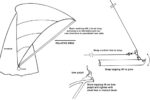
Even though I sweated through Bill Belcher’s and John Letcher’s books on windvane construction, the engineering details were too fine for me. The trim tab I made not only proved too powerful — a finger touch on the trim tab’s mini-tiller could put the rudder hard over — it created too much drag, making hand-steering an awful chore. And although the lower support strut was a stiff piece of solid 3⁄4- x 3-inch aluminum bar, it vibrated most disturbingly when we put the helm over.
Since I built it mostly with material left over from other projects, it wasn’t a huge waste of money, but its demise condemned us to hand-steering nearly every mile of our cruise. We have on the wish list a servo-pendulum style wind- vane with a blade that can be pulled out of the water when not in use so it doesn’t grow weeds and cause drag.
Self-adhesive LED button lights
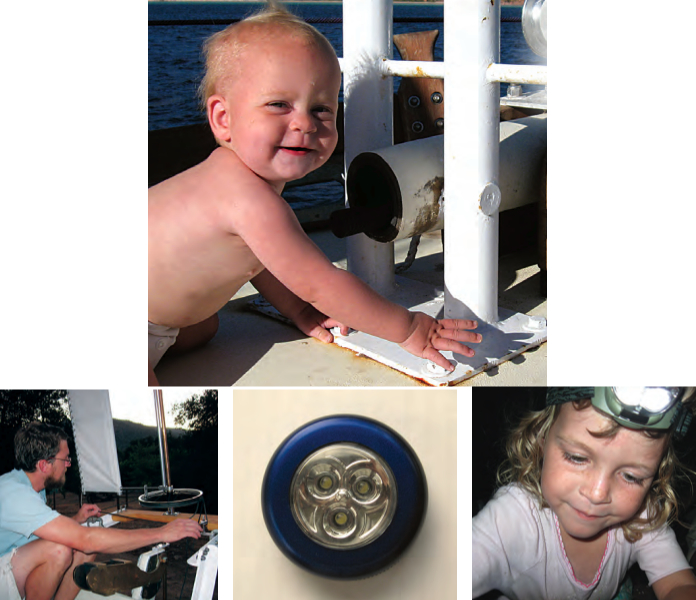
These inexpensive little lights work great for a while and don’t use much power — a set of three AAA batteries can last over a week of nightly use. The trouble is, they suffered the curse of most low-voltage LEDs: they’re not made to last. Often, a switch would go bad and need to be whacked pretty hard to make it work; usually, one of the bulbs in the array would become corrupt, making things pretty dim, and the least little bit of corrosion on the battery contacts is enough to interrupt the feeble flow of current.
They were wonderful for the first couple of months, but became altogether unreliable as time went by and we’ve now replaced them entirely with our favorite LED headlamps, made by Energizer and sold for $12 at Walmart. Their only drawback is that the elastic head strap wears out long before the lamp part does.
Mild-steel fittings
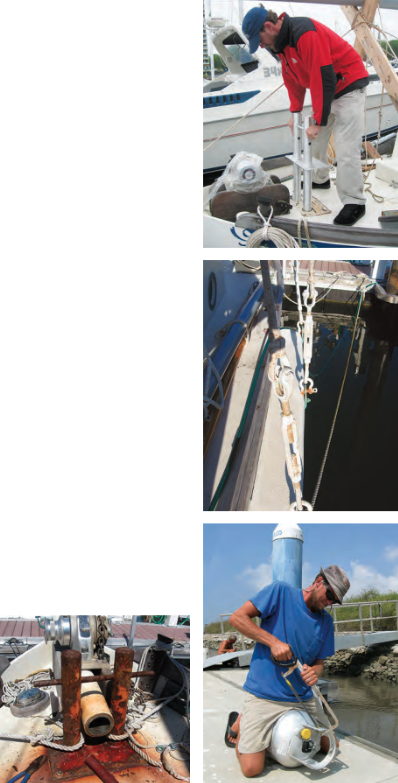
Unable to afford having things fabricated from stainless steel or aluminum by a welder, I torch-welded my own mooring bitt and boom-gallows stanchions using mild steel. Properly primed and painted, they lasted a good while, but after two years of heavy use in the tropics, Ganymede had rust streaks all along the decks and down the hull below the scuppers.
I had expected to be able to paint the fittings from time to time, but keeping three children fed and clean and entertained didn’t leave much time for other things. In fact, I painted the stanchions only once during our cruise. Unshipping them and replacing them with stainless-steel and aluminum fittings was part of this winter’s project.
Along the same lines were the galvanized turnbuckles and shackles for the rigging. Though I went to some lengths to secure only domestic galvanized hardware for the shrouds (the foreign-made stuff I saw was poorly made and indifferently galvanized) and though coated liberally with LanoCote, by the time we arrived at the Chesapeake Bay for a refit some were all but immovable.
At least one shackle — mounted near the water on a bronze chainplate — had to be hacksawed off. All the steel parts worked very well at first, but their propensity to rust, especially in tropical heat and humidity, makes them too maintenance-intensive for my taste.
Homemade propane locker
Perhaps the most frustrating failure was the most expensive. Wanting to maximize our propane supply for long-distance cruising, I built a fuel/propane locker tailored around two 20-pound Worthington horizontal aluminum LPG cylinders. They cost upward of $300 each and it would have been money well spent if they had worked consistently.
But horizontally oriented tanks have a separate, bigger fill port (a “forklift fill”) requiring a different fill adapter than regular vertical tanks. The “out” valve, to which a standard LPG fitting connects, is fitted with a check-valve so the tank cannot be filled through there. All that might have been fine, provided I could have been on hand to explain to the filling attendant which valve would allow gas in and to take it slowly lest the finicky Overfill Protection Device (OPD) put an untimely end to the process. But propane runs in other countries are often arranged by marinas where tanks are dropped off empty and returned full. Time and again, my tanks came back mostly empty with the marina staff swearing that the tank had acted as if it were full. Sometimes, no gas went in at all, but I was charged for the run nonetheless.
Eventually, I had a Mexican propane company remove the offending fill valve from one tank and install a sensible, working valve . . . with the result that on our return to U.S. waters all propane fillers refused to touch it. But the other tank, with the original fill valve and hair-trigger OPD, often takes only about a quarter load, so it’s impossible to have all 40 pounds of our propane potential. Another refit project is to secure three 10-pound tanks with the standard fills that everybody can deal with.
Bulk-sized spices
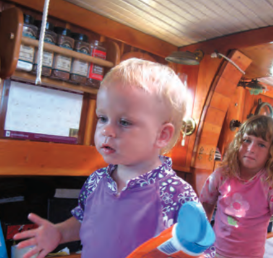
It seems a little thing, but this actually led to a good deal of waste and frustration since cooking aboard is a daily event. It didn’t help that I’d built lovely, spice racks just the right size for the large spice containers, all shaped alike, from a discount outlet. The trouble was, a lifetime supply of dill should not be carried to sea in one canister. Not only can the damp get in and make it clump up and grow mold, but it loses flavor over time in an opened container. Likewise with most of the green herbs. Anything with sugar or salt (think seasoning salt, Old Bay, bouillon powder, or drink mixes) becomes a hopeless lump in very short order. I had laughed, at the outset of our cruise, at the single-use packets of drink mix, bouillon, and spices we found in every tiny store from Baja to Panama, but I was laughing less when I had to throw out several cupfuls of all our favorite flavorings that had grown moldy or clumpy in the rainy season.
We still have our spice containers, but they are now filled with those tiny single-use sealed packets that could be stored more tidily in a kitchen drawer . . . except that I have to use those spice racks for something.
The winners
So much for what didn’t work. We also have a happier list of things we were initially unsure of that have proved useful beyond all expectations.
Reusing plastic juice bottles
Though they’re not the majority, we’ve met plenty of cruisers whose tank water is so bad it is useful only for washing and cooking. Unless it is filled exclusively by a watermaker, it’s only a matter of time before some slightly funky water supply will contaminate the whole tank.
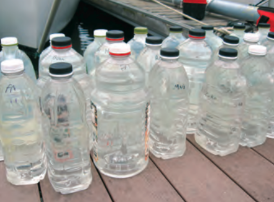
Ganymede doesn’t have enough room to carry washing-only water, so we chose not to install tanks or water lines at all and instead carry 120 gallons in carefully saved 2-, 3-, and 4-quart juice jugs. The water in them can be visually inspected for floaters or bad color before use and, better yet, getting a bad batch in some containers doesn’t contaminate the entire water supply. Once every six months or so my wife, Danielle, will scrub them all out thoroughly with a bottle brush.
Another advantage is that they can be filled a dinghy-load at a time without the expense of tying Ganymede to a pier. Labeling each bottle with a Sharpie (usually the last fill location) aids in rotating the supply and helps to identify water from questionable sources.
Gimbaled oil lamps
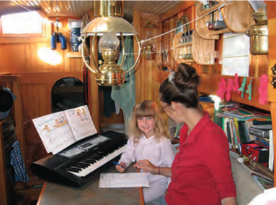
Ganymede isn’t fitted with 12-volt electric. All her appliances — GPS, shortwave receiver, and handheld VHF — run on AA batteries. But cabin lighting requires something more than small batteries can provide. We had saved three gimbaled oil lamps from our last boat and, with two more bought to match, Ganymede’s cabin is filled with the coziest of glows. We started out with yet another lamp — a ceiling-hung trawler lamp that really put out some light, but it was too big for the cabin and we sold it at the first swap meet.
During winter, when we use the lamps most, they consume about a gallon of kerosene a month. Best of all, they serve a dual purpose. Not only do they provide a homey nautical look to the cabin, the heat they give off keeps things nice and dry inside.
On the downside, the wicks and chimneys the maker sells (Den Haan, distributed in the U.S. by Weems & Plath), are frightfully expensive. With care, however, the chimneys only break occasionally and cheaper wicks can be found at most hardware stores.
Fiberglass spars
I made our boom and bowsprit by wrapping multiple layers of fiberglass in polyester resin around a length of 3-inch ABS pipe. The layup is 1⁄2-inch all around.
While it flexes a little, the 17-foot boom has proved strong enough to carry 300 square feet of loose-footed mainsail and to be steady enough to walk on while under way if something at the boom end requires attention while sailing downwind. The bowsprit has the advantage of being lighter than wood and 100 percent maintenance-free.
Attaching hardware is a breeze, since the fiberglass is thick enough to tap threads into or pass through-bolts through without worrying about water intrusion and rot.
Outboard engine
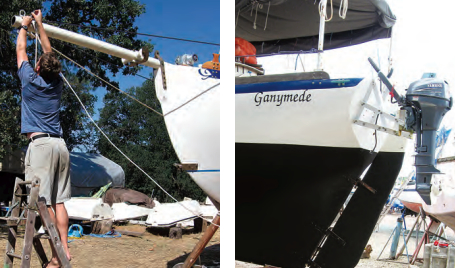
I had never intended to fit Ganymede with an inboard diesel engine — it was too much expense and bother. Besides, I needed the space for a children’s cabin. Instead, I made a very sturdy transom bracket out of structural aluminum angle and hung a Yamaha 8-horsepower, four-stroke, high-thrust, long-shaft outboard engine on it. The gasoline it burns is easier to come by than diesel in some of the nooks and crannies of the world where we’ve poked Ganymede’s bowsprit and the engine can be easily unshipped and taken ashore for service.
I had worried that such a small engine would be suitable only for getting in and out of harbors (and very slowly at that), but it can push the boat along at 5 knots in quiet water and was sufficient to effect a Panama Canal transit. In choppy seas, the prop tends to come out of the water somewhat, making an awful noise, but getting way on and maybe altering course a little can mitigate that.
Being a four-stroke, it’s susceptible to dirty or ethanol-laced gas and parts are impossible to find in Central America. But it has proved to be very reliable nonetheless, and once I got the hang of taking the carburetor apart I could clean and reassemble it in less than 20 minutes. When we sail in foreign waters again, I’ll lay in several full sets of seals and gaskets, half-a-dozen spare spark plugs, and rig a water-separating fuel filter.
Another advantage of the motor is that it tilts out of the water when not in use, eliminating electrolysis and drag. Without a prop to tow through the water, and with the cutout where an inboard’s prop would normally be glassed in solid during construction, Ganymede performs astonishingly better in light air than we’d dared to hope.
Gaff rig
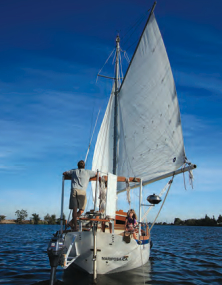
While on the topic of sailing performance, the biggest gamble we took on construction is the one we’re most happy with: a gaff-headed sailing rig. Since the full-keel heavy-displacement hull and the gaff rig were being perfected at the same time in history and kind of grew up together, it seemed a shame to put a more modern rig on a hull whose lines so closely match the quay punts and pilot cutters of the glory days of gaffers. Another weighty consideration was that I could more easily design and build that kind of rig at home than a Bermudan rig that would have cost more than double what I ultimately spent.
But financial considerations aside, the gaff rig has many advantages over its more modern counterparts. The shorter mast means less windage and weight aloft. The lower-aspect-ratio sail area means less heel, so Ganymede can carry sail into higher winds before needing to reef. There are no halyard winches to deal with and even the jib- and staysail-sheet winches are used without a handle (which I suspect is at the bottom of the Pacific somewhere — I haven’t seen it in at least a year). Best of all, by using aluminum for gaff and mast and synthetic rope (Vectran) for shrouds, I all but eliminated three of the biggest drawbacks of gaffers: weight, spar maintenance, and chafe.
Ganymede isn’t perfect — as long as we have her, there will be an endless list of upgrades and changes to make — but the important thing is to keep on testing, improving, and replacing as funds and time allow, knowing that every refinement will increase her worth and make her that much more pleasant to cruise. And as I look at my endless “to do” list, I can take comfort in the knowledge that before me is a project that will last a lifetime.
Ben Zartman lives with his wife, Danielle, and their three young daughters aboard Ganymede,the 30-foot Cape George Cutter he built from a bare hull. They spent last winter in Newport, Rhode Island, preparing Ganymede for an Atlantic crossing that was imminent as this issue went to press. Follow them on their blog at www.zartmancruising.com.
Thank you to Sailrite Enterprises, Inc., for providing free access to back issues of Good Old Boat through intellectual property rights. Sailrite.com