An interview with the first U.S. woman to sail solo around the world
Issue 34: Jan/Feb 2004
WHEN KAREN THORNDIKE SAILED into Hobart, Tasmania, in the late 1990s she was greeted as a hero. She’d just completed the longest leg — 96 days — of her world circumnavigation.
Suddenly, well-wishers showed up, clinging to her like barnacles to an unpainted bottom. Relishing the warm reception extended by locals, yachties, politicians, and reporters, Karen felt the deep satisfaction that, at last, people were taking her seriously . . . that her goal of entering the Guinness Book of Records wasn’t a menopausal delusion.
Karen wasn’t a sailing wife or a 20-something looking for adventure, but rather a mid-50s woman aiming to become the first American female to sail solo around the five capes. A woman who’d not set foot on a sailboat before age 39. A woman many had dismissed as a dreamer.
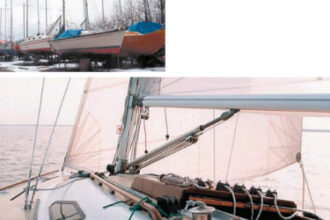
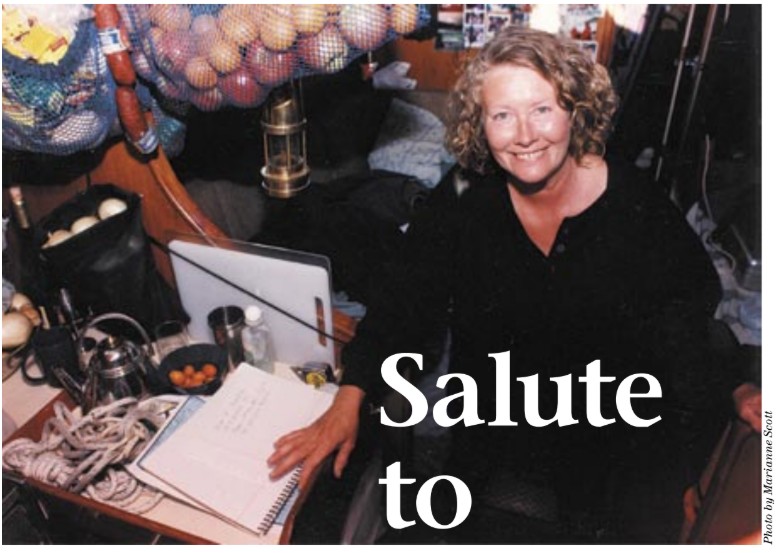
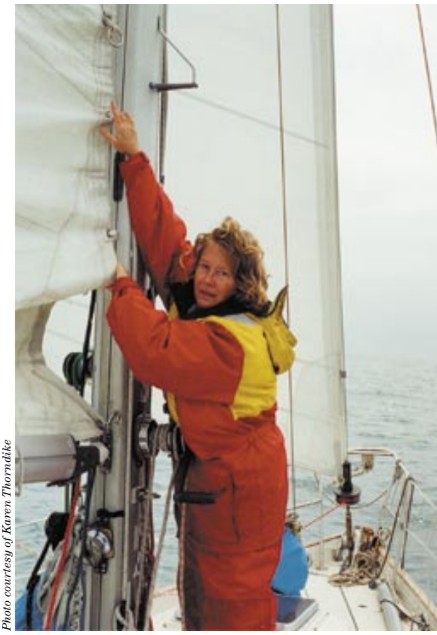
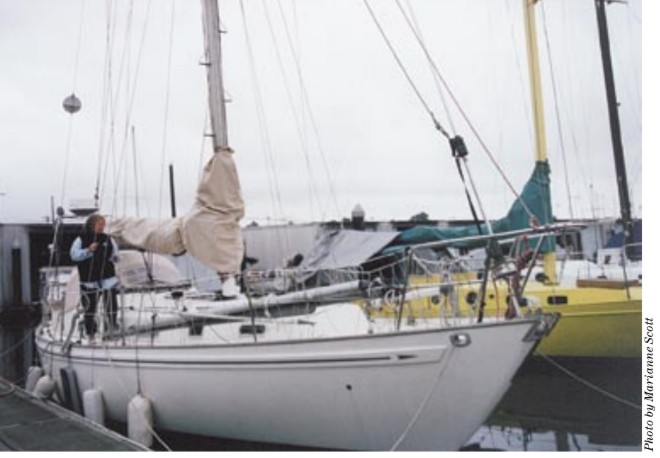
When I met Karen on Amelia, the faithful steed that carried her around the globe, her framed Guinness certificate was screwed to a bulkhead. The 36-foot Rival, a fiberglass yacht built in Great Britain, was loaded with gear, and her re-stitched backup sails were stacked on a settee. Karen is short, with cheerful blue eyes and blond ringlets. Her stature makes you wonder how she continuously hoisted and lowered the sails, reefed them, climbed the mast, made repairs, checked and rechecked the rigging and gear.
While performing these tasks, she also cooked, ate, slept, kept watch, washed, dried rain- and sea-soaked clothing, ensured the batteries were charged, wrote email messages, and eternally watched the barometer to divine the weather ahead. Her months of days and nights were punctuated by squalls, gales, and storms. Reading her logs gives clear answers to a common question: just what do bluewater sailors do while crossing oceans?
Nine-month estimate
When Karen left San Diego on August 4, 1996, she estimated her 33,000-mile journey would take about 9 months. When she triumphantly re-moored Amelia at the San Diego Yacht Club, 2 years and 2 weeks had passed. Why did the circumnavigation take almost three times as long as expected? Karen’s passages show that, as in the old sailing ships of yore, once we set sail and leave the confines of our scheduled, controlled, and time-restricted lives, the sea, wind, and waves take charge and impose the timeline.
The first part of her voyage — San Diego to Hilo, Hawaii — took 23 days. Before leaving, Karen had created a website and, through her laptop and Inmarsat C System, sent and received messages each day, weather permitting. Friends and schoolchildren from around the world monitored her electronic logs, asked questions, and sent encouragement. The electromagnetic waves often comforted Karen when she confronted mammoth waves and helped her cope with the loneliness of solo sailing. The log also reveals Karen’s self-deprecating humor and occasional wry turn of phrase. Instead of telling readers, “it’s gray and drizzly,” she writes, “there’s no danger of getting sunburned.” She dubs the flying fish expiring on her deck “high-seas road kill.” She explains that GPS does not stand for “gray plastic sextant.”
But the log also demonstrates that offshore sailing can be most unglamorous. During the first leg, her engine transmission acted up, requiring serious repairs in Hilo. She had a “strange encounter” with a freighter (she calls them BOSS, for Big Oncoming Steel Ship), which altered course to parallel hers and then stopped to watch her sail away, without responding to her radio calls. The Aries windvane continually disconnected. Conflicting winds “battled over the same piece of ocean, creating crummy nights.”
Four weeks to Tahiti
After transmission repairs were made and Karen received a Hawaiian blessing bestowing “way good luck,” she spent four weeks sailing to Papeete in Tahiti. She had problems with lumpy seas, nasty swells, a failing water pump, and a seized exhaust valve. She discovered what it meant to be in the doldrums. She marveled at the flinty sharpness of tiny salt grains, “I swear the stuff could scratch diamonds.” Crossing the equator earned her the designation “shellback.” Then, delighted, she found “French bread, French wine, and French perfume” at the Papeete quay.
Rounding Cape Horn was next and Karen vowed to revive the ancient maritime custom of installing a single earring to commemorate the event. She arrived in the Falkland Islands 58 days after lifting anchor in Tahiti. During that two-month passage, Karen realized that “solitude is a great place to visit but not to stay.” Her log relates the day-to-day survival issues of bluewater passaging — including many 35-plus-knot winds — although her funny bone pops up regularly. In the horse latitudes (between 25 degrees and 35 degrees south, where, because of freshwater shortages, sailing ships once tossed livestock overboard), she reports she “hasn’t had to throw any horses overboard yet, but they’re getting on my nerves.”
Port Stanley in the Falklands is perhaps the only place on earth where windmills could provide all electrical needs. The winds blast continually and even moored boats are often tossed around, so Karen used 10 lines to secure Amelia to the dock. But she saw penguins, pierced her left earlobe, and met “amazingly kind and generous” people. Getting ready for the next, and longest, leg across the wild Indian Ocean required repairs, recaulking, and new gaskets. While working on the boat and provisioning for the months to come, Karen wondered which among her “moldy clothes” would be suitable for dinner at the Governor’s house.
Left in midsummer
Karen departed the Falklands on January 29, 1997, in the middle of the southern summer and ran smack into trouble. In those latitudes (about 51°S), summer doesn’t mean warm weather or fair winds. Karen had caught a “touch of the flu” in Port Stanley and, as the anemometer readings climbed, so did her temperature. Endlessly buffeted by 50-knot winds, 20-foot waves, rain, and lightning, Karen’s flu bug led to extreme fatigue and dehydration.
In her log, she wrote, “A potent storm was forecast for February 2 and when it hit, I had not eaten for 4 days and had slept very little. The storm struck hard and fast and, within the hour, built to 50 knots. I stopped looking at the wind meter when it hit 60 knots. My storm jib wasn’t small enough to use as a steering sail, and I had to hand-steer through the worst of winds and seas. It rained so hard it hurt. With bare poles, the boat averaged 8 to 9 knots. I’d get the steering set and go below, and soon Amelia would lose control and go broadside into the waves. I’d dash on deck and get her downwind again. At one point, I experienced terrible chest pains and feared I was having a heart attack. Combined with fatigue, I didn’t think I’d live through it so I sent a distress call by Comsat E-Mail to [my friend] John Oman in Seattle.”
Karen was lucky. She was still close enough to the Falklands, an overseas territory of the United Kingdom, that escape from her predicament was possible. John Oman immediately telephoned the Falklands (the storm had knocked out the lines) and then called the United Kingdom Coast Guard. Thus, shortly after Karen’s SOS, the HMS Norfolk received the search and rescue notice. The 400-foot, British Duke Class missile frigate was 250 miles south of Amelia and steamed toward her at 22 knots while maintaining contact with John Oman, who received updates from Karen every 2 hours. The next morning, the frigate reached the sailboat. Karen gratefully watched the tender coming across, with three men and one woman “to pluck me off at great risk to themselves. They all faced danger, as the small sea boat and Amelia were crashing into each other during the rescue.” She explains that sailors should be wary of asking for help because it often puts the rescuers at risk. “But,” she grins, “should such an unfortunate situation occur, I highly recommend being close to a British Navy vessel.”
Sailed back
Although safely aboard the frigate, Karen fretted about Amelia’s fate. “I’d been told,” she recalls, “that if I couldn’t return to the yacht and if the volunteers couldn’t sail her back for me, the Norfolk would be obliged to sink her.” Captain Peter Hudson, after receiving permission from the British Government (he had questions about liability), asked for volunteers to sail Amelia back to Port Stanley. Forty offered — four went aboard to rescue the vessel, while the Norfolk delivered Karen to the Falklands. There she was diagnosed as having angina pectoris, a condition that triggers severe chest pains when blood flow to the heart is restricted. Karen flew to Seattle for medical treatment and recovery. Six weeks later, she returned. “I badly wanted to leave the Falklands. It was winter, cold, snowing. The winds just howled, and there were only semi-good places to tie up. Some folks recommended I go to Uruguay. But a friend advised me to winter in Argentina, and in the end I went there, to Mar del Plata. It was a great place and the people were wonderful.”
After spending nearly 6 months in that city, Karen left for Tasmania on November 1, 1997, a 96-day voyage during which she would pass the next three capes: Cape of Good Hope; Cape Leeuwin south of Perth, Australia; and South East Cape in Tasmania. She experienced bigger storms than those off the Falklands; worried about her cockleshell in the vast ocean, but enjoyed the albatrosses, petrels, dolphins, and bioluminescent krill; changed her sails incessantly; grew bored with her canned beans. She vowed her next circumnavigation would not be solo.
Karen did not grow up to be a sailor. Although her father had a keen interest in all things marine, his health kept him off boats. In the early 1960s, Karen enrolled at the University of Washington studying marine biology and communications. She wanted to be a photographer but found the cost of professional equipment beyond her reach. After learning about film, she edited a weekly ski show for several years, experience that eventually led to her becoming a film editor and negative cutter. She’s also held positions as a script continuity supervisor and has worked for television shows like The Fugitive and Northern Exposure. During her off-hours, she favored hiking and climbing, scaling mountains like Rainier and Baker. But, one day, after a long tramp near Cape Scott on Vancouver Island, she crested a hill and peered down into a cove, where a white gleaming yacht swung at anchor. “Gee,” she murmured to herself, “there are better ways of getting here.”
Changed her life
This small epiphany changed her life. She signed up for sailing lessons with Wind Works Sailing Center in Seattle, then crewed on other people’s boats. Karen raced evenings and weekends. She participated in Swiftsure International Yacht Races. She was a member of the first all-female crew racing the Vic-Maui. She got still more offshore experience bringing boats back from Hawaii. “I’ve scraped and painted my share of bottoms too,” she laughs. “For me, sailing is like a disease for which I haven’t found a cure. The old-time sailors had a saying, ‘It’s easier to swallow the anchor than to turn your back upon the ocean.’ ”
Karen’s apprenticeship lasted a dozen years. She put off buying a boat of her own until she had a specific voyage in mind. “I wanted one true adventure in my life, and I wanted it to be sailing. But it was hard financially — I just didn’t have enough money, nor did I know what boat I wanted.” But she was unwavering in her goal. She bought a historic building in Snohomish and remodeled and sold it. Profits in the bank, she began shopping for a boat in 1994, telling yacht-brokers she desired a 36- to 38-foot boat, preferably steel, but fiberglass might serve. Not wood.
“They probably get a lot of people saying, ‘Oh, I’m looking for a boat to singlehand around the world.’ They all looked at me and said, ‘Sure, sure,’ and never asked me about my experience. They patronized me: everyone knows women can’t sail, don’t like to sail. Without exception, these brokers showed me just the boats in their inventory, ones that were totally inappropriate: too big or with huge windows. ‘This is the perfect boat for you and your boyfriend or husband, blah, blah, blah.’ They really didn’t take me seriously.” Karen juts out her chin when remembering their condescending manner — she has not forgiven them.
Found her boat
Then, almost accidentally, she found the Rival cutter for sale at Shilshole, Seattle, a boat with 40,000 offshore miles under her bottom without having developed stress cracks. Karen renamed her Amelia, after the intrepid Earhart. She changed the rigging, loaded five anchors, added a life raft and EPIRB, stowed more than 300 paper charts, and ordered an additional set of sails. She did not make changes to accommodate her size or female strength.
“My only problem was the previous owner who, at 6-foot-4, set the mast steps for his long legs, but I thought, ‘Hey, how many times will I have to climb the mast?’ ” (Several times, as it turns out.) She tried to get insurance, but despite her four trips to Hawaii and the 10 deliveries back, she was deemed uninsurable. “Many magazine editors — especially the men — said I would never make it.”
When Karen reached Tasmania, any public doubts about her capability and persistence had vanished. She stayed 6 weeks, enjoying the intense sailing interest Hobartians exhibit, recuperating from the 3-month solo sail, repairing the windvane, and tending to the engine. After having passed South West Cape, the fifth and last on her circuit, she arrived in tranquil Dunedin on New Zealand’s South Island. From Dunedin, she sailed east staying between 35° and 40°S and then turned north to Tahiti, arriving 30 days later. After weeks of cooking out of cans, it was great fun to dine at the “roulottes” selling pizza, Chinese food, steak-frites, and crêpes. She felt quite at home disembarking again in Hilo, Hawaii, nearly 4 weeks later, a place where she could easily repair the roller furling that had split apart. To set the Guinness record, only one last passage — Hilo to San Diego — beckoned. Birds resting aboard, much floating debris, and several cockroach families kept Karen company. As always, her humor sparkled: “At least the cucarachas are the small ones and not the giant kind that move the furniture.”
Her own day
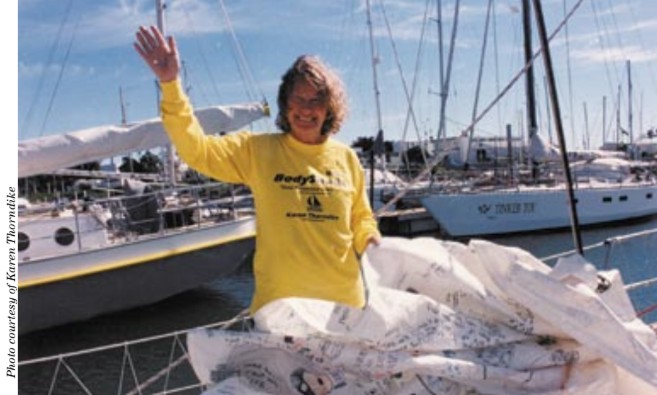
The winds were light, so Karen moved slowly, taking 35 days to reach San Diego, a city that proclaimed “Karen Thorndike Day, First American Woman to Circumnavigate the Globe” after she arrived. The cities of Coronado, Port Angeles, and Snohomish also instituted a Karen Thorndike Day. Many other honors followed, including being named Seattle Post-Intelligencer Sports Star of the Year and winning the Cruising Club of America’s Blue Water Medal and 1998 Circumnavigation Awards.
Since her return to Seattle, Karen has resumed her film editing career, but the global sail has not stopped influencing her life: “I am more at peace and satisfied. I don’t feel a need to prove myself to others. I wish I’d experienced that complete solitude long ago because it makes you search inside yourself and resolve what’s truly important in your life.” She’s co-authoring a book called Absolute Will about her experiences. She speaks to kids, to Rotarians, and at conferences about the psychology of achieving. She’s keeping the boat and dreams of sailing to South Georgia Island near the Antarctic Circle — maybe this time with a man who understands engines. “If only I were 30,” she sighs, “I’d be gone in a flash.
“When you first go offshore, you’re afraid,” she says. “I was afraid of the Southern Ocean storms. During those first storms I was overwhelmed with fear, wondering what would happen to my poor old boat. When big waves crash against you, it sounds like a freight train rams the yacht. It’s totally shocking. But then I’d lean back in the cockpit and get that sense of wonder, that feeling I was a guest, floating in a world that no one owns, a world I was privileged to experience.”
Thank you to Sailrite Enterprises, Inc., for providing free access to back issues of Good Old Boat through intellectual property rights. Sailrite.com