Issue 2 : Sept/Oct 1998
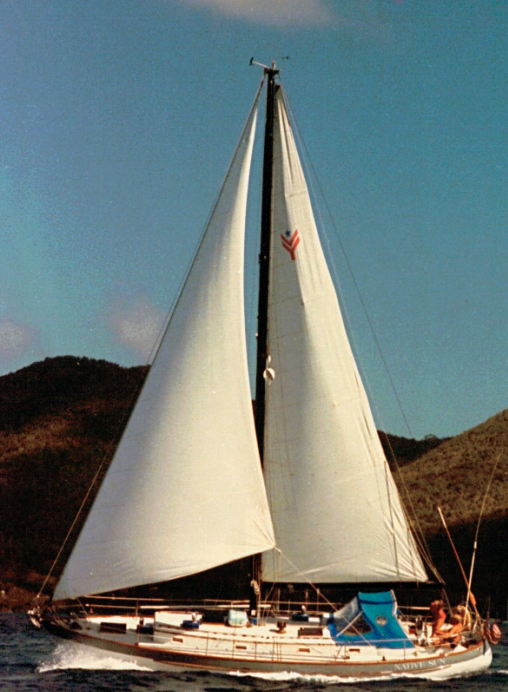
We learned to sail on Puget Sound. Like so many other people who live and cruise the Pacific Northwest, we were happy to be on our summer cruise in August … it is the best of the best of cruising times. The weather is generally clear with little, if any, fog. Winds are light. The sun is out nearly every day, and the air is so clear it turns the sky the most amazing color of blue you’ll see anywhere. In the background are craggy snow-capped mountains. It is a place of the ultimate primal alliance … a nearly perfect cruising ground … a place where islands and bays stretch for endless miles. The last week of August is our favorite, and we always laugh when we say, “Wednesday during the last week of August is always perfect.” It was always a good rule of thumb.
It must have been a Thursday or Friday of that last week in August, 1972, when my husband, Stanley, and I were crossing the Straits of Juan de Fuca, sailing toward Victoria, B.C., where we hoped to dock in front of the Empress Hotel in time for afternoon tea. All sailors who have been to the Empress for tea tell all others heading toward the Canadian Gulf Islands that this is a tradition they must not miss. We were looking forward to participating in this tradition and discussed what the proper attire would be as we thundered along under full spinnaker in our Islander 36, Amalia. The wind was building, and it was time to reef.
Where it started
In 1969 we were young corporate kids just a few years out of college, when Xerox sent its marketing team leaders to the Virgin Islands for a week of rest and relaxation and a little bit of work. We left Seattle on a gray, dreary day in April. As it turned out, that trip changed our lives and the lives of many others forever. We stayed at a 100-room hotel on Water Island, a small island in the middle of Charlotte Amalie Harbor in St. Thomas. We had spent four days snorkeling in unbelievably clear turquoise water, basking in the sun, and fishing.
Then we decided to try sailing. We have always believed that your life can change in an instant, but you can’t see it coming. Therefore, it’s important to live life fully, enjoy one another, and enjoy every moment. Those two hours we spent sailing — because of an almost mystical and spiritual experience — turned all of our dreams, goals, and thoughts about the future upside down. That night we lay awake for hours; by dawn the die was cast.
As usual, it was gray, overcast, damp, and dreary in Seattle when we returned. We turned the car lights on to go to work in the morning, and at 5 p.m. we had headlights on when we returned home. At 7 p.m., we were hunkered down in front of a fireplace talking about how, at that very moment in the islands, the sun was blazing, people were on the beach, and people were sailing! Three days after we returned to our corporate jobs in Seattle, we gave our notice.
It’s hard to explain unless you are a sailor to whom this has happened, but it seemed to us we had a calling … we even romanticized that it was an ancient calling from deep inside … it may have been. But we knew we didn’t want to live as we had been living, that it was certainly better for us to “do” than to “have,” and that we wanted to spend as much time together as we possibly could. Remember, it was also a time of adventure, escape, and great excitement, as 1969 proved to be a seminal year of change for a lot of “sixties types!”
The following weekend, with stars in our eyes, we bought a new Ericson 23, named her Amalia after the first place we had been sailing, and signed a contract for an Ericson 27, which was still on the drawing board. The day we took delivery of the Ericson 27, Amalia II, we ran into the dealer for Islander Yachts, and we actually signed a contract for an Islander 36 for delivery the following summer. We were a yacht broker’s dream. We were young, impulsive, and driven by a dream: the siren call of sailing adventures. It was 1969, and we were hooked big time!
We had made the transition from a camping style “learn-to-sail” boat with crawl-around headroom, to what we believed was the boat to fulfill our dreams, the same dreams many people have when they “discover” sailing. We fantasized about translucent turquoise lagoons where the mahi-mahi jump into the cockpit, of rum and cokes at sunset anchored by the palm trees, of anchorages at secluded tropical islands, of sailing across calm purple oceans, of white beaches that no one else had yet discovered, and of our youthful bodies tan and lean from hours of snorkeling on glorious reefs. We were filled with the cocky confidence that we could sail the oceans of the world with what we knew and with the boat we had. We were … so very young!
Reality grows with the wind
Throughout the afternoon, as we sailed toward teatime at the Empress Hotel, the wind continued to rise, and Amalia continued to charge forward and then surge to the left and surge to the right. Later we would find out this violent motion was called “death rolls.” But by this time we were so out of control we couldn’t shorten sail and so inexperienced that the only thing we knew for sure was that we had a lot to learn about sailing and ourselves. That afternoon we also realized that as much as we loved this boat she was not suitable for us, not for long distance, bluewater cruising, not for living aboard, nor for fulfilling our sailing dreams.
The Islander 36 continues to be one of our favorite boats. It has beautiful lines and sails wonderfully. We now know of two couples who sailed to Hawaii and back with an Islander like her. But that day we made the decision to buy a true bluewater passagemaker … whatever that was. We also started planning for the liveaboard lifestyle, which included more knowledge of sailing, more experience, and a boat with more storage for a large complement of tools, parts, and gear. We wanted a boat that was conceived, designed, and built for bluewater passagemaking. But what were our choices in 1972? There were very few alternatives.
Westsail was just coming into being at the time and was featured on a cover of Time magazine. After we called the California office, a factory rep came to our house in Seattle to show us the lines and to tell us about all the plans they had for this new boat. It was nice, but it simply didn’t fit us.
Around this same time, a mutual friend who knew of our sailing passions introduced us to Jay Benford, a local yacht designer and ferrocement/ferroconcrete guru, who was designing boats in Seattle. We knew of Jay, because after our corporate escape, we had established a printing and publication company and had become the printers of his design books. It was wonderful to see the designs, reviews, and new drawings he brought to us for printing, and we were enthralled with the “new” concept of ferrocement. Remember, this was the era of the great escape, and we joined the group of those who considered a “concreter.” It made sense to us at the time, and there were not too many alternatives.
During the Seattle Boat Show, sometime around 1972, Jay invited us to come to the show and see a “real live” ferroconcrete boat being built. This was the first time we met Nathan Rothman who had recently arrived from New York, where he had been selling buttons on the street with John Lennon’s photo on them and working at various City Island boatyards. Nathan was now working for Jay, building production ferroconcrete yachts. Next to Nathan, inside a huge chicken-wire cage, smearing concrete, was Bob Perry, who was working for Jay as an assistant designer.
After the show that night, over great big bowls of spaghetti at the recently opened Spaghetti House in Seattle — gourmet dining for us in those days — we became instant friends with Nathan, his significant other, Linda, and Bob. It was just one of those special relationships where we did a lot of dreaming, laughing, and talking. We spent endless hours together. Linda was unemployed, so I got her a job with my brother in a plant shop in the university district of Seattle. And Bob, who was then batching it, soon moved aboard our Islander 36 at Shilshole Bay Marina.
The idea takes shape
We all spent a lot of time onboard our Islander 36 and in the cafés around the Seattle marinas, drawing our “dream boat” on napkins. She would be a good, livable bluewater yacht. We talked about berths, galleys, storage, and performance. After a three-month cruise to Alaska aboard a ketch-rigged Sea Spirit 32, essentially a smaller version of a Sea Wolf 41, we really started defining our concept of what a liveaboard cruising yacht was, what performance was, what comfort aboard meant (a primary issue was fewer leaks), and what — for us — would be the ideal layout above and below decks. Of course, every time we found what we thought was a suitable boat, Nathan would tell us it was not right for us. Up to that point, most offshore cruising boats were heavy and slow and not all that fun to sail.
The U-shaped galley was a must on our list; the proper forward-facing and really usable nav station, one which would hold a large complement of navigation equipment, was important, too; as was a real double berth on which fitted sheets could be used. We wanted a traditional layout, and Bob’s concept of performance was critical, since it fit our desires like a glove. These ideas eventually evolved into the Valiant 40.
With the collapse of the “concrete era,” Nathan and Bob found themselves unemployed. Nathan suggested that we have Bob work our ideas into a design, as we all had the same thoughts and dreams. Our parameter for performance was that it had to sail as well as our Islander 36. Hull shapes were tossed around, other Seattle friends — Mary and Bill Black, Steve Murphy, and Darryl McNabb — started hanging over our shoulders looking at the ensuing plans, and we began hearing, “Yes, we would be really interested in this boat also.”
All four of us were interested in the same type of cruising yacht! Bob was young, hugely creative in his yacht designs, and a great friend. We talked about what had disappointed us in other boats, threw ideas around, and spent so very many hours drawing, erasing, talking, laughing, but never thinking Valiant Yachts would be born!
Pretty as a picture
Having been influenced by Scandinavian fishing boats and other double-enders which we were used to seeing in the Pacific Northwest, some of which were off the board of another great local yacht designer, William Garden, we were greatly impressed with the cover of a Soundings magazine that Nathan brought to the café one morning. He asked if we would be interested in a boat that looked like the one on the cover. It was beautiful! Holga Dansk was the name of the boat, and she had the most beautiful hull design we had ever seen.
We were struck by lightning it seemed. We had the inside lines we wanted, and now there she was: a hull design and styling we just had to have. Now we had a decision to make. Actually, the decision was easy, but how and where do a bunch of kids build a boat?
Later at the Miami Boat Show, in 1975 I think, where Nathan, Stanley, and I were introducing Valiant to the world, a “big time boating bigwig” came to our booth, where we had drawings and a projector with slides of what we were doing in the boatbuilding industry. His comment, which we have never forgotten, was that we were the “cutest kids I’ve ever seen … The boat looks pretty nice, but you will never make it … you can’t just start a company like that!”
Back then, we didn’t know better. Nathan was unemployed; Linda was working at my brother’s flower shop for low pay; Jay’s ferrocement production company was out of business; and Bob was unemployed as well. We all were pretty motivated to take some action.
Since Nathan’s great love and experience was in boatbuilding, and since he was out of work and aware that we were in the market for a good offshore yacht, he asked if he could build a boat for us. As we were totally tied up in the printing business, Stanley said, “Yes, wonderful, why not?” We had all talked often about what constituted a good boat, and we were all kindred spirits, so we knew it would work!
Because of the oil crisis at that time, the big question was where would he ever get resin, an oil byproduct? The oil shortage caused us to take turns filling each other’s cars up in the gas lines … a feat that sometimes took all day, if we were tending to three or four cars. The oil shortage meant, of course, no resins for fiberglass boats … something that impacted our lives greatly over the next few months.
A native of Seattle and an avid sailor by now, Stanley suggested, since there were so very many powerboat builders in the Northwest which were not currently building as many fuel-guzzling powerboats, that Nathan should visit some of them — such as Bayliner, Tollycraft, Reinell, and Uniflite — to see if they would sell resin to us. Uniflite had, in fact, built sailboats in the past — the very beautiful and famous yawls for the Annapolis Naval Academy.
And then came the Valiant
Nathan took out his earring, got a haircut, put on a suit, shined his shoes, and hit the road looking for resin. He went only 90 miles north of Seattle, but he was gone for several days. We were worried, excited, and very apprehensive, thinking that none of those companies would have the resins we needed. Nathan had no luck until he hit the Uniflite factory. Then he phoned with the “good news and the bad news.”
Yes, Uniflite had resin, but rather than sell us the resin, they wanted to build yachts for us. That was better than good news; we were elated. The bad news was that Nathan had signed a contract with Uniflite to build 12 of these yachts. Remember, there were only three people for certain, and possibly a fourth, who wanted a boat built. That he had signed such a contract wasn’t just bad news … it was terrible news! Now funding had to be found, and a whole bunch of “never-before-seen” boats had to be built and sold.
We called for a meeting with all of us. Together, we chose the name Voyager Yachts. Nathan had a couple of very artistic friends, Michael and Marsha Burns, who drew up the logo of the VY with the star in the middle, and we all loved the logo. We were really dismayed when we found out that name was already taken. It was decided that we should keep the logo; it was pretty and looked good from both sides of a sail, so we had to work a name around it. Nathan suggested, and it seemed suitable, naming this beautiful yacht after an America’s Cup boat, and Valiant Yachts was born.
We opened a tiny office on Lake Union in Seattle. Nathan moved to Bellingham for a year to oversee the building of the tooling and boat production. He would be the president of Valiant Yachts. Stanley would become vice president, taking over marketing and sales. Every week he would take Wednesdays off from our printing company to go to this tiny office in order to write ads and put together brochures, which we would print in our printing shop and use to sell the other nine Valiants. For funding, we turned to a mutual friend, Jeff Brotman, who was able to secure an SBA loan. Jeff later founded COSTCO, so undoubtedly we went to the right source for startup advice and help. With the completion of the tooling and the launching of the prototype boat, Stanley went to work as vice president full time. We sold our printing company, and all of us became totally immersed in the boating business.
Soon after leaving Jay’s employment, Bob found work with Dick Carter near Boston, whose design and yacht building organization was the hot design house of the era. His designs were winning world One-Ton championships and doing equally well on the SORC. Bob was confident that he could incorporate the performance design parameters of the time within a comfortable performance cruising yacht. It still had to sail as well as our Islander 36!
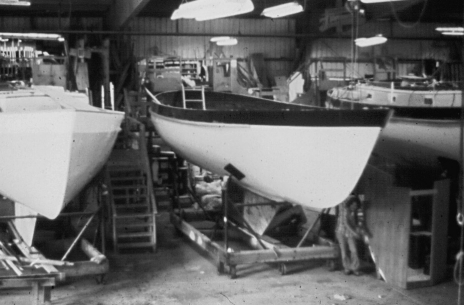
Thus, the era of the performance cruising yacht was born. Interestingly, the Valiant 40 hull form, that today is called the Valiant 42, is exactly the same hull form that was originally laid down by Bob Perry in 1973, with the exception of an evolved keel design. The Valiant 40 became an instant success, and we had eight boats on order by the time the first Valiant was launched. It is said that the Valiant 40/42 has been in non-stop production longer than any comparable yacht, a true testimony to its timeless design.
By 1978, we were selling and building some 50 Valiants a year, including the Valiant 40, Valiant 32, and the Esprit 37, which later became the Valiant 37 and then evolved into the Valiant 39. With the success of this new performance cruiser, Valiant became the hot cruising boat of the era, attracting enthusiastic fans and supporters.
Free at last!
During that time, there was a man who often came into the Valiant office in Seattle. Remember, our only goal had been, and was, to go cruising, so we were ready for some changes. What followed was the perfect opportunity for us to get on our way. Dane Nelson had come into the office repeatedly asking us to build a pilothouse Valiant. Stanley’s constant response, tongue in cheek, was, “It will never happen unless you buy the company.” As it turned out, Dane and his partner, Sam Dick, did buy Valiant and the name of the company became Valiant Yachts, owned by Sam Dick Industries. Uniflite was still building the boats, except for the Esprit 37.
After 10 pilothouse Valiants were built (Sam and Dane each owned one), Sam Dick Industries sold the company to Uniflite, which later became Chris-Craft. Somewhere around 1982/83, Valiant was bought by the present owner. He built several Valiants in South Seattle and then moved production to Texas. By then we were out cruising, chartering, and brokering boats until we took a direct hit from Hurricane Hugo in 1989.
After Hurricane Hugo, we shipped our boat, Native Sun, to the Valiant factory for a proposed six-month re-manufacturing. The owner of Valiant Yachts asked Stanley if he could help Valiant with marketing and sales, and so Stanley was, once again, the marketing manager of Valiant Yachts, and I was asked to become manager of customer services. It was wonderful watching Valiant grow and seeing it change for the better, and we enjoyed the excitement of once again meeting with fellow Valiant owners.
After four and a half years in Texas, we realized that a lot of valuable time had slipped by, and we needed to be back by saltwater. We opened Offshore Atlantic Yachts in Annapolis and Florida. We were Valiant factory dealers until 1996. But in 1997, after a bad winter with five feet of snow in our Annapolis driveway, we decided to move back to Florida, a much more salubrious climate, where we had once had our Valiant office, some 18 years earlier.
Our Native Sun is a good old boat and, as a result of her hurricane damage, a work in progress. Though she is 25 years old, she is a timeless classic. We continue to schedule projects on her as time and money allow. We are only one story of the many we see every day in our office and in our marina.
The reasons people continue to love and work on these boats are as varied as your imagination. Some center around being able to buy a boat which would be unaffordable when new, to invest time and sweat equity, and to create a yacht which will take them anywhere they dream. Some good old boats are family boats with years of memories. There are many stories yet to be told.
Our Valiant story is about how a group of young, idealistic, and enthusiastic people came together with a lot of creative energy and developed something “special.” In the beginning, we had no idea this new and “radical” boat would become a timeless “classic” 25 years later. . . truly a good old boat.”
Thank you to Sailrite Enterprises, Inc., for providing free access to back issues of Good Old Boat through intellectual property rights. Sailrite.com