One last job for the old one
Issue 62 : Sept/Oct 2008
Through the course of normal use, halyards gradually wear as they routinely pass over the sheaves at the top of the mast, around turning blocks, and through deck organizers. Obviously, these are all potential wear points. Therefore, in order to prevent a rigging failure, periodic inspection of your halyard is necessary to monitor this wear and to schedule the line’s eventual replacement.
With the mast unstepped, halyard replacement is easy and straightforward. This is especially true if the halyard is reeved externally to the mast. However, things get a bit more involved when the mast is standing or when the halyard is reeved internally.
To avoid losing the line up or inside of the mast when replacing a halyard, an “end-to-end direct joint” has worked well for me. I’ve successfully used this technique under a variety of conditions, including when the mast is up, when the mast is down, and with both external and internal halyards. I’ve even used it to send up messenger lines. This is how I do it:
Using approximately 12 inches of whipping twine (or dental floss), make a loop by passing the twine through the eye of a needle and tie the two ends together with a stopper knot. I use a double overhand knot.
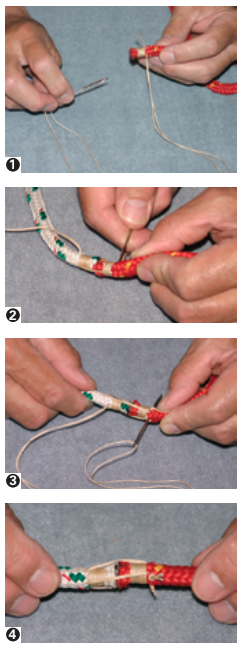
Starting about 1/2 inch from the end of the old halyard, push the needle through and pull the twine until stopped by the knot (1). Place the new halyard end-to-end with the old one. Once it’s in this position, stitch the new halyard to the old one (2).
To ensure that the joined halyards will run smoothly through the sheaves, turn the end-to-end joint 90 degrees and repeat the stitching process (3). Once the second connection has been made, tie another stopper knot and cut off the needle and excess twine (4).
The new halyard can now be pulled through as a replacement for the one being retired — without fear of losing a line. Simply hoist the new halyard into place by pulling on the old halyard. After the switch has been made, you just cut and remove the twine joining the two halyards.
Gregg Nestor, a contributing editor with Good Old Boat, developed a keen interest in sailing while growing up on the southern shore of Lake Erie. His third book, currently at the publisher, has a working title of To Windward at 55: The Trailer Sailer Owner’s Manual. When not writing about sailing, Gregg and his wife, Joyce, cruise aboard Raconteur, their Pearson 28-2.
Thank you to Sailrite Enterprises, Inc., for providing free access to back issues of Good Old Boat through intellectual property rights. Sailrite.com