Here’s a simple catch-all for all your plotting needs
Issue 56 : Sept/Oct 2007
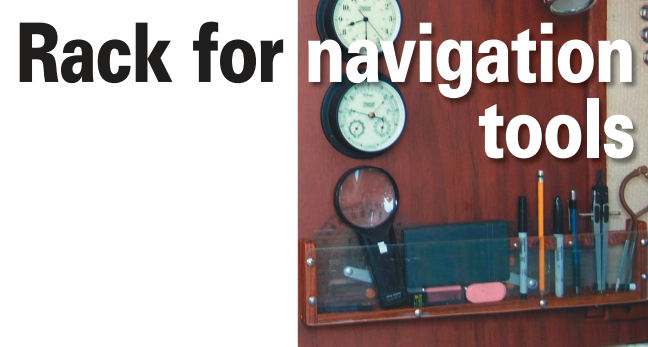
Oour 28-foot Pearson isn’t big enough for a dedicated navigation station with a chart table and drawers, so we needed a catch-all rack to hold plotters, dividers and compass, pencils, pens, a calculator, a protractor, erasers, extra leads for mechanical pencils, and a chart magnifier. I wanted it to take up as little space as possible, organize the tools, rather than just dump them into a pile, make it easy to see what’s where, and make it possible to get to it. I also wanted to knock it out pretty quickly.
The end result satisfied me on all counts. It has a 1⁄2-inch solid teak frame and its face is made from some 1⁄4-inch acrylic I had lying around. (You can get inexpensive acrylic scraps at the hardware store.) The enclosed pencil-divider rack is made of 1⁄2- x 1⁄2-inch sticks, and I drilled depressions in the bottom of the rack under this part to catch the tips of pencils, pens, and dividers, which otherwise just fall in. There is space behind the pencil-divider rack so long plotters can slide in behind it.
The dimensions are: 19 inches long, 4 1⁄4 inches high, and 1 3⁄8 inches deep. The pencil rack is 7 1⁄4 by 1 inch.
Never cut acrylic? It’s a pain. If you don’t need the transparency, avoid it and use wood or polyethylene, but for this rack, the transparency is useful. Even on the lowest speed, my (expensive, fancy) jigsaw melts acrylic to goo, which glues it back together as fast as I cut through it. And it cracks easily. I have to work it with hand tools to get satisfactory results. Drilling works fine on low speed with a sharp bit. Slightly over-drill all holes or they will crack. Use a very slow drill speed, a sharp bit, and no pressure.

Final polish
Finish the edges by hand with progressively-finer sandpaper (to at least 220-grit) and if you really want to go all-out, do a final polish with toothpaste or polishing rouge.
I’m my own harshest critic — ask any of my slip neighbors who are unfortunate enough to be aboard when I’m working — but this tool rack rules.
The key was taking every tool I wanted to put in this rack to the shop, measuring the space each took up, and arranging it all in the rack before final assembly. I mounted it on the bulkhead because it’s about the only available place.
A good tool rack should be long enough to hold your biggest plotter — in my case, the 3-arm protractor. And you re- ally need separate slots for pencils and dividers or they will simply fall in and get lost. These two requirements made it too long for any other place on the boat, and besides, on a small boat, the chartwork is usually done at the galley table by necessity. So there it is. Given where it is mounted, it seemed likely that at some point someone would use it as a handhold, so I through-bolted it to the bulkhead.
Phillip Reid, his wife Andie, and certain other miscreants sail their 1977 Pearson 28, Miss Bohicket, out of Wilmington, North Carolina. They finished a five-year refit in the fall of 2005. When not sailing, writing, or boat- grubbing, Phillip teaches a college history course.
Thank you to Sailrite Enterprises, Inc., for providing free access to back issues of Good Old Boat through intellectual property rights. Sailrite.com