Cruising breakdowns: What broke and how they fixed it
Issue 41 : Mar/Apr 2005
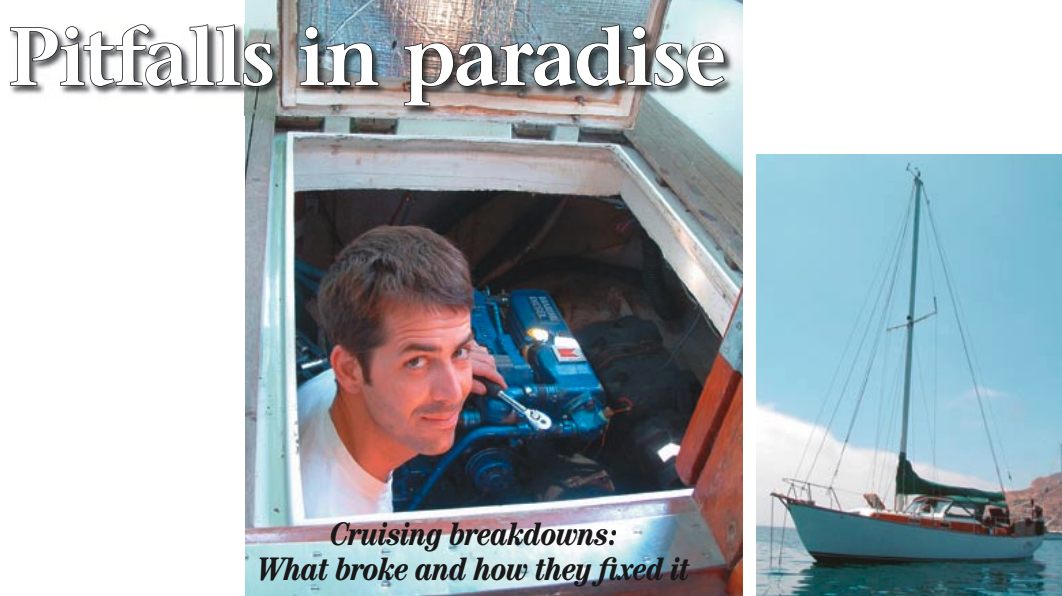
In the last six years of my life I’ve been fortunate enough to experience two cruises on two different 1960s-era boats. The first voyage was on a 1969 26-foot Westerly Centaur, traveling south along the coast of California, through Central America and the Canal, then north through the western Caribbean and up the East Coast.
After that it was time to go back to the grind for two years before upgrading to a 1964 35-foot Sparkman & Stephens-designed Chris-Craft for a cruise through the eastern Caribbean, Venezuela, back through the Canal, and the return to California.
While there’s no disputing that older boats need love, attention, and know-how, both trips proved that, with a little elbow grease and sweat equity, most things can be fixed. There have been more than a few boat projects along the way. Some have taken place on beaches, many in the cockpit or the odd pier, and a few even in the rare luxury of a boatyard. Because there’s no way to expect the unexpected, any trip over the horizon is bound to throw a couple of curve balls your way.
Engine woes
The biggest heartache on an older boat invariably rises from the piece of iron humming or clunking away in the recesses of the engine compartment. Part of this stems from the fact that sailors go sailing to be in tune with nature’s elements, working with prevailing winds and currents to get from one point to the next.
Contorting over a hot engine with a mysterious problem in a bouncy sea is about as far away from this kind of freedom as you can get. I found out the hard way that I get seasick only when I’m upside-down working on a hot engine, periodically being sprayed with diesel fuel.
Our Westerly had a diesel engine that took a fair bit of tinkering to coax it back to life after we bought it. Replacing the 30-year-old diesel with a brand-new Yanmar would have been the optimal solution, but the engine alone would have been worth more than the price of the boat, and we’d probably still be at the dock paying for it.
While I’d cruised a fair bit before this trip, including a trip from New York to Greece across the Atlantic, I had somewhere along the way reacquired romantic notions of using the engine only for getting in and out of port. Suffice it to say that this engine was particularly hands-on. In Baja the regulator quit — this engine had a strange animal called a Dynastart, a combination starter motor and generator — and we could no longer use the starter button to turn the engine on.
But we could still hand-crank it, a feature not common on today’s engines. A small solar panel kept the batteries up with the minimal energy demands of our Tillerpilot, tricolor light, and cabin lights.
Sharp reports
The whole engine, a Volvo MD2B, returned to its dormant state off the coast of southern Mexico. A series of sharp reports from the engine compartment brought the engine to a standstill, and sailorly curses filled the air. We’d blown a head gasket. We sailed 150 miles to the next port — experiencing a calm en route that had us spinning in circles at times, completing one of the slowest mileage runs of our trip: 12 miles in 12 hours.
My mechanical skills at this point were fledgling at best, but with each new daunting boat project comes a new bit of knowledge that can be built upon. Rather than pay a local mechanic of dubious skill the inflated prices that usually accompany a breakdown in paradise, and then still not know how things on the boat work, it’s nearly always better to do the work yourself. If you’re really out of your league, you can hope to find another cruiser who knows more than you do.
One of the great things about cruising is the camaraderie — no one knows everything about the mysterious innards of engines, alternators, regulators, and the like, but get enough cruisers together, and anything can be fixed.
Soon we had made friends with a South African cruiser/mechanic who just happened to be ordering parts that day. With a new push rod, head gasket, and valve spring, we were back in business. There was also a field valve job, spinning the valve stem in a cordless drill with grinding paste to his careful specifications — a crude but effective fix that lasted the whole way back to the States and was still working the day we sold the Westerly.
I can still see the engine parts strewn across the galley and the Zip-loc-bagged and labeled screws and bolts. An entire day was spent with denatured alcohol and a razor blade cleaning the old gaskets off engine surfaces and getting the engine parts clean again for reassembly. We made gaskets out of gasket paper and used RTV gasket maker for the exhaust manifold. Then out came the torque wrench with strict instructions to re-torque the head bolts after the next oil change. It was a happy day when the engine came back to life. We’d learned a lot by doing it ourselves, and down the road we ended up helping mechanically stricken cruisers who crossed our path with their own tales of mechanical woe.
Through-hull blues
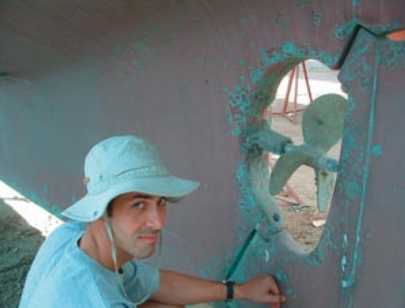
In a calm and beautiful anchorage in Costa Rica I was cleaning the bottom of the boat. Merrily scraping away with a paint scraper, I watched barnacled carcasses float downward as brilliantly colored tropical fish gathered for a free lunch. That’s when I noticed it — a perfect circle of blindingly white gelcoat. It took my brain several moments to comprehend what I was seeing: this white circle had previously been covered by the outer flange of a bronze through-hull, the only one I hadn’t replaced before leaving. It had simply flaked off like a barnacle. If there ever was a time to panic, it was now.
After hopping quickly aboard, I learned that there was some good news. We weren’t sinking. The through-hull and its backing plate were fiberglassed over and not likely to be going anywhere anytime soon — another thing you won’t see on a modern production boat.
The bad news was that we’d just had a hard lesson in the dangers of electrolysis. We’d left the boat in a marina in northern Costa Rica for four months. The marina was one rickety dock whose structural integrity was created largely by the cruising boats Med moored to it. Electrical wires and shorepower cords ran along the dock and dangled in the water.
The zinc on the prop was gone — eroded to a nub over the four months we’d been gone. That should have been the first red flag. Fortunately, because our boat was a bilge-keeler, we were able to beach it to change out the through-hull. Finding a new through-hull was another matter. After some hot walks around town, we found out that we could have a bronze one machined nearby at an approximate cost of $100, or we could buy one in Panama City, several hundred miles away for about $50.
Then we noticed a neighboring French boat whose through-hulls were all nylon. With misgivings we changed the through-hull to nylon (I believe you should be able to hit a through-hull with a sledgehammer). To its credit, this one never gave us any problems for the rest of the trip back to the States, where it was replaced during our first haulout.
Rudder problems
Water has been called the universal solvent. If there’s a chance for it to get into anything, it will. A boat’s rudder is a prime spot for water ingress. The lateral forces on a rudder in a seaway can be immense. The weakness, especially on a boat 40 years old, is where the shaft enters the rudder.
And so it was on another dive that I noticed the top part of the rudder had begun to delaminate and water was making its way inside. My better half, Laurie, held the tiller in the cockpit. My worst fears were confirmed when I moved the rudder in the water, and it flexed back and forth. Fortunately, we had another rudder: our windvane had an external rudder with a trim tab, so we could still steer the boat should we need to.
The other plus was that we could pull the rudder out of the boat without hauling out or beaching the boat. One of the benefits of cruising on a smaller boat is that major repairs are a little bit more manageable . . . or so we told ourselves. Once the set-screw was removed and a little coaxing applied from the water, the rudder simply slipped out of the rudder tube. I had securely fastened the rudder to the boat, thinking it would sink under the weight of the stainless-steel shaft. But I was pleasantly surprised to find that the rudder floated.
Under a shady grove of palm trees, we began our island-style repair, using a chisel and mini sledgehammer to cut the rudder into two clamshell pieces. (See a similar Good Old Boat article about a rudder repair in Mexico in the May 2001 issue).
Corroded webbing
This revealed another problem. The stainless-steel webbing welded to the shaft inside the rudder had corroded away. The original design had long, skinny pieces of stainless steel fiberglassed to tapered teak blocks that were rotten and also going to need to be replaced.
There was some good news: the fishing community at this particular outpost of civilization used polyester resin to repair their own boats, so we’d be able to find additional supplies to add to what we had aboard.
Laurie and I walked around town with the shaft and the stainless-steel webbing, looking for a soldadura, or welder. Once we found one, the other key word was inoxidable for stainless steel. Incredibly, in only an hour the work was done — probably faster than if we had been in the States —and we began to put things back together. The other good news was that we had two-part expanding foam in our shipboard stores. If you’ve never had the chance to work with this stuff, it’s pretty crazy; a little goes a long, long way.
We cut new blocks of wood, fiberglassed them to the inside of one half, then glassed the stainless-steel webbing over that before starting to put the rudder back together again. The idea was to fill the rudder completely with foam, drilling relief holes here and there to have a visual means of checking that foam had filled that part of the rudder. We seam-taped the two halves together using polyester resin, sheathed it, filled, faired, sanded, painted, and reinstalled the rudder to get back on our merry way. The other useful motto when cruising is “Where there’s a will, there’s a way.”
A “new” boat
Our current vessel, which replaced the Centaur, is a 1964 35-foot Chris-Craft. We were ready for more storage and faster passages and bought the boat from friends with whom we had cruised in tandem from Panama to the East Coast. The difference between buying an older boat that had been previously cruised and getting an older boat ready to go is immense in terms of the amount of work, gear, and equipment to purchase. Not that there wasn’t work to do. In the six months before we were ready to cruise again we replaced the standing rigging, the lifelines, and running rigging. We installed an inverter and an SSB radio and had the life raft repacked. But on the whole, a previously cruised boat has a lot of the glitches already ironed out.
Autopilot mysteries
Even if you switch boats, though, invariably the quirks and idiosyncrasies catch up with you. We’d left the world of the tiller slave behind and now had hydraulic steering, complete with a fancy autopilot thatrivaled Hercules. But when the unit was activated, the wheel turned a little this way and a little that way. Then an alarm sounded and “Actuator Failure” flashed on the screen.
After flipping through the manual several times, we decided that it sounded serious enough to call the manufacturer. A knowledgeable and patient representative talked me through reprogramming the brain of the unit — a 20-minute production that revealed everything working as it should be. But when the autopilot was turned on again, the same error flashed. I began to steel myself for some serious squirming in the lazarette to remove the autopilot.
By chance, while traveling down mind-numbing section after mind-numbing section of the Intracoastal Waterway — prime territory for our autopilot — we happened to cross paths with our friend, the previous owner of our boat. When I told him about the problem with the autopilot, he looked at me quizzically and asked, “Do you have the wheel locked off?”
I had thought that the autopilot would make the wheel spin when it was working. It turns out that without the wheel stopped, the hydraulic pump was simply circulating hydraulic fluid through the hoses. With the wheel locked off, we went merrily on our way. My only consolation was that the tech-support guy overlooked the obvious as well. Whatever the case, I’ll take looking silly for a simple fix any day.
Starter challenges
Another little bit of idiosyncratic charm the new boat had was that every 15 or 20 times the key was turned, a faint click came from the starter solenoid, and that was that. Ordinarily such a click would mean a low battery. But the voltage was fine. The previous owner had told me about this endearing little feature. His solution was to turn the flywheel a quarter turn and try again. For some reason that eluded both of us, this seemed to work. At least initially. But by and by, a curveball every 15 or 20 attempts became every 5 or 10. Out came the starter, in went a new solenoid . . . with the same results.
A mechanic was consulted. It was suggested that what could be happening was that the teeth on the flywheel were wearing off. The engine was stopping in the same place, and the teeth that the starter engaged in that area were being worn down.
He suggested taking the coupler apart, taking the transmission off, heating the gear on the flywheel with a torch, and flipping it . . . basically a mechanical nightmare.
Clearly, it was time for more sleuthing. The starter came out, went on the bench, and passed with flying colors. Although previous probing with the voltmeter revealed everything was getting the voltage it should, I began running new wires from the ignition to the solenoid. After replacing one yellow wire in particular I noticed that I had started the engine and stopped it and started it again some 15 times in a row. Another head of the hydra had been slain. (Note: Treat the circuit from the key switch to the solenoid as a 30-amp circuit. Use 12- or 10-gauge wire to prevent this problem. –Ed.)
Pop rivets and trade winds
Once you’re out of the lee of the many Caribbean islands, 20- to 25-knot winds are pretty much the norm. Much of the trip south from Florida to St. Barts is close-hauled against it. On our trip through the eastern Caribbean, we took on fuel once in the British Virgin Islands and didn’t take on any more until Panama. There is no shortage of wind.
But over time the wind can take its toll on sail-handling gear. As we approached Tortola for the first time, marveling at the gazillion sailboats tacking back and forth against the towering headlands and amazed that we had reached one of sailing’s prime destinations, there came an innocuous-sounding “ping” from somewhere.
My first concern was that some critical fastener holding the mast had given way. Looking up, though, I couldn’t find anything. A bit more sleuthing revealed that eight of 10 rivets holding our outhaul track down to the boom had given way, and the remaining two could go at any point. We reefed the sail and, at the end of the day’s sail, riveted the piece back in place with larger rivets. These are still there and seem to be up for the task. They had quite a workout on the uphill climb off the coast of Baja as we made our way back to the States.
Bottom line
The sea, the wind, the salt, the sun . . . these are unstoppable forces guaranteed to break something on even the best-found vessels. You can either do the work at the dock and never leave or accept the fact that the cruising life is a hands-on affair rife with triumphs and pitfalls. For us, each new project helped gain insight into the workings of the physical world, and a sense of how to refine things. The more you can fix yourself, the better you’ll know your boat, and the more self-sufficient you’ll become. That’s the real joy of cruising.
Thank you to Sailrite Enterprises, Inc., for providing free access to back issues of Good Old Boat through intellectual property rights. Sailrite.com