A spritely sailer with plenty of cruising room
Issue 66 : May/Jun 2009
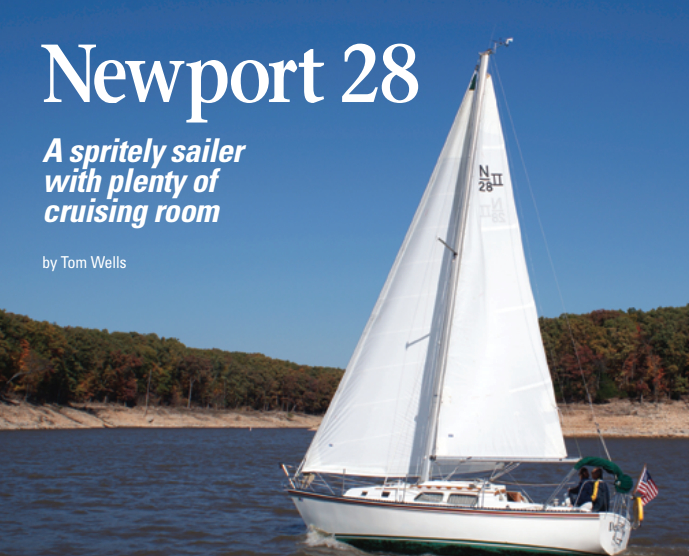
On a breezy day in October 2008, Charlie and Elaine Lawson put their 1987 Newport 28 II, Desirée, through her paces and then hosted a tour and test sail for this review.
As a former naval aviator and airline pilot, Charlie knows a thing or two about form and function and how movement of air affects performance. When he and Elaine decided it was time to move up from their beloved Columbia 24, they sought a boat that combined efficient use of space with satisfying performance at a reasonable price. After a successful search, they were soon sailing Desirée on Missouri’s Mark Twain Lake. The boat is competitive in PHRF fleets and comfortable for weekends and short-term cruising . . . all without breaking the bank.
History and design
Lindsey Plastics originally built the Newport line in Santa Ana, California. It commissioned the well-known Canadian firm of Cuthbertson & Cassian to design the Newport 27, which was produced by Lindsey and later by its successor, Enterprise Yachts. When Capital Yachts of Harbor City, California, purchased the molds and the Newport name in 1971, it continued production of the popular 27.
The Newport 28, introduced in 1974, shares the features of C&C designs at that time: the characteristic sheer, scimitar rudder, and swept-back keel. However, George Cuthbertson recalls that only the Newport 27 and 41 were actually designed directly by C&C. The Newport 28 designer is not credited in the sales brochure, and Capital’s Newport 28 II price sheet states that the boat was an in-house design.
The Newport 28 is basically an enlargement of the Newport 27 with a higher cabin trunk and improved accommodations. In 1982, Capital Yachts introduced a more efficient fin keel with 5-foot 2-inch draft and combined it with a spade rudder to improve performance. The modified design was dubbed the Newport 28 II, and the remainder of the production run included the underbody modifications. At the end of production in 1987, nearly 1,000 Newport 28 and 28 II hulls had been built.
Construction
The Newport 28 II has a solid fiberglass hull and balsa-cored deck. Capital did not use an ounce more material than was necessary, but the basic construction was reasonably sound. The deck lands on an inward-turning flange on the hull and is secured with a bonding agent and through bolts that fasten through an anodized-aluminum toerail. Leaks occur in this joint from time to time and, because the freeboard is low and the rail is often in the water, owners should check it frequently.
Bulkheads were tabbed into the hull to provide torsional stiffness, but one common complaint is that the bulkhead tabbing was sometimes light. The hull twisting that results causes some gelcoat cracking, especially on the deck in transition areas. Desirée has some minor gelcoat cracks that are barely noticeable.
The fit and finish of the interior joinerwork can be considered average. Other issues cited by owners include plastic through-hull fittings, poor backing plates on deck hardware, and smallish cockpit scuppers.
On deck
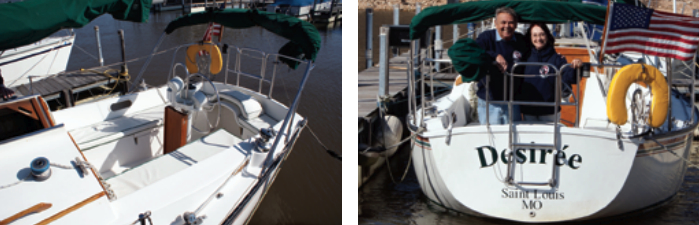
The Newport 28 II has a masthead rig with single spreaders, upper shrouds, and dual lower shrouds. Chainplates are set inboard next to the cabin trunk, allowing room on the sidedecks for crew movement fore and aft. The mast is deck-stepped and supported by an interior compression post neatly incorporated into a bulkhead.
The cabin trunk has a rounded top. Teak grabrails are fitted along its edges but they don’t extend forward past the mast. As a result, working on the cabintop requires increased caution. A solid fiberglass hatch over the front of the cabin trunk was standard and translucent hatches over the saloon and the head compartment were popular options. The sliding companionway hatch runs beneath a traveler that provides mid-boom sheeting. Two small opening ports are fitted on each side of the cabin trunk forward, and larger fixed ports aft of them allow plenty of light to enter the saloon on both port and starboard sides.
An adequate anchor-stowage locker fitted in the foredeck is covered with a hatch; an anchor roller also was standard equipment. The original port and starboard cleats were small and many owners have replaced them with larger ones. The bow lacks chocks for docklines, so chafing gear on mooring lines is a must.
The stainless-steel bow and stern pulpits are robust. To improve access to an optional stainless-steel folding stern ladder, the top rail of the stern pulpit is cut in the center and replaced by a lifeline and pelican-hook closure. Single port and starboard lifelines were standard, but most boats were ordered with the optional second lifeline.
The cockpit is adequately sized for a 28-foot boat. It will comfortably seat four adults, although crew have to shift periodically to provide access for line-handling and winch-grinding activities. The standard helm arrangement was a tiller, but the wheel option proved popular. Unfortunately, the space behind the wheel is cramped and the helmsman cannot go forward easily. Since the boat has mid-boom sheeting and the traveler is on the cabin trunk, singlehanding a wheel-steered Newport 28 II is not easy. It’s helpful to have crew along who can handle the mainsail.
Accommodations
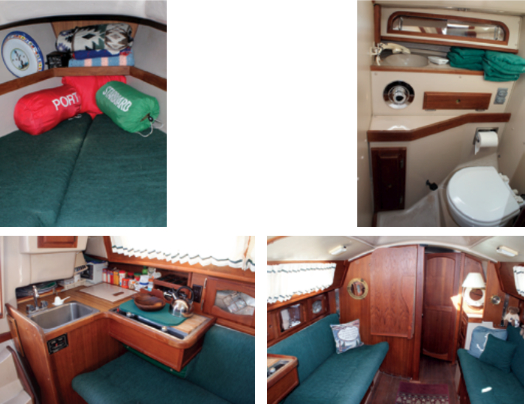
Perhaps the most attractive feature of the Newport 28 II is a well-planned and nicely appointed interior. The rounded cabintop provides standing headroom of 6 feet 2 inches near the companionway which, while it diminishes quickly outboard and forward, is a pleasant surprise in a boat of this size.
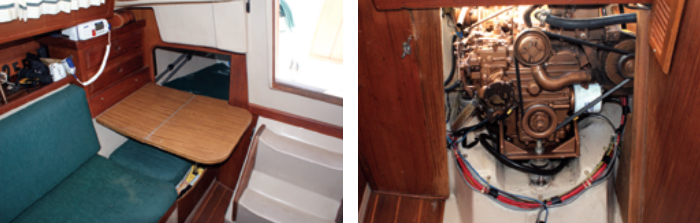
The saloon has settees to port and starboard and a very nice fold-down table mounted on the forward bulk-head. When the table is down position, it reveals a clever cabinet that can be used to stow a wide variety of smaller items. Stowage is available above both settees in a combination of lockers and open bays. Each settee can accommodate one person for sleeping. The port settee supposedly converts to a double berth, but it’s not really big enough for two people.
Desirée’s galley is aft on the port side. A two-burner propane stove with a cutting-board cover overhangs usable foot room at the aft end of the settee, and a single stainless-steel sink is mounted just to port of the companionway ladder. An insulated icebox is located outboard of the sink. There’s not a great deal of usable counter space but, for a 28-foot boat, it’s adequate.
The Newport 28 II also was available with a starboard galley option that included a two-burner stove with an oven. This option cut short foot room on the starboard settee berth. To restore it, the builder made a cutout in the forward bulkhead which may have weakened the bulkhead system somewhat, though no major problems have been reported.
At the aft end of the settee on the side opposite the galley, a clever folding seat lifts to reveal a fold-up navigation table. When the navigation table is in the down position, it forms the head of a quarter berth that extends beneath the cockpit seating. This adds a usable berth but, because access to it is poor, many owners use this space for stowage.
The V-berth is more than 6 feet long. With a filler section in place at the aft end, it provides a comfortable double. Foot room at the forward end is tight, but unless both occupants are very tall it won’t be an issue. Usable shelf space is installed along the hull above the full length of the berth on both sides.
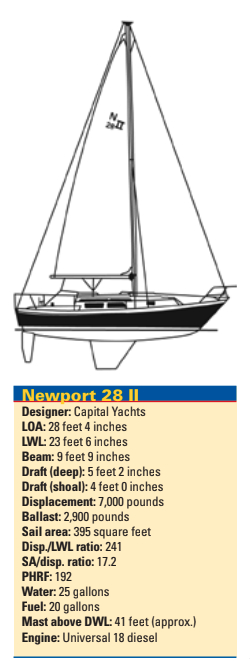
The head compartment is to port and forward of the main bulkhead. It features an aft-facing marine toilet, a sink mounted against the hull, and adequate room. A foot pump was the standard equipment for servicing the sink and shower on the 28 II, but pressure water and a water heater were popular options. Fresh water capacity is 25 gallons.
Propulsion
The Universal Atomic 4 gasoline engine powered most of the earlier Newport 28s. Later Newport 28 and 28 II models featured Universal or Yanmar diesels. Desirée has a Universal 18 diesel and, according to Charlie Lawson, it’s highly reliable. Engine access for maintenance is fair. The engine front and belts can be reached by removing the companionway ladder and a removable hatch in the cockpit provides access to the top. Fuel capacity is 20 gallons, which provides a reasonable range under power for coastal cruising.
Performance
The Universal diesel and standard two-bladed prop move the boat nicely in moderate conditions. Backing under power is good, although some attention is needed to work with the prop-walk, which pulls the stern to port. Once the boat has gained sternway, low engine rpm and very slight helm corrections make it possible to control the boat while backing. Engine noise seems a bit high but is not overly bothersome, unless crew are trying to rest below.
Under sail, the Newport 28 II is nimble and fairly fast. Its average PHRF base rating is around 192, a few seconds quicker than the Newport 28. For comparison, a C&C 27 rates 200 to 204, and a Morgan 28 rates 207.
We sailed Desirée in 12- to 14-knot breezes. After some initial tenderness, she becomes quite stiff. The smaller standard mainsail and larger overlapping headsail are characteristic of the 1970s design philosophy, and the arrangement does provide a lot of power.
On the test sail, she sailed to weather comfortably with the wind at approximately 35 degrees apparent, displaying the slight amount of weather helm needed for control. She could be pinched slightly higher but quickly lost drive. Others have reported sailing the Newport 28 II to 30 degrees apparent wind, but straight-line performance and velocity made good (VMG) will both be much better when drive is maintained.
On a beam reach, the boat trimmed well and remained under very good control. The brisk breeze drove the boat at hull speed with little effort. When reaching in lighter breezes, trim for the large headsail is improved by moving the sheet leads outboard. The sheet could be led through a snatch block attached to the aluminum toerail, or a Barber hauler could be rigged to accomplish the same adjustment without changing the primary sheet leads.
The boat behaves well on a run, exhibiting very little tendency to roll, and tracks well. Falling off too deeply may require going wing-and-wing, or poling out the genoa and sailing by the lee, a tactic not advisable in higher wind conditions. Sailing the boat slightly higher and faster provides good VMG and increased safety.
The mainsail on Desirée has only one set of reefing points. This works well with the single-line reefing system, but at least two sets of reef points should be fitted for coastal cruising.
Price and availability
With nearly 1,000 hulls produced, several Newport 28 and 28 II models will almost always be for sale at any given time. A check of brokerage listings in early 2009 found at least 10 on the market. Four older Newport 28s were available with prices ranging from $9,900 to $16,900. Five Newport 28 II models were priced from $12,000 to $25,900. A sixth Newport 28 II was offered at an asking price of just $7,900. A survey might reveal defects leading to such a low price but, providing any such problems can be fixed reasonably, the boat may still be a good value.
Conclusions
The Newport 28 II was built to a set of compromises to suit a certain market. It is not an offshore-capable boat, and its construction quality is perhaps less than ideal, but it is nevertheless solid and dependable and has a very accommodating interior and good sailing characteristics. Anyone desiring a smaller coastal cruiser at an affordable price would do well to consider one of these boats. As Charlie and Elaine Lawson will tell you, the Newport 28 II is a good value for the dollar.
Tom Wells and his wife, Sandy, own and sail a 1979 Tartan 37, Higher Porpoise. They have been sailing together since the 1970s and look forward to cruising upon retirement.
Thank you to Sailrite Enterprises, Inc., for providing free access to back issues of Good Old Boat through intellectual property rights. Sailrite.com