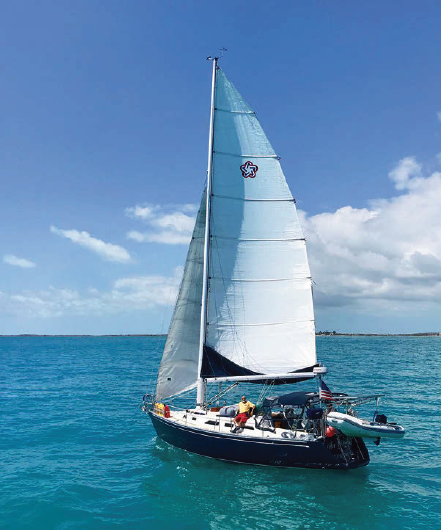
 A refit turns a Great Lakes daysailer into a Caribbean cruiser
Issue 128: Sept/ Oct 2019
When my wife, Sheila, and I bought Her Diamond, our 1991 Freedom 38, she was the ideal daysailer and vacation boat, an opinion affirmed by this magazine (“Freedom 38: A well-built sloop with an unstayed mast,” January, 2014). But we didn’t buy our Freedom 38 to daysail and vacation aboard, we bought her to fulfill our 20-year dream of cruising in retirement. Thus, we were challenged to convert our daysailer to a liveaboard cruiser. Accordingly, we bought Her Diamond 10 years before our expected retirement date to allow us time for a lengthy refit. As happens, life and work got in the way and our refit was squeezed into over just the 6 months between my retirement date and the sunny July day in 2017 when we cast off our dock lines and sailed away. Since departing, we’ve discovered that our kind of refit is really a two-phase process: first, we did what we thought was necessary based on research, then, we did what we learned was necessary based on experience. We’ve learned a lot along the way. Our preliminary refit budget was $24,000 and our goals were to ready the boat for sailing in saltwater, for liveaboard comfort, for passagemaking, and for anchoring (which we almost never did on the Great Lakes). In the end, I completed about 70% of the work and left 30% to the yard.
Sailing in saltwater
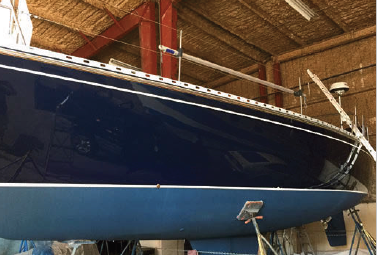
We knew Her Diamond’s fresh water VC17 bottom paint wouldn’t do the job in saltwater. To remove the old paint, we had the bottom pressure blasted with a pulverized-glass medium. Once all the old paint was removed, the yard sanded the surface fair before coating it with an epoxy barrier coat. Over that, they applied Sea Hawk Biocop, a high-copper-content bottom paint. Because we knew we would be moving aboard, we had the yard raise the waterline by five inches, narrowing our broad boot stripe to just one inch. Fully equipped and loaded, she now shows two inches of bottom paint above water. Thank goodness boats float higher in saltwater.
Liveaboard comfort
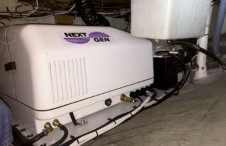
Primary to liveaboard comfort is plenty of power. We installed a 3.5-kilowatt Next Gen AC diesel generator. I did the wiring and installation of the controls. The boatyard built the platform, installed the generator, and ran the plumbing for exhaust and fuel connec- tions to the boat’s diesel fuel tank. (I have no idea how they shoehorned the unit through the 24-inch-wide opening to mount it in our cavernous lazaret.)
Because the unit burns only 1⁄10– gallon of diesel per hour, we decided to forego solar panels and a wind generator. After a year of cruising, we realized how unrealistic this plan was, especially as we shifted away from marina stays and started spending more time on the hook. We thought we’d be able to fully charge our modest 300-amp-hour AGM house bank by running the generator two hours every other day, but because the charge-acceptance rate of lead-acid batteries slows dramatically after reaching the 80-percent-charged point, a more realistic generator-run projection is eight hours every other day. We now understand why 90% of cruising boats (power and sail) are sporting solar panels.
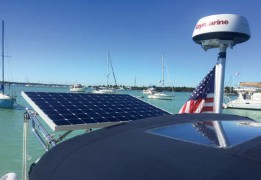
In our first year of cruising, we mounted a 320-watt solar panel atop our new davits, connected to our batteries through a Victron MPPT 100/30 solar controller. Our batteries now silently receive electrons throughout the day, and we get away with running the generator for several hours every four days, which coincides perfectly with our water-making schedule.
To ensure we get the most power out of any time we spend motoring, we upgraded from our stock 30-amp Yanmar alternator to a 100-amp Balmar alternator with an external regulator.
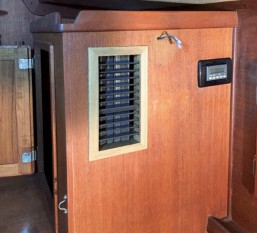
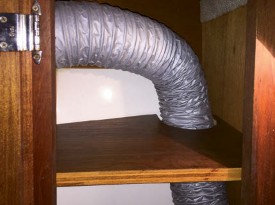
And having ample power allows us to run an air conditioner at anchor. Under the V-berth, we installed a 16,000- BTU reverse-cycle Dometic unit. I did the plumbing, wiring, and most of the duct installation. The yard built the plat- form and installed and commissioned the unit. Humid, buggy, windless nights in the tropics are no longer sleepless! For marina stays, I later installed a second 120-volt AC circuit dedicated to the air conditioner (which means new shorepower cords with splitters).
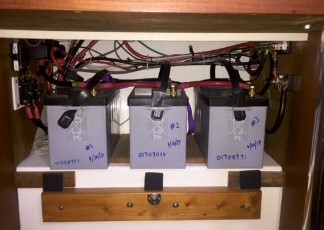
Despite having adequate means to charge our batteries, we knew that at anchor, we’d be taxing them with our lifestyle. To ease the burden on the house bank, we installed a separate starter battery (for the diesel inboard and generator) and connected it to the system using a Blue Sea battery switch and an Automatic Charging Relay (ACR) that automatically combines the batteries during charging and keeps them isolated otherwise. We installed a Xantrex LinkLite battery monitor and
I replaced most of the 12-volt wiring aboard. I replaced our 12-year-old Lifeline AGM batteries with identical new batteries: three 100-amp-hour group 27 12-volt AGM batteries, providing a total modest capacity of 300 amp-hours.
Since leaving, we’ve learned that also primary to liveaboard comfort is plenty of water. Before leaving, friends suggested we would not need a watermaker in the Bahamas because water is available, for purchase, almost everywhere. Their rationale was that we could buy a lot of water at 50 cents per gallon for the money we’d save not buying a watermaker. This made sense to us.
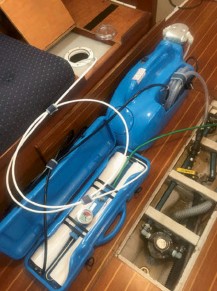
Then we arrived in the Bahamas and found the water quality variable. We learned that further south (mostly in the Exumas), good water for sale is harder to find. Between showering, dish washing, and drinking, our 62-gallon supply was exhausted much too quickly. After much research, we purchased a Rainman 115-VAC portable watermaker. Because the pump and membrane units are relatively heavy, we installed a diverter valve on the air conditioning raw-water inlet and use the watermaker down in the cabin, where it is stored. The product water is pumped directly into our boat’s water tank through a clean-out plate and brine is discharged into the galley sink. The unit produces up to 18 gallons per hour and is powered by our diesel generator.
Only after throwing off the docklines and heading for blue water did we learn that living aboard didn’t substantially decrease our need for connection to the internet. We sought to download books, do route planning, research destinations and boat repairs, and stream our favorite TV shows. We found that many marinas and mooring fields provide WiFi, but the signal was rarely particularly strong, especially as we moved further away from the marina office. We ended up installing a Coastal WiFi booster, which captures and amplifies available WiFi signals and creates an in-boat network, allowing us to simultaneously connect multiple devices.
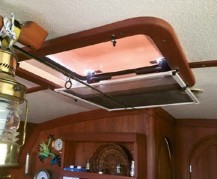
But none of our enhanced connectivity mattered if we were getting eaten alive by flying pests. Our Freedom came with portlight screens to keep out flies, mosquitoes, and no-see-ums, but we built additional screens for the companionway and overhead hatches using scraps of teak and aluminum framing. What a difference.
Production boats from the 80s and 90s were commonly fitted with numerous cavernous cabinets. But nearly all these cabinets lack interior dividers or shelving to allow organization of clothing, linens, personal items, and ship’s stores. We carefully measured (no right angles on boats) and built shelves for nearly all the lockers and cabinets. In some of these cabins, we stole a bit of space for wiring and electronic equipment, the inverter, generator controls, AC ducting, and a secondary AC breaker panel for the air conditioning.
Passagemaking
When we purchased Her Diamond in 2006, she was equipped with Raymarine ST60 wind, speed, and depth instruments. When the depth sounder head stopped working, we replaced it with a Raymarine i50 unit, reusing the transducer and wiring. But because the ST60 series operates on a daisy chain and the i50 series uses a backbone wiring approach, we had to put the new depth instrument at the end of the daisy chain, fooling it into believing it was on a backbone.
Our original chart plotter was a monochrome unit from the time of Christopher Columbus. The radar was even older. Though we never felt we needed radar sailing on Lake Erie, we knew it was time to make some electronics upgrades. We already had a suite of Raymarine instruments and we opted to stick with the same brand, for compatibility and tech support purposes. We installed a Raymarine eS78 Multifunction Display (MFD) unit with digital radar. The radome communicates with the MFD via its own WiFi network, making rewiring much simpler. In addition to pulling new wires for the system, we needed to install a converter so the old SeaTalk instruments can communicate with the eS78’s new-generation SeaTalk protocol.
Our next focus was our communications systems. We removed the vintage marine VHF radio and replaced it with a Standard Horizon Matrix unit that includes built-in digital selective calling (DSC) and an AIS receiver. Having lived with an AIS receiver, we’d like to install an AIS transceiver. The broadcast function would allow others to track and hail us. In addition to the new VHF at the nav station, we wired and installed a remote radio extension at the helm. During our Great Lakes sailing days, we rarely used the VHF, but we find now that we use the radio often, sometimes dozens of times per day, and usually from the helm.
We considered all the options for communicating outside of cell phone and VHF range. We weighed SSB (very expensive and complex), satellite phone (very expensive), and cell phone boosters (expensive and mixed reviews on effectiveness). We ended up purchasing a DeLorme (now Garmin) inReach and haven’t looked back. The unit is reasonably priced (purchase and service packages), easy to use, and enables us to email, text, receive weather forecasts, and leave a trail of cookie crumbs on a tracking map that friends and family can access online. To round out our communications package, we purchased a Standard Horizon HX870 handheld VHF with DSC and built-in GPS functionality. We use this radio in the dinghy and would throw it in the ditch bag.
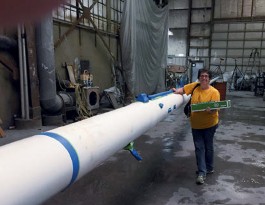
With her unstayed mast, our fractional-rigged sloop incorporates a much larger mainsail than is found on other 38-foot sloops (and with a lot of roach). We rely on our main. In preparation for our journey, we knew we needed to replace our 1991- vintage mainsail. We had a new main built by Ullman at their production facility in South Africa. We went with medium-weight cruising cloth and three reef points. We were very pleasantly surprised by the improved performance.
At the same time, we added an asymmetrical spinnaker on a top-down furler. But since leaving, we’ve found that because the Freedom’s mainsail is so large, we do most downwind sailing under main alone. And because of the 3⁄4 hoist on our fractional rig, the spinnaker is relatively small. We have used it only four times since departing.
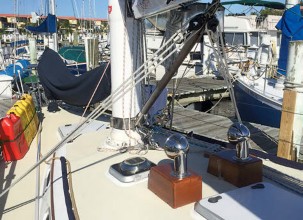
Because jibing with a massive main is no fun, we installed block-and-tackle preventers. Attached just aft of the rigid vang, they provide 4:1 purchase between the boom and the perforated toerail on either side. We lead control lines from cam cleats on the toerail to just outboard of the cockpit. In addition to controlling the boom in the event of an accidental jibe, the preventers help stabilize the boom when motoring in ugly seas. Being able to adjust the preventers without leaving the cockpit is an important safety feature.
Another safety consideration is preventing falling overboard. We set up jacklines in both the cockpit and along each side deck. Our rule is that when sailing at night or offshore, we’re clipped in.
Perhaps the most important safety item we purchased is a four-person offshore life raft. We have cruising friends who have opted to not install a life raft, reasoning that rescue is close at hand with an EPIRB and that their dinghy provides an adequate rescue platform should they need to abandon ship. I disagree. I think waiting for rescue in an open dinghy, halfway across the Gulf Stream, in a squall, and being tossed by huge standing waves, is neither safe nor secure. And if the EPIRB fails?
Anchoring
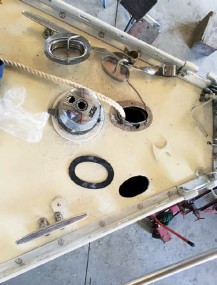
In 33 years of sailing on Lake Erie and nearby waters, I believe we anchored a total of three times. Our two-week vacations over the years involved sailing from marina to marina. Lacking any substantial anchoring experience, we really didn’t know how to prepare the boat, and we didn’t give it enough consideration during our initial refit. We did replace our old plow anchor with a 35-pound Manson Supreme, having read that the new generation of roll-bar anchors have excellent setting and resetting qualities.
And while the Manson performed admirably during the times we used it, at the end of our first year cruising, after a respected sailing friend referred to a heavier anchor as a sleeping pill, we exchanged the Manson for a 44-pound Rocna. We haven’t looked back; it can blow in the Bahamas.
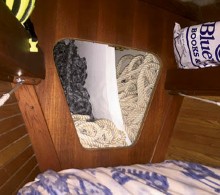
After departure, we also added a Davis Instruments anchor-line snubber and a Mantus chain hook. And it was on our way south, after anchoring in the muddy Chesapeake, that we learned we needed a deck washdown hose. There were times when so much mud came up on the chain that its shape and size were completely unrecognizable. I installed the pump in the head and T-ed off the existing raw-water intake. Now that everything is dialed in, we can only wonder what took us so long to discover the joys of anchoring.
Of course, anchoring out creates a need for getting ashore. There are many high-quality RIB dinghies on the market and most people we talked to like the dinghy they own. We ended up buying a 9.5-foot BRIG RIB. To power it, we opted for a 4-stroke 6-horse- power Mercury. We chose this size because we knew we would be moving the engine back and forth between the dinghy and the bracket on Her Diamond’s stern rail. The two of us could manage the 6-horsepower Merc. But having lived with it, we’ve found the engine lacking in power. We can’t exceed six knots in calm conditions. After loading the dinghy with our folding bicycles, groceries, or additional passengers, or motoring into head winds or seas, she is substantially slower, too slow for us. A four-mile run to a neighboring island for snorkeling becomes a very long trip. We should have added an outboard hoist to the stern rail and purchased a 9.9-horse- power outboard.
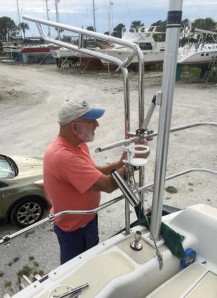
Transporting our dinghy yielded challenges we could not have anticipated prior to our transition from occasional daysailors to liveaboard cruisers. On our previous boat (a Freedom 30), we’d been happy with the Dinghy-Tow for years of Lake Erie sailing. The Dinghy-Tow is a great system that allows the dinghy to be towed transom-to-transom with the mother boat. The system lifts the dinghy stern well above the water and only the dinghy bow drags behind. In this way, the engine can remain on the dinghy when being towed. Before leaving the Great Lakes, we ordered and installed a Dinghy-Tow unit on Her Diamond. This was a mistake.
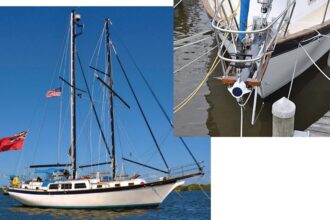
We’ve since removed the system and installed a set of Garhauer davits in its place. The davits are a better and more secure way to carry the dinghy for the kind of traveling we are doing. Deploying and retrieving the dinghy from davits is much easier and we’re relieved of the 1⁄2-knot penalty in drag.
At this point, we’ve spent over three times our original $24,000 refit budget (final refit tally is about 60% of our boat’s market value). While that may seem crazy, we can justify it knowing that we’ve ended up with a boat in very good condition, and one with which we are familiar and comfortable. It’s hard to put a price on that. As I write this, we are getting ready to leave Charlotte Harbor to return to the Bahamas (via the Keys) for another winter. Our good old boat continues to get better with each passing year. And in this sailing retirement life, it seems like the same might be true for us.
Bob Allenick has held a 50-ton USCG Master License since 2013. He and Sheila both grew up sailing and have been sailing together on their own keel boats since 1986. Bob and Sheila left Cleveland on July 23, 2017. Their blog and tracking map can be found at herdiamond.net.
Thank you to Sailrite Enterprises, Inc., for providing free access to back issues of Good Old Boat through intellectual property rights. Sailrite.com