Singlehanded to Grenada in a Tartan 33
Issue 68 : Sept/Oct 2009
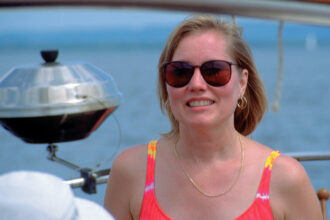
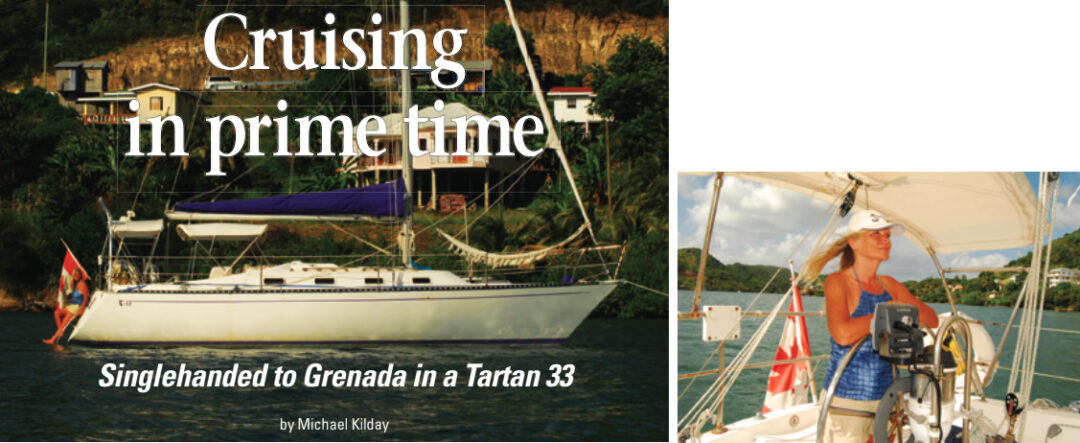
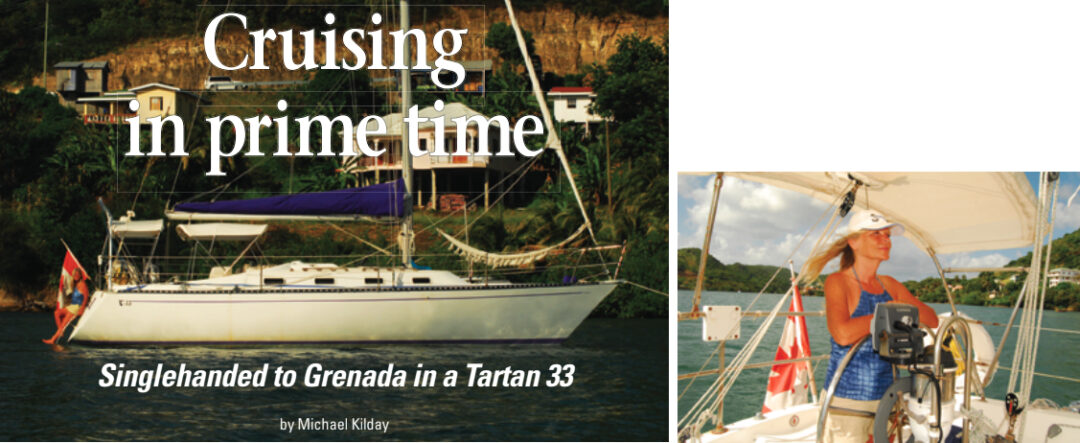
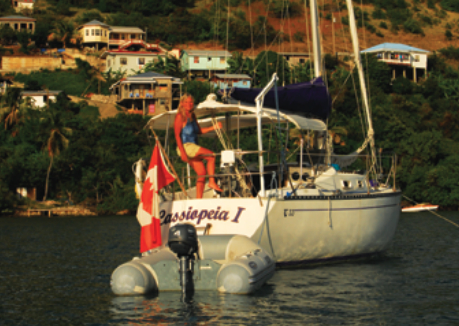
“Two ladies in the prime of their lives.” That’s how Mina L’Ecuyer (pronounced MY-na Lek-WEE-a) describes herself and her 1982 Tartan 33, Cassiopeia I. Mina, a retired laboratory worker from Ontario, Canada, was halfway through her singlehanded transit of the Caribbean, having sailed from Florida to Grenada, West Indies.
After retiring, and with her two sons grown, Mina said she needed something to challenge her. “I was bored and didn’t want to look back later in life and realize I had developed a case of the ‘shouldas’ — I should have done this or I should have done that.”
From the time she was a young woman, Mina had dreamed of sailing her own boat to tropical isles. She even bought a sextant and kept it in her hope chest.
“My father had been in the Navy. When we went out in our boat together, he could always tell where we were — even in the fog — and he always knew what time it was just by looking at the sun. I thought that was magical. I wanted to be a sailor so I could do those things.”
She still has the sextant — though she admits that celestial navigation is the one boating challenge that has so far eluded her — but the hope chest is long gone. “No room for it on board,” she muses, “Anyway, my hopes came true.”
A need for challenges has been a constant in Mina’s life. Before ocean sailing came along, she was an accomplished diver and private pilot, and she sailed extensively on Lake Erie. When it came time to go to sea, Mina decided she wanted a Tartan 33. “I have good friends who own a Tartan 33 about the same age as Cassiopeia I. They spoke so highly of it I figured I should get one.”
A very suitable boat
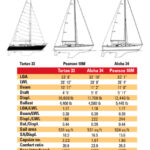
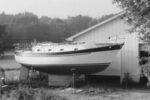
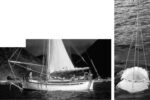
Cassiopeia I is hull #157 of the popular Tartan 33 line introduced in 1979. Cassi, as Mina calls her, is the cruising version with the Scheel keel and fractional rig. Mina feels that, with her easily handled rig and shallow draft, Cassi is well suited to singlehanded sailing in the Caribbean. Designed by Sparkman & Stephens, the Tartan 33 has proven itself as a weekend racer and as a sturdy coastal cruiser. And its designers have expressed confidence that, when properly equipped and sailed, it has offshore capability.
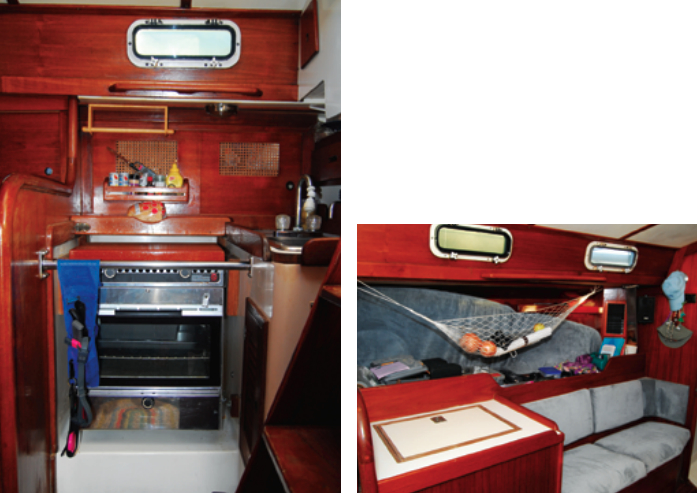
Although Mina would sail alone, the Tartan 33 was designed with a couple in mind. It has an adequate V-berth, an athwartships head with shower pan (some have suggested that the doors closing off the head from the saloon and V-berth could be more substantial) and an airy saloon with port and starboard settees and a fold-down bulkhead table. The port-side settee is truncated to allow room for the icebox while the starboard settee is long enough to be a berth. The galley is small, but it’s tucked out of the way of companionway traffic and sits opposite a 24 x 30-inch chart table and seat. The galley was originally equipped with an alcohol stove — Mina still swears by hers — but there is adequate space for upgrading to a kerosene or propane stove with an oven. Just aft of the navigation station is the quarter berth, which can be used as a sea berth or a favorite place to put those things that don’t fi t anywhere else.
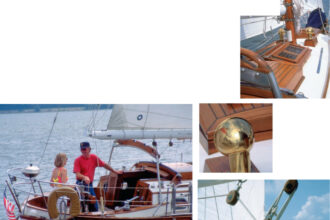
The Tartan 33’s cockpit is roomy without being too spacious for offshore work. It is in a T-configuration with the helmsman’s seat and sole canted for comfort when the boat is heeled. A 32-inch destroyer-type wheel with a 5-inch compass and engine controls mounted on the pedestal was standard for this design. Because the mainsheet traveler spans the cockpit just in front of the steering pedestal, moving around the aft end of the cockpit can be tricky, but it does keep all the essentials close at hand.
Moving about on deck is made easy by comfortably wide sidedecks and handholds on the cabintop. Those looking at this boat for serious offshore sailing should consider adding beefier handholds than the teak ones originally fitted. The single-spreader mast is keel-stepped and carries a sloop rig. While the Tartan 33 is not a large boat, the foredeck has good enough room for sail handling and working with the ground tackle, or for a hammock between the forestay and mast, a favorite spot of Mina’s for relaxing.
Hurried preparations
Mina found her Tartan 33 in St. Petersburg, Florida, and based upon the overall good condition of the boat and how it was equipped, she believes it had seen little more than occasional weekend duty.
“Friends told me I should take a year to learn the boat and upgrade all her systems. I thought, ‘Heck no, I want to go sailing,’ ” Mina recalls with a smile. “It’s my nature to trust that things will work out. Now, after having cruised for 14 months, I haven’t really changed . . . but I am not recommending my approach to everyone.”
Mina says some of the problems she faced during this voyage could have been avoided had she had more time with the boat and its equipment before heading offshore. However, she believes it was better to be sailing the boat than working on it. Driven by the need to leave the United States in time to comply with Florida’s sales tax regulations, Mina addressed what she felt were the boat’s most pressing issues and decided to attend to others while under way.
Purple highlights
One job Mina did not want to delay raised a few eyebrows at the local canvas shop. She wanted Cassi to look like a “proper lady.” She painted the sheer stripe bright purple and ordered a new mainsail cover in the same color. After agreeing reluctantly, the shop’s staff seemed to get into the spirit of “feminizing” Cassiopeia I. Not only did they make her a purple sailcover, they lined it in flaming pink.
“It looks like something out of a Victoria’s Secret catalog,” Mina says with a laugh.
Like most fractional-rigged boats, the Tartan 33 has a large main that must be reefed early to ensure a comfortable ride. “I always start out passages with a reef in the main. It often stays there.” Mina says. “Up front, I only use the furling genoa. I have two spinnakers, but they haven’t left their bags.”
Before leaving St. Petersburg for Key West, from where she went on to Cuba and the Caribbean, Mina had no experience either in offshore sailing or maintaining a cruising boat. But she did prepare. She took classes in sailing, navigation, engine repair, seamanship, and marine electronics from the London Power & Sail Squadron in Canada.
Look for the book
“My mantra is, ‘Where’s the book?’ ” Mina exclaims. “Anytime there’s a problem, I go looking for one of my handy dandy fix-it books. Then I spend a day or so in my bunk reading everything I can about the problem. Then I go fix it . . . or try.” She can recall only one or two times when she had to call in professionals to fix something on her boat.
For a woman sailing a small boat alone, the most common question is, “Are you scared?”
“No,” Mina answers, adding, “ I’ve always been independent. I was a single mom, so I’m used to doing things myself. And I trust my boat.”
Being a woman singlehander also raises some interesting problems and prompts inventive solutions. When Mina went shopping for new boat batteries, for example, she didn’t study their amp-hour ratings. Instead, she went into various marine stores and tried picking up each battery. Since she would have to carry it back to the boat and install it herself, her buying criterion was simple: “Which one can I lift and carry?”
When she had finished all the work she could in the time available, Mina sailed from St. Petersburg to Key West, Florida. Reaching Key West was relatively easy, but getting to her next stop, Cuba, which entailed crossing the Gulf Stream, was a much bigger challenge. She had made one small oversight in her preparations: she had no charts for Cuba. But Mina was not deterred. With only the coordinates of Havana Harbor plugged into her chart plotter, she set off.
There was a further glitch in her plan, however. Mina had assumed that Marina Hemingway would be in Havana. It isn’t. It’s about 10 miles away and, while Cuba has become more open to visitors, its officials still frown on anyone sailing into Havana Harbor without permission.
Unwelcome in Havana
With fenders out and lines made ready, she sailed triumphantly into Havana Harbor. Mina was thrilled to have successfully made her first ocean passage. She had seen her first wild porpoises and Cassi had behaved like a true lady.
“‘We did it!’ I thought. If I could have got my arms around her I would have hugged my boat,” Mina says.
The Cuban officials were kind enough to take her lines before informing her that she must leave immediately. She must go to Marina Hemingway. “Isn’t this Marina Hemingway?” Mina asked sheepishly. “No,” they told her, “the place you are looking for is up the coast.” While the officials were clear about her having to leave, they were frustratingly foggy about where Marina Hemingway actually was. Pointing up the coast, they gave Mina their best guess.
By this time, Mina had gone two days without sleep. Groggy, and still not sure where she was heading, she took in her lines and sailed out of Havana Harbor.
Soon she could see masts, and thought that she had at last found the elusive Marina Hemingway. After tying up and being visited by Cuban customs, immigration, health, and even a drug-sniffing dog, she was again informed that she must leave immediately and move to Marina Hemingway.
Just let me sleep
“I couldn’t believe I’d have to go back out again,” Mina remembers, “ I begged them to just let me sleep. Then I would move. They wouldn’t budge but then I sensed something was up. They were all smiling.” Pleased with their joke, they told Mina she only had to move a few hundred yards to be in the marina proper.
Mina cruised the coast of Cuba for three months before continuing on to Jamaica, the Dominican Republic, a quick stop in Haiti, and then to Puerto Rico, the U.S. Virgin Islands, the British Virgin Islands, and down through the Leeward and Windward islands to arrive in Grenada — her most southern position — in July 2008.
While Mina is pleased that Cassiopeia I suffered no real problems on the way to Grenada, she herself had a few “moments.” As she passed through the British Virgin Islands late one afternoon, Mina spotted a large rock off her bow. Nothing on her charts indicated any rocks or shoaling in the area.
“I thought, ‘If there is one rock, there must be more.’ I swung the boat hard over with my heart in my throat. As I passed, the ‘rock’ lazily made a half roll and disappeared. It was a sea turtle,” Mina remembers, adding: “You can’t possibly print what I said to that turtle!”
Mina also learned a lot about anchoring during her southbound trip. Unfortunately, she says, she learned it the hard way.
“I lost two anchors because of inexperience,” she says. “I was down to my last anchor when I arrived in Grenada. But I’m getting the hang of it now.”
Steering by hand
Because of autopilot failure (both the primary and backup failed between St. Petersburg and Jamaica), Mina was forced to hand steer most of the way to Grenada except for those times when the wind direction allowed her to tie off Cassi’s wheel for short periods. She also lost the use of her chart plotter for a time after it was soaked by a sea splashing into the cockpit. Mina was able to get the chart plotter working again, but her fix-it books couldn’t save the autopilots. After they failed, even short passages became drudgery.
“I’d got really tired. And I couldn’t leave the helm long enough to make a decent meal. I ate a lot of peanut butter and crackers . . . not a healthy diet,” Mina says. “By the time I arrived in Grenada, I just wanted to be away from the boat. I didn’t want to be responsible for everything anymore. I bought a Stephen King novel and lay in my bunk and read for four days.”
Another problem Mina faced was entering the Caribbean as summer approached.
“I was really running late, with the hurricane season on top of me. It’s one of my regrets that I didn’t have more time to spend in the islands I visited and had to miss several islands I wanted to visit.” Mina says. “When I return north this winter, I plan to take my time and enjoy more of the islands.”
She faced her only serious sailing crisis shortly after leaving Grenada during an overnight sail to the island of Carriacou.
“Cassi felt funny about halfway to Carriacou. I couldn’t pin down what the problem was, but the boat just felt different,” Mina remembers.
A close call with the rig
After a night spent pounding into strengthening trade winds, Mina and her Tartan 33 arrived in Carriacou and anchored in Tyrell Bay. As Mina dropped the mainsail, the lazy-jacks dropped too. The lazy-jacks were not supposed to come down.
“Maybe the Lord wanted me to look up, because when I did, I immediately spotted a problem with the spreaders. They were coming loose from the mast.” Mina recalls.
A closer inspection showed that both spreaders had come loose at the U-shaped bracket that holds them to the mast. One of the two bolts that secures each of the opposing spreader brackets to the mast had broken and the stress that resulted had bent the remaining bolt and the brackets themselves. Mina has no doubt that, had the second bolt also broken during Cassi’s beat to windward during the night, the rig could have come down.
To make matters worse, the stainless-steel strap that held the shroud to the outboard end of the starboard spreader had failed from corrosion. With help, Mina removed both spreaders and had them rebuilt with new hardware. While she was at it, she replaced the boat’s lower shrouds, which were beginning to show wear.
Mina blames the failure on the rig’s age and her own failure to do a more thorough rig survey before leaving Florida. Owners of Tartans of a similar age should carefully inspect all rigging, hardware, and connections before venturing offshore.
“I could have lost everything out there. Cassi and I were very, very lucky,” Mina says.
While no one should discount luck in any voyage, Mina now recommends augmenting it with careful preparations. As a famous athlete once said, “The more I practice, the luckier I get.”
A dream fulfilled
Was it all worth it? The planning, the boat work, sailing alone far from home? For Mina, the answer is yes.
“I haven’t lost the thrill of waking up in different places: new people, new foods, new everything. It has definitely lived up to my dream.”
Mina’s cruising plans will take her back through the Windward and Leeward Islands and then to Florida to store Cassiopeia I until the end of the 2009 hurricane season. Then what?
“Back to the Caribbean!” she exclaims.
Mina would be the first to say that there may have been things she should have done differently in preparing for and carrying out her Caribbean voyage. But, as far as she is concerned, she took care of the most important “shoulda.”
She went.
Michael Kilday and his wife, Donna, are circumnavigating the Caribbean piecemeal during time off from their jobs. Michael has been sailing for 30 years, in the Pacific, Caribbean, and Atlantic.
Thank you to Sailrite Enterprises, Inc., for providing free access to back issues of Good Old Boat through intellectual property rights. Sailrite.com